
For over 125 years, Country Life magazine has chronicled the architecture, gardens, and social world of rural Britain. From stately homes to parish churches, from landscape design to country sports, the publication has become the definitive record of British heritage.
In this episode of the Anglotopia Podcast, host Jonathan Thomas speaks with John Goodall, the magazine’s architecture editor. His insights into British building history, the editorial process behind Country Life, and the state of heritage preservation offer a masterclass in understanding Britain’s built environment.
The Bible of British Architecture
Country Life was first published in 1897, and from the beginning, architecture has been central to its mission. The magazine’s country house features—detailed explorations of historic homes, their histories, and their owners—have created an unparalleled archive of British domestic architecture.
John’s role as architecture editor means examining buildings with both scholarly rigor and genuine passion. Each feature involves extensive research, site visits, and careful photography. The goal isn’t just to document—it’s to understand. Why was this house built? How has it evolved? What does it tell us about the people who lived here and the times they inhabited?
The magazine’s photographic archive, accumulated over more than a century, has become a resource of national importance. Images captured decades ago often show buildings in states long since altered, making Country Life an invaluable tool for restoration and research.
Understanding British Architectural History
Britain’s buildings tell a continuous story from medieval times to the present. John traces the evolution: the great medieval halls that established domestic patterns, the Tudor innovations in privacy and comfort, the Georgian embrace of classical proportion, the Victorian eclecticism that borrowed from every era.
Each period left distinctive marks on the landscape. Medieval buildings cluster around churches and market squares. Georgian crescents speak of urban planning and social ambition. Victorian piles announce industrial wealth and romantic nostalgia. Understanding these patterns transforms how you see Britain.
John emphasizes that architectural history isn’t just about grand houses. Parish churches often contain the most authentic medieval work in their communities. Vernacular buildings—farmhouses, cottages, barns—reveal how ordinary people lived. The complete picture requires attention to all scales of building.
The Editorial Process
Selecting buildings for Country Life features involves balancing multiple considerations. Architectural significance matters, but so does narrative interest. A perfectly preserved Georgian house might be less compelling than a medieval manor whose alterations tell a story of changing fortunes.
Access is crucial—many of Britain’s finest houses remain private homes. Building relationships with owners, gaining their trust, and ensuring the magazine represents their properties fairly all require diplomacy. The resulting features must satisfy scholars while remaining accessible to general readers.
Photography presents its own challenges. Historic interiors often have complicated lighting. Exteriors must be captured in the right conditions—the right season, the right weather, the right time of day. A single feature might require multiple visits over months.
Heritage Under Pressure
The threats to British heritage are numerous and growing. Development pressure converts historic buildings into modern uses, sometimes at the cost of their character. Maintenance costs overwhelm private owners. Climate change damages stonework and destabilizes foundations.
Yet John sees reasons for optimism. Public appreciation for heritage has never been higher. Organizations from the National Trust to local preservation societies work tirelessly. Skilled craftspeople maintain traditional techniques. The challenge is ensuring these resources match the scale of the need.
The heritage sector faces particular challenges in funding. Government support fluctuates with political priorities. Private philanthropy, while generous, can’t cover everything. Commercial approaches—tourism, events, filming—help but bring their own pressures.
The English Country House Today
The classic country house faces an existential question: what is it for? The agricultural estate that once justified its existence has largely vanished. The servant class that made it function has disappeared. The tax regime that allowed wealth accumulation has been transformed.
Different owners have found different answers. Some open to the public, reinventing themselves as tourist attractions. Others find commercial uses—hotels, wedding venues, corporate retreats. Still others maintain private occupation, accepting reduced circumstances as the price of family continuity.
John argues that there’s no single right answer. What matters is that buildings remain in use, adapted sensitively to contemporary needs while preserving their historic character. A country house as a successful hotel beats a country house as a picturesque ruin.
Gardens and Landscape
Country Life has always given gardens equal billing with architecture. The two are inseparable—a house without its landscape is incomplete, and understanding designed landscapes requires the same historical knowledge as understanding buildings.
Britain’s garden history parallels its architectural history. Tudor knot gardens gave way to Stuart formality, which yielded to the Georgian landscape movement. Victorian plant hunters transformed what was possible, while 20th-century designers created new syntheses of formality and naturalism.
Climate change is reshaping what can be grown where. Species once marginal now thrive. Others, long reliable, struggle with altered conditions. Gardens must adapt, though always within the framework of historic design intent.
Reading Buildings
John offers advice for developing architectural literacy. Start by observing—really looking at buildings, noticing their details, questioning their features. Why are the windows that size? Why does the roofline have that shape? Why are the materials arranged that way?
Every feature has a reason. Windows shrink and grow with changing fashions and taxes. Rooflines reflect structural methods and local materials. Wall treatments speak of status and regional tradition. Reading these clues turns every building into a document.
Local history resources help fill in context. Parish records, old photographs, maps from different eras—all illuminate how buildings and their communities evolved together. The story of a building is always also the story of the people who built and occupied it.
The Future of Heritage
Looking ahead, John sees heritage increasingly valued but increasingly threatened. The public understands, as previous generations did not, the irreplaceable nature of historic buildings. But pressures from development, climate, and economics continue to intensify.
Technology offers new tools for documentation and interpretation. Digital recording can capture buildings in unprecedented detail. Virtual access can share heritage with those who can’t visit in person. But technology can’t replace the thing itself—the authentic fabric that connects us physically to the past.
The fundamental challenge remains human: persuading each generation that heritage matters, that the buildings we inherit deserve protection and transmission to the future. Publications like Country Life play their part, but the work requires everyone who cares about Britain’s built heritage.
—
Want to hear more about British architecture and the stories behind Country Life magazine? Listen to the full episode of the Anglotopia Podcast wherever you get your podcasts.
The Anglotopia Podcast is your deep dive into the rich and diverse world of British culture, hosted by Jonathan and Jacqueline Thomas, publishers of Anglotopia.net and Londontopia.net. Each episode takes you on a journey through iconic British television, captivating historical events, and essential travel tips, ensuring you experience the very best of the British Isles. Our engaging discussions feature important British guests and authors, covering everything from the latest trends and timeless traditions to hidden gems and popular landmarks. Whether you’re a passionate Anglophile or simply curious about the UK, our podcast offers a delightful mix of insights and entertainment. Join us as we celebrate the charm, heritage, and unique allure of Britain, making every episode a must-listen for anyone who loves all things British.
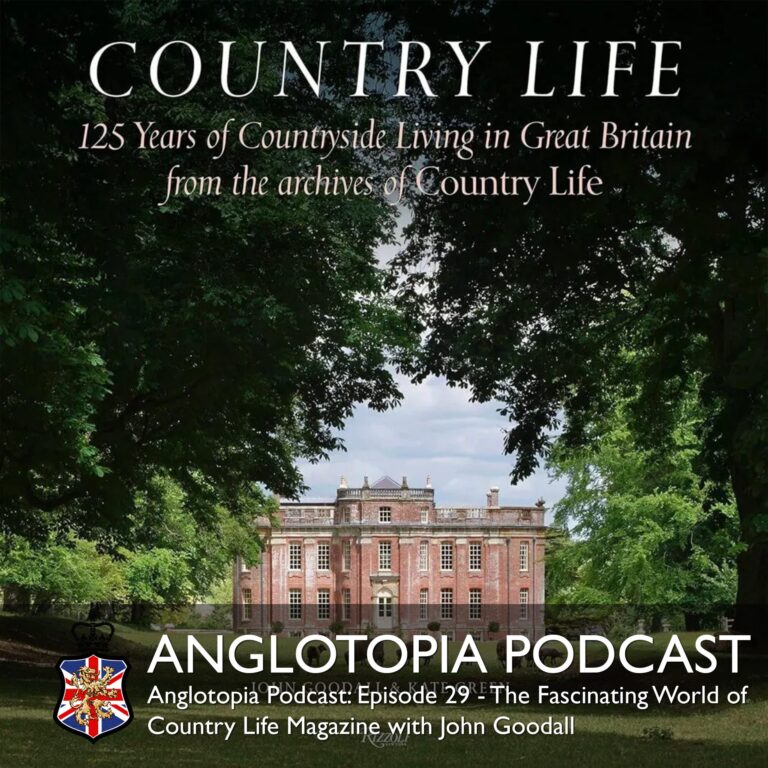
In this episode of the Anglotopia Podcast, we interview John Goodall. John Goodall is the architectural editor of Country Life magazine, responsible for producing weekly articles on country houses in Britain and abroad. He has a background in medieval architecture and has written guidebooks for English Heritage. Goodall became interested in architecture while living abroad and developed a fascination with medieval buildings. He enjoys the privilege of visiting and writing about a wide range of country houses, meeting interesting people, and commissioning high-quality photography. He believes that country life is a national treasure and values its role as a historical record. In this wide-ranging discussion, we talk about his work, architecture, Britain’s heritage legacy, and American architecture as well.
Links
- Country Life: 125 Years of Countryside Living in Great Britain from the Archives of Country Life
- Country Life Magazine
Takeaways
- John Goodall is the architectural editor of Country Life magazine, responsible for producing weekly articles on country houses in Britain and abroad.
- He has a background in medieval architecture and has written guidebooks for English heritage.
- Goodall became interested in architecture while living abroad and developed a fascination with medieval buildings.
- He enjoys the privilege of visiting and writing about a wide range of country houses, meeting interesting people, and commissioning high-quality photography.
- He believes that country life is a national treasure and values its role as a historical record.
Sound Bites
- “I became interested in buildings when I was living abroad and latterly, we served in India and that’s a place that I began to look at buildings that seemed completely different to anything I was familiar with.”
- “One of the things I love about traveling to Britain is that we can see old things.”
Chapters
- 00:00 Introduction and Discussion of Recent Events
- 02:41 The Editorial Process for Featuring Houses in Country Life Magazine
- 06:00 Preserving the Historical and Cultural Significance of Architectural Landmarks
- 11:12 Addressing Problematic Histories and Heritage Conservation
- 27:00 Challenges Faced by Country Houses and the English Countryside
- 46:29 Exploring British Heritage and Architecture
- 46:58 Appreciating the Beautiful Architecture in the Midwest and the US
- 47:22 Discovering Fascinating Country Houses in Country Life Magazine
YouTube Video

Free Podcast Newsletter
Subscribe to our special podcast newsletter below and never miss the latest episode of the Anglotopia Podcast.