
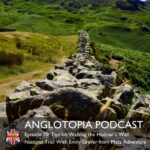
From the Anglotopia Podcast: Episode 70
There are few walks in Britain that ask you to step so completely out of the present and into the deep past as the Hadrian’s Wall Path. For 84 miles it runs coast to coast across the narrow neck of northern England, tracing the line of the stone frontier that the Emperor Hadrian ordered built in AD 122 to mark the northernmost edge of an empire that once reached from Scotland to the Sahara. To walk it is to put one foot in front of the other along a route the Roman legions themselves laid out nearly two thousand years ago, from Wallsend in the east to Bowness-on-Solway in the west.
In this episode of the Anglotopia Podcast, host Jonathan Thomas laced up his hiking boots, at least virtually, to talk to someone who has actually done it. Emily Graver is an adventure operations specialist at Macs Adventure, where she has spent more than three years crafting self-guided walking and cycling holidays across some of Britain’s greatest trails, from the windswept Outer Hebrides to the rugged Pembrokeshire Coast Path. Based in Glasgow and a self-confessed history nerd, Emily has not only walked the full 84-mile Hadrian’s Wall route herself but has helped train her entire team on it.
The conversation carries an extra charge because Jonathan is not asking hypothetically. He is planning to tackle the walk himself next summer, and he came to the interview armed with the questions of a man who buys every guidebook before he does anything. What follows is an insider’s field guide to walking the wall: how to plan it, how to prepare for it, when to book, what to pack, and which hidden gems only the experts know about.
Two Thousand Years of History on One Wall
Ask Emily what she loved most about the walk and the history nerd comes straight to the surface. “It basically spans like 2000 years of history, all on this one wall,” she said. “You just can’t quite comprehend it.” The Roman frontier is the headline act, but it is far from the only story written into this landscape. The path also carries the memory of the Anglo-Scottish conflicts and the border reivers, the raiding families who once came south across the Solway to steal cattle and slip back over the border again. It all sits together, layer upon layer, on a single line drawn across the country.
Geographically, the trail is a study in contrasts. It runs from Newcastle in the east, a real and busy northern city, all the way across to Bowness-on-Solway in the west, where the walk drifts through little villages and hamlets and, near the end, a nature reserve. “You’ve got two like contrasting kind of geographical land masses,” Emily explained, and the pleasure of the route is in watching one give way to the other. As for the climate, she offered the one guarantee anyone contemplating a British long-distance walk should internalize early: the weather is unpredictable, and you need to pack for all seasons. “But that’s just, that’s British weather,” she laughed. “And we love talking about the weather. That’s like our passion.”
The Biggest Mistake First-Timers Make
When Jonathan asked about the single biggest planning error people make, Emily did not hesitate. “The biggest mistake people make is they underestimate the level of walking that’s involved.” This is not a gentle stroll. Depending on your itinerary you may cover 15 to 30 kilometers a day, and the terrain is relentlessly, if modestly, vertical. “It’s also very hilly. There’s a lot of ascent and descent,” she said. “It’s not like big mountains, but it’s just constant rolling hills.” Expect a great deal of farmland, and yes, expect cows. Emily admits she is not the biggest fan of them, though she was quick to reassure nervous walkers: the cattle are so used to seeing people on the trail that they simply keep their distance.
The good news, as Jonathan pointed out, is that even the leisurely eight or nine day plan tops out at around 15 miles in a single day. That is still a lot of walking, especially up and down hill, but it is manageable with preparation. And preparation is where Emily gently steers everyone. If you have a whole year before your walk, she said, that is more than enough time to work up to it, provided you actually use the time.
Getting Fit and Getting the Right Boots
So what fitness level do you really need? Emily’s benchmark is refreshingly concrete. “The ideal fitness level is like if you can go a day walking 10 miles, then you should be fine.” You do not have to walk ten miles every day to train. Managing a single ten-mile day on a weekend is a good sign you will be ready by the following year. Jonathan, who lives in Indiana near a national park with an 18-mile trail, reckoned he could manage it, and Emily agreed that if he could knock out that distance in a day he would be more than fine.
Her one crucial refinement to the “just walk a lot” advice is to practice on hills, not just flat ground, because the constant undulation of the wall is what catches people out. And then there is the matter of footwear, where Emily offered one of the interview’s best insider tips. She recommends packing both a pair of proper hiking boots and a pair of trainers. The reason is the surface underfoot: parts of the route run along tarmac or asphalt, and hiking boots can be punishingly hard on the feet over that kind of ground, whereas trainers are far better suited to it. Jonathan seized on the detail immediately, noting that if you walk west to east from Bowness-on-Solway, the first ten miles or so is essentially an asphalt path along a road. “We need the trainers,” Emily agreed. “For sure.”
How Self-Guided Walking Actually Works
For anyone unfamiliar with the concept, Emily walked through exactly what a company like Macs Adventure handles. The idea of self-guided walking is that everything except the walking itself is taken care of. They book all your accommodations, they move your luggage from place to place, and they are on call if anything goes wrong. Crucially, they also offer a range of itineraries pitched at different fitness levels and time budgets.
The shortest option is a six-day itinerary for fit walkers determined to do the whole thing in longer daily stages. There is a highlights-only version for those with just a few days. And for people who want to walk the entire route but really savor it, there is a nine-day itinerary that spreads the mileage out so the days feel far less intense. Underpinning all of it is a navigation app that Emily returned to again and again as the secret weapon of the whole experience. “You literally just have to follow the dot and it like vibrates. If you go off the path, it’s so useful.” Beyond navigation, the app suggests where to stop, recommends places to eat, and flags the sites worth seeing, and on the Hadrian’s Wall route there is at least one such site to see every single day.
Jonathan, who confessed he leans toward the leisurely nine or ten day version precisely because there is so much he wants to see, put his finger on the appeal. If you are only focused on the walking, he said, you will completely miss everything there is to see along the way. Emily framed the value of the service in emotional terms as much as logistical ones. “We really just take away the stresses and pains of travelling, like you just get to focus on what you actually want to do, which is have a lovely time.”
When to Book, and When to Walk
If there is one piece of practical advice from this episode that walkers should act on immediately, it is this: book early. Alarmingly early. “May and September, it’s crazy,” Emily said. “May is booking up a lot for people, very keen people that are ready to go on holiday for next May. It books up really, really quickly.” The reason is simple math. The accommodations along the wall are small and limited, so availability disappears fast. Book now, Emily advised, and Macs can secure you priority on the places that are genuinely on the path, and honor your preferences about the style of place you want to stay. Leave it a few months and you may find yourself booked into a village off the route with a taxi transfer to bridge the gap.
As for timing, May and September are Macs’s recommended windows because you are close to guaranteed good weather. Emily herself did the walk in April and, in her words, really lucked out, though she also managed to get sunburned on exactly one half of her face because of the direction of the sun. Jonathan is likely to be walking in late June or early July, tied to when his kids finish school and the family makes its trip to the UK, and Emily reassured him he should be absolutely fine. The bonus of walking in high season is company. “There’s going to be quite a few people on the trail,” she said, “and if you’re looking for camaraderie and like a shared experience, that’s exactly what you’re going to find.” Because the accommodations exist specifically for walkers, she added, the whole atmosphere is warm and welcoming. “They know what you’re about. They enjoy having walkers there. And you just get to meet other people.”
East to West or West to East?
This was the question Jonathan called the most important one he had, and it is the great debate of every Hadrian’s Wall guidebook. His shelf of three or four books splits down the middle; some champion the eastern route, some the western. Emily walked it east to west and prefers that direction for reasons that are as much poetic as practical. “You’re going from like quite a busy city, Newcastle, and then you’re slowly walking towards like really peaceful areas,” she said. There is a satisfaction in moving from the busyness to the quietness, and there is something more: you are following the route the Romans took, because they began building at Newcastle and worked their way across. “It feels like you’re walking through time,” she said. The path was also originally designed to be walked east to west.
The counterargument is meteorological and topographical. Walk east to west and you are heading into the prevailing wind and on a very slight uphill gradient the whole way. Walk west to east and the wind is at your back and the ground trends gently downhill. For an easier physical experience, the west-to-east direction wins. Jonathan found himself genuinely torn, drawn to the romance of walking out of the city into open countryside, a transition he compared to leaving Chicago and hitting open fields within ten miles, yet mindful of the practical case for keeping the weather at his back. Emily, ever the historian, offered the tiebreaker with a grin: “Don’t you kind of want to walk in the footsteps of the Roman soldiers?”
The Toughest Stretch and the Best of the Wall
Having trained her team on the route, Emily knows exactly where people get caught out. The most challenging section runs between a cute little village called Once Brewed and the Haytongate turn-off. It is very, very hilly, and because accommodation there is so scarce, it can stretch up to 30 kilometers. The nearest beds are at Lanercost, next to Haytongate, but walkers often have to be booked into Brampton instead, which adds three miles and pushes the day to around 18 miles total. “It’s a lot,” Emily admitted, but she insists it is worth it, not least because Lanercost has a genuinely interesting Norman priory. There is history in the stones, too: Edward I, the king known as the Hammer of the Scots for his relentless campaigns against the Scottish borders, actually died near there. If the distance defeats you, Emily noted, you can always call a taxi, a remark that had Jonathan cheerfully predicting he would have one on speed dial.
For those who cannot spare the time for the whole thing, Macs offers a “Best of Hadrian’s Wall” itinerary of about four or five days. It includes a stay in Corbridge, which is not on the official path but sits beside the site of a Roman town you can visit, roughly a mile from the modern village. From there the route runs Corbridge to Carlisle to Brampton and captures the best bits of the walk. Jonathan, characteristically, declared he still has to do it all. And for the many people who want to see the wall without walking it at all, he reminded listeners of the wonderfully practical infrastructure: the Hadrian’s Wall bus follows the line of the wall, letting you hop off at the best spots and back on again, while major railway stations anchor each end.
Packing, Luggage, and the Small Things That Matter
Macs works with a local luggage company that specializes in transferring walkers’ bags along the Hadrian’s Wall path. You simply drop your bags off by 9am and they travel by van from one accommodation to the next, ready and waiting when you arrive. There is a weight limit, somewhere around 18 to 20 kilograms, and the operator is flexible about storing bags or holding extra luggage. Emily gave a warm shout-out to Mark, the man behind the van, whom she clearly regards as an unsung hero of the whole operation.
For the day pack itself, Emily’s essentials come down to a memorable short list. First, snacks, which she is emphatic about. Second, waterproofs: a rain jacket, waterproof trousers, and ideally an elasticated waterproof cover for your day pack, because the weather will change. Third, plenty of water, and here she reassured refillable-bottle users that British tap water is completely safe to drink. Cafés are usually happy to fill your bottle, and water points and taps crop up along the way, clearly signposted if for any reason the water is not safe. The one item people consistently forget, and the one Emily learned the hard way, is blister plasters. On her own walk her feet were so sore that a kind lady at an accommodation called Vallum Lodge in Bardon Mill gave her a pack of her own. Blisters, Emily warned, may happen no matter how much you train. Her feet, she had hoped, would “just harden into like shoes,” but it did not happen. Sun cream rounds out the list, and, as Jonathan sensibly added, several of these items are things you may simply want to buy on arrival rather than carry through airport security. Starting in Newcastle makes that easy; it is a major city where you can pick up anything you forgot.
A Typical Day, and Where You’ll Rest Your Head
The beauty of self-guided travel, Emily said, is its flexibility. You get up whenever you want and set off whenever you want; the day is entirely in your hands. Breakfast is usually served between eight and ten, and Emily’s own preference is to start walking around nine, after a big full English, then stop along the way at cafés and museums before checking into the next hotel to relax and have an evening meal. Your bag is already there waiting. The next morning you leave it downstairs to be collected and do it all again. She did warn, with feeling, that the full English breakfasts are so enormous, all sausages, bacon, eggs and often black pudding, that she rarely needed lunch afterward and could simply power on through.
As for accommodation, Macs works with bed and breakfasts, guest houses, inns (which are essentially pubs with rooms), restaurants with rooms, and hotels. Emily was honest that on Hadrian’s Wall the opportunities to upgrade are limited, because the places are so small; you will not find the four and five star country hotels you might in the Cotswolds. What you get instead is something arguably more valuable. “You get to actually meet the people that live there and work there, and you get to know more about what it’s like to live in England.” Jonathan, drawing on his own experience, unpacked the distinctions for American listeners: a pub with rooms can be great fun and sociable but noisy above the bar until closing time; a bed and breakfast is usually in someone’s home, quieter and more personal; guest houses sit somewhere closer to hotels. Emily’s own loyalty was never in doubt. “I personally love a pub,” she said, and the family-run character of these places is, for her, the whole point. The owners “always got the gossip.”
Vindolanda and the Roman Soldier Who Wanted New Socks
When Jonathan asked for her most memorable moment, Emily could barely contain herself. The answer is Vindolanda, a Roman fort near Once Brewed that you can visit, complete with a museum devoted to life at the site. Inside are hundreds of pairs of Roman shoes and even armor the horses would have worn, but the treasures Emily loves best are the preserved handwritten wooden tablets, letters written by Roman soldiers. As she tells it, someone tried to burn a pile of them long ago, the fire failed to consume them, and sediment settled on top and preserved them perfectly. Among the surviving correspondence is a soldier writing home to ask his mother for a new pair of socks because it was so chilly on the frontier. “It’s so personal,” Emily said, “and it makes like 2000 years of history really, really relatable.” So significant is the find that the tablets are split between the British Museum and the Netherlands. Whenever anyone asks Emily the one thing they must do, her answer is instant: visit Vindolanda.
And Vindolanda is only the beginning of her list. In Newcastle, the Great North Museum devotes its biggest exhibition space to Hadrian’s Wall and provides exactly the background you need before you start, another argument, she noted, for walking east to west. Among its treasures are the tomb of a Palmyrene woman, a Syrian who married a Roman merchant based near Newcastle, rendered as a beautiful fusion of Eastern and classical design, and a statue connected to the temple of Mithras, the mysterious Persian god whose shrine you pass on the wall itself. There are the forts, too: Chesters near Chollerford, Birdoswald toward Carlisle, Housesteads, and beyond them Lanercost Priory, Carlisle Cathedral, and Carlisle Castle, which Emily notes is the most besieged castle in Britain. Even the three churches at Bowness have a story, having been turned into fortresses against the border reivers who raided across the Solway. For pubs and food, she highlighted the Crown Inn at Humshaugh near Chollerford, with its curious car-photo décor and the best steak she has ever had; the Twice Brewed Inn with its own attached brewery; and the Howard Arms in Brampton.
Weather, Safety, and Peace of Mind
British summer weather is not to be underestimated, as Jonathan can attest; he has told the story more than once of nearly getting hypothermia at an outdoor concert in July. Emily’s guidance on genuinely bad weather is sensible: use your judgment, and if it is truly torrential, do not force yourself to walk it, because wet surfaces and poor visibility can make it unsafe. The comforting truth is that you will miss very little. With the Hadrian’s Wall bus and the region’s excellent connections, a rainy day becomes the perfect excuse to visit one of the area’s many museums or archaeological sites, and, reassuringly, you still get your stamp in the walker’s passport at the checkpoints along the route. Besides, as both host and guest noted, British rain often lasts ten minutes and then switches off like a tap; find a café or a bus shelter, wait it out, and carry on.
Things can go wrong on any self-guided trip, and Emily’s answer to how Macs supports walkers came back, once again, to the app, which carries local taxi numbers, emergency services contacts, and all the background information you could need. Beyond that there is a genuine 24/7 safety net: a US office covers the phones through the British night, the UK team picks up by day, and a shared inbox means an email sent at nine in the evening can be worked on and resolved by morning. As Jonathan noted with some relief, that kind of round-the-clock support is exactly what will reassure his wife about him disappearing off to walk 84 miles alone.
Solo, Social, and the Insider’s Final Tip
Hadrian’s Wall is, Emily believes, a wonderful walk for solo travelers precisely because of the camaraderie of such a popular route. The unwritten rule is that when you pass someone, you say hello, you get chatting, you talk about the weather, and then it is on to the next person, and the next. “Although you’ll be solo, you’re never alone,” she said, and yet if you would rather walk in silence, that is entirely your right, because it is your journey. For groups, the one caveat is that limited accommodation can mean being split across two locations on a given night, something Macs cannot always prevent, though Emily reframes it cheerfully as simply more to talk about the next day.
Pressed for the one insider tip she always shares with her team, Emily’s answer was easy to guess by then: book an extra night in Once Brewed and go and visit Vindolanda. She also urged overseas visitors to look into an English Heritage visitor pass, available as a nine-day or sixteen-day option, which grants free entry to English Heritage sites across the whole of England and, given how many of the wall’s sites the organization runs, quickly pays for itself. On getting there, her advice is unequivocal: take the train. London to Newcastle is direct, Carlisle is well connected, and Manchester now offers easy rail links to both, whereas taxi drivers are understandably unwilling to make a two or three hour drive. And if the wall gives you the walking bug, Emily’s recommendation for your next adventure is the West Highland Way, 97 miles through the heart of Scotland and Macs’s single most popular trip.
What comes through most clearly across the whole conversation is that walking Hadrian’s Wall rewards exactly the qualities Emily embodies: curiosity about the past, respect for the terrain, and a willingness to plan ahead. It is a walk where a burnt Roman letter about a pair of socks can collapse two thousand years into a single human moment, where the best steak of your life might be waiting in a village pub papered with photographs of cars, and where, as Emily put it, you simply get to focus on having a lovely time. For anyone dreaming of following in the footsteps of the legions, her closing words were the best encouragement of all. As she said of the whole experience, you really need to go and see it.
—
Want to hear the full conversation? Listen to Episode 70 of the Anglotopia Podcast, with Emily Graver from Macs Adventure.


Never miss an episode
Free newsletter
New episodes, full transcripts and long-read articles on British history, travel and culture, straight to your inbox. Join 36,000+ fellow Anglophiles.
Unsubscribe anytime. We never share your email.


