
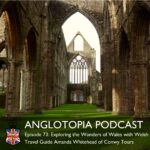
From the Anglotopia Podcast: Episode 73
Some corners of Britain hide in plain sight. For all the American travelers who have crossed the Atlantic seven times to walk the walls of York, wander the honey-colored streets of Bath, or lose themselves in the Scottish Highlands, there is one Celtic nation just over the border that most of them have never set foot in. Wales — three million people, a dragon on its flag, more castles per square mile than anywhere else in the world — remains one of the great overlooked destinations of the British Isles. And it has a champion.
On this episode of the Anglotopia Podcast, host Jonathan Thomas ventured west into the heart of Celtic Britain in conversation with Amanda Whitehead, an official Wales guide with a remarkable 25 years of experience showing North American visitors around her adopted homeland. Through her company, Conwy Tours, based in the north-west of the country, Amanda has become the go-to expert for Americans who want to go beyond the Cotswolds-and-Stonehenge circuit and discover a country that, as she puts it, “has everything.” What follows is a warm, funny, and deeply knowledgeable tour of Wales — its landscape, its language, its history, its castles, and its cooking — from someone who has spent a quarter of a century falling in love with it on other people’s behalf.
From Mountain Leader to Official Wales Guide
Amanda did not set out to become a talker. She started life as a mountain leader, guiding walkers through the peaks of Snowdonia, and only gradually discovered that she liked the talking as much as the walking. “I took my qualifications and I ran the two businesses side by side for a while,” she explained, “but now I’m getting a bit longer in the tooth. There tends to be a lot more of the talking and maybe a bit less walking — or certainly not as fast.” It is the kind of self-deprecating honesty that runs through the whole conversation.
Becoming an official guide, though, is no small thing. As Amanda explained, Britain is unusual: in much of Europe it is illegal to work as a tour guide without a license, but Britain is a “free state” where anybody can call themselves a guide. What Britain does have is a rigorous voluntary system of certification. To earn it, you study hard — one or two years, part-time or full-time — and you don’t just sit written exams on the knowledge. You have to pass practicals: guiding people around a religious building, leading a walking tour through a crowded town, commentating from a moving coach (“which of course you call a bus, but we call a coach”), and completing tour-planning projects. “It’s quite a hard hurdle to cross over,” she said. And in Wales there is one further distinction: the Welsh Government formally recognizes the qualification, which is why Amanda’s badge carries the word “official.” As Jonathan noted, it’s always good to be officially official.
Why Americans, and Why the Personal Touch Matters
Amanda’s specialization in North American visitors grew organically. She is, by her own admission, not a linguist — many guides work in a foreign language, but she found her affinity lay elsewhere. As a young woman she spent a year as an exchange student in America, and over the decades the industry did what it does: satisfied clients recommended her to their friends, contacts led to contacts, and a steady stream of North Americans and Australians began booking her services. “Thankfully, if you give them a good job, they come back,” she said. Today much of her work is with North American clients — individuals, couples, and larger tour groups traveling by coach.
What she loves most, though, has changed with the times. In the age of Wikipedia and Google, she noted, people no longer need a guide to tell them how many bricks are in a cathedral — they can look that up. What they want is interpretation and insight: why is it here, what do the locals think of it, how has it evolved? The tours she enjoys most now are the ones with a slight specialization, where she can bring her real expertise to bear. She recalled taking a group of firemen visiting from New York who quickly made it clear they had no interest in churches — what they wanted was to be taken to the local fire station for a cup of coffee with the lads. She has led pilgrimages for people interested in religious sites, and tours for visitors fascinated by the Druids and prehistory. “You’re not just taking people to places,” she said. “You’re introducing them to — you’re a hostess, really.” A good, experienced guide, she argued, is a matchmaker between the traveler and the people who can give them exactly the specialism they came for.
That flexibility is now finding new outlets. Amanda mentioned that only the day before recording she had spoken to a new online business called Contenta 360, which is trying to appoint experienced guides in every country in the world so that independent travelers can book an hour’s consultation. It solves an old problem: guides have always put together itineraries for people, but were only ever paid if the client subsequently hired them for a full day. Plenty of travelers prefer to drive themselves around in a hire car, and now there is a way for them to tap a local expert’s knowledge without committing to a full tour. “I thought that was a marvellous idea,” she said.
A Small Country That Is Bigger Than It Looks
One of the great themes of the conversation is the gap between how small Wales looks on a map and how much it actually holds. Amanda quoted an American visitor’s perfect summary of the difference between the two cultures: to an American, a hundred years is a long time; to a Brit, a hundred miles is a long way. That difference in mentality, she said, is enormous. Overseas visitors look at the size of Wales and assume they can dash from St David’s in the south-west up to the town with the impossibly long name in a single day.
The reality is different. Wales is about 180 miles from north to south, roughly 90 miles across at its widest and only 40 at its narrowest — a genuinely small country of three million people. But it is packed with river estuaries and mountain ranges, and it has just one motorway in the whole nation, so getting around takes time. Because Wales did not get its own parliament until 1990, the roads were historically built to run east into England rather than north to south within Wales itself. One of the first priorities of self-government was to improve the A470 — what Amanda called “the dragon’s back” — the road that starts in Cardiff in the south and runs all the way up to Llandudno in the north. Rail is workable but not fully joined up; as she noted, to travel from her home in North Wales to Cardiff she often has to dip into England first.
What that compact country contains, though, is staggering. Wales was the first nation in the world where you could walk the entire shape of the country, thanks to a coast path that rings the outside, plus the Offa’s Dyke long-distance trail. There are beaches, mountains, waterfalls, and rivers; there are steam railways you can actually use to travel; and there are castles — “more castles per square mile than anywhere else in the world,” many of them built by the English. Amanda was cheerfully unbothered by that fact: “We’re glad they did build them. We make lots of money out of them these days.”
“How British Can You Get?” — The Guide Who Chose Wales
Listeners with a sharp ear will notice that Amanda does not have a Welsh accent, and she is the first to address it. She was born in Scotland, brought up in England, and never lived anywhere more than three years until she moved to Wales in the 1980s, after a spell working around London. Wales, she said, “sucked me in like it does everybody.” Her own family is a one-woman survey of the British Isles: “I’m Scottish, my husband was English, my children were Welsh, and my daughter’s just married an Irishman — so how British can you get?”
Choosing Wales meant learning Welsh, which she has now been doing for 30 years. Her children, who learned it from nursery school onward, are completely fluent and take great delight in laughing at her — “but then a mother’s job is to be laughed at by her kids, and I do my best.” She gets by. It is a small detail, but it captures something essential about her approach: she came to Wales as an outsider and did the work of belonging, which is perhaps why she is so good at translating the country for other outsiders. As Jonathan told her, in his book that makes her Welsh enough.
Culturally Independent: What Makes Wales Different
Asked what makes Wales different from England or Scotland, Amanda offered a memorable framing. Scotland, she explained, is politically independent-minded because it was never conquered the way Wales was — the Scots always kept their own laws. Wales, by contrast, is culturally independent to a remarkable degree. “We had books written in Welsh before anything was written in Anglo-Saxon, let alone English,” she said, “and a long, rich tradition of poetry and song.” That is where the real difference lies.
The history runs deep and, at times, painful. Edward I — a Norman king, whose court spoke French, though “England against Wales is a better story” — conquered Wales in the thirteenth century, making it, as Amanda put it, “England’s first colony.” After the conquest a law declared that henceforth Wales was England. “But nobody told us,” she said, “and we went on being Welsh secretly, like we could have.” The Welsh dragon, she pointed out, is gloriously absent from the Union flag, which carries only crosses. Wales got its own assembly in 1990 and, with it, a large degree of internal governance. The modern relationship is, she thinks, a generally happy one, built on a fiscal settlement in which Wales receives roughly 6% of UK spending (matching its 6% of the population) and gets to decide how to spend it — even though it does not generate 6% of the wealth, which is largely made in London and the South East. The one thing that reliably upsets Welsh people, she stressed, is any suggestion that their language is dead. It is a living language, spoken by people who “live their whole lives through the medium of Welsh.”
She also had a lovely observation about the fruits of being a new nation: Wales has been able to build brand-new civic institutions, like the Millennium Centre in Cardiff — the striking National Theatre and opera house Jonathan saw on his own visit. It sums the nation up, she said: not stylish like the Italians, but “a little bit quirky.” And with the last few series of House of the Dragon filmed on the beaches and mountains of her own North Wales — “a whole village burnt by a dragon” — film tourism is booming, just as it long has for Gavin and Stacey fans making the pilgrimage to Barry down south.
Castles, Steam, and Tiny Churches: What to Actually See
When Amanda builds an itinerary for Americans who have never been to Wales, three things go on the list. First, a castle — and not a ruined chunk or a Victorian businessman’s baronial fantasy, but a real medieval fortress. Down south she points people toward Chepstow, Caerphilly, or Pembroke; up north, toward Caernarfon or Conwy. These Edwardian castles are World Heritage sites for a reason: nothing like them had ever been built before Edward I raised them in the 1280s. Earlier castles had been little more than “a grassy hump with a tower,” and these introduced innovation after innovation. Crucially, because Wales stopped mattering strategically once it was conquered, the castles were never modernized the way Windsor was, with bedrooms and bathrooms bolted on over the centuries. They stand more or less as they were 800 years ago. “You just evoke history walking in those,” she said.
Second, she puts people on a steam train. And third, she takes them to some industrial heritage, because Wales was the first industrialized nation in the world. In Cardiff you can go down a coal mine with a miner; in the north you can watch how slate is split, an original Welsh craft. But the sites that move visitors most, she has found, come from the opposite extreme: incredible tiny rural churches, buildings where people have worshipped since the fourteenth century, reached by crossing a field because the old Welsh pattern of settlement was isolated farms rather than villages. “That’s very evocative for people,” she said. “It blows them away.” For travelers combining Wales with the West Country or the Lake District, she would build a couple of days in North Wales — castles, railways, and mountains — then run up through Chester and Liverpool to the Lakes, or come in from the south past Stonehenge and Bath and swing across to St David’s Cathedral and the cute little town of Tenby before finishing in Cardiff, a capital she rates alongside Europe’s finest for architecture and castles.
A Land of Legends — and a Living Language
Amanda lit up when the conversation turned to Celtic heritage. In the early days of Welsh tourism marketing, she recalled, surveys asked visitors what they had expected and how the reality measured up. The landscape blew them away, the people were friendlier than expected, and the food was better than they had feared — but there was one disappointment. Twenty years ago, visitors expected a land of mystery and legends and often left without finding it. The reason, she explained, is that you can taste the food and meet the people on your own, but “you don’t know the legends unless someone tells them to you.” Unlike Ireland, where you’ll be “leprechauned to death in the pub if you’re not careful,” the Welsh have always been more reserved about explaining how important their mythology and symbolism are. That, she believes, is precisely the role of a good guide: to unlock the rich stories behind everything, right down to why there is a dragon on the flag.
The language is central to the experience. Amanda gives visitors a little of its history: the whole of the British Isles once spoke Celtic tongues, which were pushed west and split into Gaelic in Ireland and Scotland, and Welsh, Cornish, and Breton in the south. She loves pointing out the linguistic fossils hiding in plain sight — the Welsh word for water, dŵr, echoing in place names, and the many River Avons whose name simply means “river.” In her corner of North-West Wales, there are communities where 90% of people speak Welsh as a first language, which comes as a genuine shock to Americans walking into a grocery store — and even to some English visitors, who mistakenly assume the Welsh are speaking it just to be awkward, not realizing it is the language a mother sang the nursery rhymes in. And, of course, everyone wants their photograph taken beside the station sign at Llanfairpwllgwyngyllgogerychwyrndrobwllllantysiliogogogoch, which Amanda reeled off in casual conversation to Jonathan’s applause.
Welsh Cakes, Bara Brith, and a Cup of Tea
Welsh food, Amanda explained, grew out of a historically poor society, so the staples resemble those of the other Celtic nations: hearty stews of beef or lamb with plenty of root vegetables — a dish called lobsgows, which actually arrived from Liverpool (and is why Liverpudlians are called “scousers”; the original is a Norwegian stew). Wales even has a national vegetable, which not many countries can claim: the leek. Join a Welsh regiment and you must eat a raw leek on St David’s Day, the patron saint’s day — “I don’t know why soldiers are so cruel.”
Then there is the tea table. Welsh cakes are the local answer to the scone — a rubbed-in mixture, but with no raising agent, spiced and studded with dried fruit and cooked on a griddle. Bara brith, “speckled bread,” is a tea bread every housewife makes to her own recipe, the secret being to soak the dried fruit in cold tea. Laverbread, made from seaweed, is a common delicacy. And the best modern restaurants now do wonderful fusion cooking with superb Welsh ingredients. Amanda is also bullish on Welsh whisky, which she hopes will do to Scotch what California did to French wine: Wales has the same wonderful peaty water, but where Scotland must stick to traditional stills and methods, Welsh distillers have been free to use new copper Faraday stills to make a purer spirit. “If you like whisky and you’ve never tasted Welsh whisky, do so.” As for tea, she is unwavering: “I’m a British lady of a certain age, and I don’t function unless I’ve got a cup of tea.” As Jonathan noted, you can’t have a proper day out in the British Isles without stopping for tea at least twice.
When to Go, and What Surprises People Most
On timing, Amanda gave a genuinely useful answer wrapped in a joke about the British and their weather. Britain’s climate is made out in the Atlantic, and because water heats and cools more slowly than land, the shoulder seasons are the sweet spot: May, June, and September are generally better across the whole of western Britain than July and August, which tend to bring more downpours. As a bonus, with the schools not out, those months are much quieter — she takes her own holiday in August precisely because the sort of people who hire guides like to avoid peak family season. (Anglotopia’s standing advice applies here too: look up the British school half-term dates and the long summer break before booking.)
What surprises first-time visitors most? The landscape, above all. Many arrive expecting an industrial country out of How Green Was My Valley, and are astonished to find there are no working coal mines left at all — Wales now imports Ukrainian coal for its steam trains. Instead they find mountains, waterfalls, and rivers, and people who are genuinely friendly and curious about visitors precisely because Wales is not over-touristed. Amanda shared a striking statistic: only about 6% of Wales’s visitors come from overseas, compared with roughly 30% in Ireland. That means no honeypot crowds — even with a cruise ship in, you won’t find the crush of a York or a Bath — and locals who are happy to sit down and have a chat. The country is also full of things travelers didn’t expect: because of the coal wealth that once made Cardiff so rich, its museums hold what Amanda described as the greatest collection of impressionist paintings outside Paris. And a whole new adventure-tourism industry has grown out of the old industrial sites: the fastest zip line in the northern hemisphere strung across a disused slate quarry, giant trampolines slung inside an old mine, mountain biking, hiking, and coasteering — a sport invented in Wales, in which you climb horizontally along the cliffs in a wetsuit and buoyancy aid, jumping into the sea between the high and low tide lines.
The One Piece of Advice: Stay Longer
For Anglotopia listeners planning a first trip, Amanda’s number one piece of advice was simple and heartfelt: stay longer than you think. Wales does not have the big showstoppers — there’s no Niagara Falls — but it has countless lovely little waterfalls, and it needs time to be understood. You need time to sit down with locals, to linger, to let the landscape work on you. She pointed to Wales’s wonderful smaller country-house hotels as the perfect base for that kind of slow travel; near her, for instance, you can stay at Plas Dinas, which has a top restaurant and was once Lord Snowdon’s house, its living room still holding the photo albums of his wedding to Princess Margaret. “Don’t say I’ll allow two days for Wales,” she urged. “Try and allow four. Or if you’ve only got two days, spend them in one region.” Trying to do Cardiff, St David’s, and the north all in one go just means spending the whole time driving and never really getting out to experience the place.
It was a fitting note to end on. Wales, in Amanda Whitehead’s telling, is not a place to be ticked off on the way to somewhere else. It is a small country whose miles are long, whose stone houses change color as the geology shifts from rounded sandstone to jagged volcanic rock, and whose greatest riches — the legends, the language, the friendliness — reveal themselves only to travelers willing to slow down and stay a while. By ten minutes into the conversation, even Jonathan, who confessed to having visited Wales only once in 25 years of British travel, had decided he needed to go back. Consider that a recommendation. Just remember her parting rule for the road: don’t say England when you mean Britain — and never in front of a Welsh person.
—
Want to hear the full conversation? Listen to Episode 73 of the Anglotopia Podcast, with Amanda Whitehead.


Never miss an episode
Free newsletter
New episodes, full transcripts and long-read articles on British history, travel and culture, straight to your inbox. Join 36,000+ fellow Anglophiles.
Unsubscribe anytime. We never share your email.
Featured image: Photo: © stock contributor / Depositphotos


