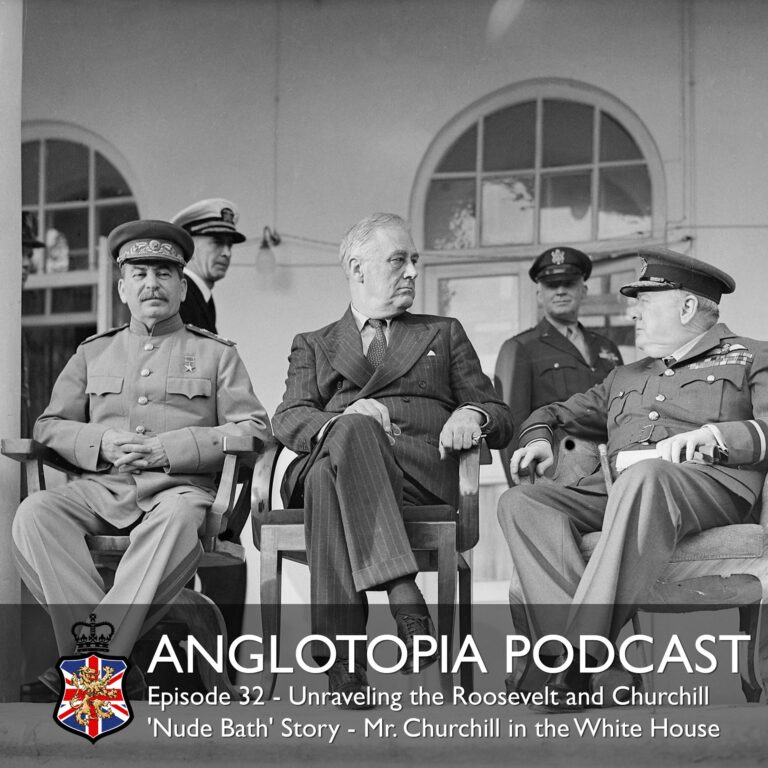
It’s one of the most enduring anecdotes about the Special Relationship: Winston Churchill, emerging naked from his bath at the White House, encounters President Franklin D. Roosevelt. Unabashed, Churchill declares, “The Prime Minister of Great Britain has nothing to hide from the President of the United States.”
It’s a wonderful story. It’s almost certainly not true.
In this episode of the Anglotopia Podcast, host Jonathan Thomas speaks with Robert Schmuhl, author of “Mr. Churchill in the White House,” about this legendary tale and the genuine history of Churchill’s wartime visits to Washington. What emerges is a story more interesting than the myth—a portrait of two leaders navigating unprecedented circumstances in intimate quarters.
The Origins of a Legend
The nude encounter story has been repeated in countless books, articles, and documentaries. Its sources, however, prove remarkably thin upon examination.
Robert traces the tale’s genealogy. The earliest versions come from secondhand accounts, often published years after the events supposedly occurred. No contemporary diary entries, letters, or official records corroborate the incident. Neither Churchill nor Roosevelt ever mentioned it in their extensive writings and recorded conversations.
More tellingly, the logistics don’t work. Churchill stayed in the Rose Suite at the White House, with his own bathroom. Roosevelt, confined to a wheelchair by polio, wouldn’t have casually wheeled himself into Churchill’s quarters unannounced. The White House staff maintained careful protocols precisely to avoid such awkward encounters.
The story likely originated as a jest—perhaps even from Churchill himself, who enjoyed cultivating his larger-than-life persona. Repeated and embellished over decades, the quip hardened into accepted fact. It’s a reminder of how readily we accept entertaining stories over careful documentation.
The Real White House Visits
What actually happened during Churchill’s wartime stays in Washington proves far more illuminating than any apocryphal bath story.
Churchill first arrived at the White House in December 1941, just weeks after Pearl Harbor brought America into the war. He stayed for three weeks—an unprecedented length for a foreign leader—as he and Roosevelt hammered out the initial framework for Allied cooperation.
The proximity was deliberate. Roosevelt invited Churchill to stay under his roof precisely to enable constant, informal contact. Decisions that might have taken weeks of diplomatic correspondence could be made in evening conversations. The two leaders developed a working relationship impossible to achieve at formal distance.
Subsequent visits in 1942 and 1943 reinforced this pattern. Churchill treated the White House almost as a second office, working his customary long hours, dictating memoranda, hosting meetings. The American staff adapted to his nocturnal schedule and his demands for whisky at all hours.
Two Leaders, Two Styles
Robert’s book illuminates the contrasting personalities that somehow meshed into effective partnership. Roosevelt was political to his core—charming, evasive, always calculating electoral implications. Churchill was more direct, more emotional, driven by historical imagination as much as practical calculation.
Their relationship included genuine warmth but also significant tension. Churchill needed American resources desperately and couldn’t afford to alienate Roosevelt. Roosevelt recognized Churchill’s value as a war leader but had his own agenda for the postwar world—one that didn’t include propping up the British Empire.
These dynamics played out in White House conversations that shaped the war’s conduct. The decision to prioritize the European theater. The timing and location of the Second Front. The management of Stalin and the Soviet alliance. All were debated in the corridors and sitting rooms where these two men lived alongside each other.
The Human Dimension
Beyond grand strategy, Robert’s research reveals the human texture of these visits. Churchill’s habit of working in bed until noon. His demands for specific foods and drinks. His evening film screenings, where he would provide running commentary. His tears at emotional moments—Churchill cried easily and without embarrassment.
Roosevelt’s household had to accommodate a guest who operated on London time, who thought nothing of summoning staff at 3 AM, who expected the same level of service he received at 10 Downing Street. The White House staff rose to the challenge, but not without grumbling.
Eleanor Roosevelt’s diaries and letters reveal her mixed feelings about their demanding guest. She respected Churchill’s leadership but found his imperial attitudes troubling and his personal habits exhausting. The Churchill visits disrupted the household in ways that no one fully anticipated.
Churchill’s Health Crisis
One dramatic episode during a White House visit received little attention at the time: Churchill suffered a mild heart attack in December 1941. His physician, Lord Moran, kept the matter secret, fearing that news of the Prime Minister’s ill health would damage British morale.
Robert explores this incident and its implications. Churchill continued his punishing schedule despite the warning signs. The secrecy meant he received no proper rest or treatment. The decision to conceal his condition reflected wartime priorities but also risked catastrophe—had Churchill died or been seriously incapacitated, the cover-up would have created a crisis of confidence.
The episode reveals the precarious nature of leadership in wartime. So much depended on these two men’s continued health and capacity. Their personal relationship was irreplaceable; no deputies could have maintained the same dynamic.
The Special Relationship’s Origins
These White House visits established patterns that outlasted both leaders. The idea that British and American leaders should maintain direct, personal contact; that phone calls and visits could supplement diplomatic channels; that the relationship had a special character requiring special cultivation—all these emerged from the Roosevelt-Churchill partnership.
Robert argues that the visits’ informality was itself significant. By living together, sharing meals, watching movies, staying up late in conversation, Roosevelt and Churchill created something more than an alliance. They created a model of Anglo-American cooperation that subsequent generations inherited.
The Special Relationship has been stressed, tested, and sometimes abused since 1945. But its foundation—laid in those White House conversations—has proven remarkably durable. Even leaders who didn’t particularly like each other have felt obligated to maintain its forms.
Why Myths Persist
Returning to the nude bath story, Robert reflects on why such myths prove so persistent. The anecdote captures something true about Churchill even if the specific incident never occurred. He was larger than life, uninhibited, supremely confident. He would have been capable of such a quip, even if he never actually delivered it.
Myths serve purposes that mere facts cannot. They condense complex truths into memorable images. They humanize remote historical figures. They give us stories to tell and retell, keeping historical memory alive even if imperfectly.
The task of the historian is to distinguish myth from documentation while understanding why myths arise. The nude bath story tells us something about how Churchill wanted to be remembered and how we want to remember him—even if it tells us nothing about what actually happened in the White House.
—
Interested in the true history of Churchill’s wartime relationship with Roosevelt? Listen to the full episode of the Anglotopia Podcast wherever you get your podcasts.
The Anglotopia Podcast is your deep dive into the rich and diverse world of British culture, hosted by Jonathan and Jacqueline Thomas, publishers of Anglotopia.net and Londontopia.net. Each episode takes you on a journey through iconic British television, captivating historical events, and essential travel tips, ensuring you experience the very best of the British Isles. Our engaging discussions feature important British guests and authors, covering everything from the latest trends and timeless traditions to hidden gems and popular landmarks. Whether you’re a passionate Anglophile or simply curious about the UK, our podcast offers a delightful mix of insights and entertainment. Join us as we celebrate the charm, heritage, and unique allure of Britain, making every episode a must-listen for anyone who loves all things British.
As part of our ongoing series about Winston Churchill in the lead-up to the International Churchill Society Conference in London in October, this week we interview author Robert Schmuhl about his new book ‘Mr. Churchill in the White House.’ The conversation explores the history and relationship between Winston Churchill and Franklin D. Roosevelt during World War II. Robert Schmuhl, the author of ‘Mr. Churchill in the White House’ discusses the dynamics between the two leaders and their interactions. The conversation touches on Churchill’s storytelling, the differences between his relationships with Roosevelt and Eisenhower, and the significance of their meetings. It also delves into Churchill’s writing process, his visits to the White House, and the famous ‘nude bath’ story. Let’s take a deep dive into Anglo-American relations during and after World War II.
Links
Mr. Churchill in the White House
International Churchill Conference
Winston Churchill’s Christmas in the White House
Churchill And Roosevelt At White House (1941)
Churchill’s Wilderness Years Drama
Takeaways
- The relationship between Winston Churchill and Franklin D. Roosevelt was complex and evolved over time.
- Churchill was known for his storytelling and had a talent for captivating people with his tales.
- Churchill’s relationship with Roosevelt was different from his relationship with Eisenhower, as they had different backgrounds and values.
- Churchill’s visits to the White House were marked by his demanding nature and his ability to make himself at home.
- The ‘nude bath’ story, while true, is more nuanced than popularly portrayed.
Chapters
- 00:00 Introduction and Background
- 06:10 Churchill and Roosevelt’s Relationship
- 10:32 Churchill’s Visits to the White House
- 13:53 Logistics of Churchill’s Travel
- 19:05 American Views of Churchill
- 24:01 Churchill as a House Guest
- 26:54 The ‘Nude Bath’ Story
- 33:28 Introduction and Exploring the History of Churchill
- 35:10 The Relationship Between Churchill and Eisenhower
- 38:29 Churchill’s Meticulous Writing Process
- 41:43 Recommended Books About Churchill
- 45:20 Recommended Churchill Film: ‘Darkest Hour’
- 49:27 Recommended Churchill Series: ‘The Wilderness Years’

Free Podcast Newsletter
Subscribe to our special podcast newsletter below and never miss the latest episode of the Anglotopia Podcast.