
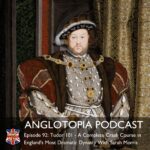
From the Anglotopia Podcast: Episode 92
If you have ever found yourself lingering in front of a Tudor portrait, wandering through the roofless bones of a ruined abbey, or getting hopelessly swept up in a Hollywood drama set in the sixteenth century, then you already know the pull of the Tudors. It is a strange, magnetic thing. A dynasty that ruled England for barely more than a century, with only five monarchs to its name, somehow looms over the whole of our historical imagination. Five hundred years later, we simply cannot stop talking about them.
To make sense of it all, Jonathan Thomas invited one of the most passionate and knowledgeable Tudor guides working today onto the Anglotopia Podcast for something a little different: a proper crash course, start to finish. Sarah Morris is the creator of the Tudor Travel Guide, a membership community, podcast, and content platform devoted to helping history lovers immerse themselves fully in the Tudor world. She has written several books, both fiction and nonfiction, centered on Anne Boleyn and the six wives of Henry VIII, and alongside fellow Tudor expert Adam Pennington she now runs Simply Tudor Tours, an immersive company that takes small groups to some of the most breathtaking Tudor sites in Britain.
The premise was simple. Many of us love Britain but may not know the full Tudor story: who these people really were, what made their era so dramatic and consequential, and why it still feels so alive. Consider this Tudor 101, taught by a guide who fell in love with the whole gloriously messy dynasty at the age of eleven and never quite recovered.
A Hobby That Got a Little Out of Control
Sarah’s route to becoming a full-time Tudor evangelist was, by her own cheerful admission, largely accidental. She trained originally as a doctor and then spent more than twenty years as an executive coach. Somewhere in her mid-forties she reached the point so many of us know: the feeling that it was time for a reset, a rejuvenation, a rethink of what the second half of life should look like. She knew she had two enduring passions. One was writing. The other was history, and the Tudors most of all, a love she traces back to a childhood spent being dragged around the heritage properties of northern England by her parents.
“I often say it was a hobby that kind of got a little bit out of control,” she told Jonathan, “and it snowballed into one thing after another.” The books came first, then the Tudor Travel Guide, and more recently the tours. It is a story Jonathan recognized instantly, because it is more or less the origin story of Anglotopia itself. A love of Britain that refused to stay a hobby has a way of taking over your life.
The pivotal moment came in 2010, on a hot August day at Hever Castle. Sarah had toured the castle and was having a picnic on the lawns afterwards when her famously fertile imagination began to wonder what it would be like to step back in time and simply be there, to see Anne Boleyn, her historical heroine, in the flesh. Out of that daydream came her novel of Anne, and it was the deep research for that book that opened up entirely new vistas. She had read plenty about the people and the events, but not about what life was actually like, how the court was structured, how houses were built and their spaces used. As she went down those rabbit holes, her understanding of the period became, in her words, “more 3D, more colorful.”
That is the animating idea behind everything she does now. “It is time and not space that separates us from the past,” she likes to say. When she walks into a room and can reconstruct in her mind’s eye how it looked and how it was used in the sixteenth century, the events and the people leap to life. It is like pulling back the veil of time, and she finds it genuinely thrilling. The mission of the Tudor Travel Guide is to give other people that same felt sense of connection: to tell the stories of Tudor history through the lens of the places where they happened, and to coax readers out of the armchair and into the actual rooms where the past unfolded.
An Unlikely Dynasty, Born Out of Chaos
So who were the Tudors, and where did they come from? Sarah’s answer begins, appropriately, with chaos. The dynasty was born out of the Wars of the Roses, the long and bloody dispute between the House of York and the House of Lancaster that raged through the middle and later fifteenth century. Henry Tudor, the future Henry VII and founder of the line, came from the Lancastrian side. His lineage ran back through Catherine of Valois, the widow of Henry V, who after the king’s death had an affair with a gentleman of her household, a certain Owen Tudor. Their son Edmund Tudor became the father of Henry VII.
On the Welsh side the family descended from the Ap Tudors of North Wales, hardly an auspicious royal pedigree. But the fusion of that Welsh line with the blood of Catherine of Valois produced, eventually, little Henry Tudor. And “unlikely” barely covers it. As Sarah put it, quoting a memorable line from the television drama The White Queen, Henry Tudor was going to have to step over several dead bodies to become King of England. Edward IV had sons, the princes in the Tower. Richard, Duke of Gloucester, later Richard III, had a son too. By any reasonable reckoning, others stood far ahead of Henry in the queue.
Forced into exile by the reigning House of York, Henry fled to Brittany and stayed there for roughly twelve years. He returned only to seize the crown at the Battle of Bosworth, where he faced Richard III in the field. Richard was slain, and Henry won the crown on the battlefield itself. It was, Sarah stressed, a wildly improbable outcome, requiring an entire chain of twists and turns of fate to line up in exactly the right order.
The dynasty that followed lasted just 118 years, from 1485 to 1603, and produced only five monarchs. Why, then, do the Tudors loom so large? Sarah offered two answers. The first is pragmatic: they were a genuine hinge point in English history, the bridge between the medieval world and what we would recognize as the modern one. Enormous political, religious, and cultural shifts were set in motion in that single century, and many of them still shape Britain today. The second answer is emotional. “The Tudors are just full of drama, aren’t they?” she said. “We have power. We have betrayal. We have brutality. We have glamour.” These are stories that feel as though they belong on Netflix rather than in a history book. And crucially, the Tudors left behind portraiture, artifacts, and objects we can still see and sometimes touch, a physical connection to real faces that the earlier medieval centuries simply cannot offer.
The Founder in His Son’s Shadow
Every list of famous English monarchs skips lightly over Henry VII, and Sarah thinks that is a genuine shame. In recent years, while researching three of his royal progresses in detail, she has, in her words, “fallen a little bit for Henry VII.” The point she keeps returning to is the simplest and most important one: without Henry VII, there is no Tudor dynasty at all.
What she has come to admire is the sheer skill of his kingship. Here was a man who had spent much of his youth in exile, who had visited Westminster, the heart of royal power, only once in his life, for an audience with Henry VI, and who had almost no direct experience of rule. And yet he and those around him had somehow instilled in him everything effective kingship required. He projected the image of royalty. He took up the traditions, the habits, and the glamour expected of a king, and he wore them convincingly. Above all, after the long instability of the Wars of the Roses, he brought England something it had not enjoyed in years: stability. That achievement was sealed by his marriage to Elizabeth of York, eldest daughter of Edward IV, which united the warring houses at last. Overlooked and underappreciated he may be, but he is the foundation on which everything else was built.
Henry VIII and the Break That Reshaped a Nation
His son is another matter entirely, probably the most famous English monarch in history, rivaled only by his daughter Elizabeth. Ask most people about Henry VIII and you get the six wives. But Sarah wanted to hone in on the one thing that, more than any marriage bed, defined his legacy: the way he bent an entire nation to serve his personal will.
It began, of course, with his determination to secure a male heir, and with his struggle against Rome. To marry Anne Boleyn and hope for a legitimate son, Henry needed to break with the Pope, and that break, engineered in close collaboration with his first minister Thomas Cromwell, unleashed the English Reformation and the dissolution of the monasteries. “The intent,” Sarah noted, “was to get himself a son and heir.” But the output was something vastly larger than any one man’s dynastic anxiety. It changed the physical landscape, the societal structure, and the entire cultural and religious fabric of England, and it triggered a religious earthquake whose aftershocks rolled on through the rest of the Tudor century and well beyond. Jonathan pushed the timeline further still, tracing that Protestant tendency all the way to the Civil Wars and the Glorious Revolution before it was finally cemented. Sarah, laughing, confessed one of her own historical blind spots: a “terrible lack of interest in English history after 1603.” It is a running theme of the episode that every history lover, no matter how expert, has a period they simply cannot get excited about.
The Most Misunderstood of the Six Wives
We all learn the wives through the grim little rhyme, “divorced, beheaded, died, divorced, beheaded, survived,” and, more recently, through the hit musical Six. So Jonathan asked the obvious question: which wife does a Tudor expert consider the most misunderstood? Sarah seized on that precise word. Had he said underappreciated, she might have named Anne of Cleves. But misunderstood pointed her, historically at least, straight to Anne Boleyn.
For a long time the dominant narrative cast Anne as either a romantic heroine or a scheming home-wrecker, an “adulterer” and worse, much of it Catholic propaganda that took hold not long after her death and never entirely faded. Get to know her better, Sarah argued, and a very different figure emerges: a woman of profound religious principle, of the reformed faith, who enforced that faith strongly within her own household. Having, in effect, walked in Anne’s footsteps while writing her novel, Sarah came away convinced of Anne’s genuine conviction and sense of purpose. Her role in the break from Rome was, Sarah insisted, “not inconsiderable.” It was Anne, for instance, who passed Henry a copy of The Obedience of a Christian Man, a book that sharpened his ideas about the relationship between his own kingship and the authority of the Bishop of Rome, as Henry came disparagingly to call the Pope. Anne, in this telling, was a real and important catalyst in the whole Reformation process, with all the vast social, cultural, and religious ramifications that followed.
Three Siblings, Three Reigns, and Rather Too Many Marys
Henry VIII’s three children each had their own dramatic and remarkably short reign, and taken together the sequence is extraordinary. Edward VI inherited the throne on his father’s death in 1547 at just nine or ten years old, a minor governed by a council headed by his uncle as regent. Tutored by Protestants and an ardent believer himself, Edward pushed England from the reformed faith of his father’s day toward the extremes of Protestantism. But he died in 1553, aged around sixteen, before he could ever fully establish his own authority. We simply do not know what kind of king he might have become, though Sarah relayed the intriguing view of some historians that he might have proved even more ruthless than Henry.
What followed was one of the strangest episodes of the century: the month of three monarchs, July 1553. With Edward dead, the Protestant council put forward Lady Jane Grey, the “nine days queen,” but the people were not behind her. Mary, the Catholic daughter of Henry VIII and Catherine of Aragon, prevailed. Her reign became a mirror image of her brother’s, a determined effort to reverse everything she saw as damage and to restore Catholicism, even attempting to revive some of the dissolved monasteries. Her zeal earned her the enduring nickname Bloody Mary, for the burning of heretics, yet Sarah offered an important corrective: Henry VIII was almost certainly responsible for executing far more people than Mary ever was. The tag, she suggested, is more than a little unfair. Mary survived only five years, married to a largely indifferent Philip II of Spain, believing herself pregnant when she was probably suffering from a tumor that eventually killed her.
Jonathan seized the moment to clear up a confusion he had shared until only a few years ago: Bloody Mary and Mary, Queen of Scots were two entirely different people. Sarah laughed that the Marys are “everywhere in Tudor history,” along with the endless Henrys and Thomases. The untangling goes like this. Bloody Mary was Mary Tudor, daughter of Henry VIII and Catherine of Aragon. But Henry VIII also had an elder sister, Margaret Tudor, who was sent north to marry the King of Scots. Margaret was the grandmother of Mary, Queen of Scots. So the two women shared a common ancestor in Henry VII, but represented the English and Scottish branches of the same family tree. That Scottish claim would become the great problem of the next reign, because Mary, Queen of Scots had a genuinely strong claim to the English throne and was Catholic, a combination that terrified Elizabeth’s ardently Protestant chief minister William Cecil, later Lord Burghley, who worked from day one to thwart her.
Gloriana: The Making of the Virgin Queen
And then there is Elizabeth, often called the greatest of the Tudors. What made her reign so significant, and how did she cling to power in a world that deeply distrusted female rulers, surrounded by men forever plotting? Sarah’s first answer was time itself. Reigning from 1558 to 1603 and dying at the age of sixty, Elizabeth simply had the years her siblings never got, years enough to establish herself, to find a workable religious settlement, and to bring real stability. That settlement was not perfect, and tensions simmered, but she managed to tolerate both Catholics and Protestants and to carve out a middle way.
Her greatest gift, Sarah argued, was the ability to turn her supposed vulnerability as a woman into a virtue and a source of strength. The definitive moment came at Tilbury, as she rallied her troops in armor against the threat of the Spanish Armada: “I know I have the body of a weak and feeble woman, but I have the heart and stomach of a king, and a king of England too.” That, for Sarah, encapsulates the whole miracle of Elizabeth: feminine guile deployed when useful, backed by extraordinary reserves of courage. And consider what she had survived to reach that point. Her mother executed when she was not yet three. Thrown into the Tower during her sister Mary’s reign, accused of plotting, holding out through interrogation until she was acquitted and released. She had passed through a baptism of fire in politics, power, and danger, and it forged in her a rare blend of resilience and wisdom.
Later in her reign she elevated all of this into something close to myth: the cult of the Virgin Queen, a near-deified image that lifted her above the ordinary into an almost goddess-like figure people could look up to and revere. It was, Sarah said, “an utter stroke of PR genius.” And the stability she created allowed the English Renaissance to flower, giving us Shakespeare and the great expansion of the English language, the age of voyage and discovery, and a small island nation that suddenly began to see itself with global ambitions and set out, as Sarah noted with a smile to her American host, in Jonathan’s direction.
The Scars Still on the Landscape
For Americans, the Reformation can feel abstract, even though, as Jonathan pointed out, we are its children. Sarah could not overemphasize its impact, and she wanted people to understand that it was, quite literally, the biggest transfer of wealth in British history, something many visitors never realize as they wander among the ruins. The phrase “the dissolution of the monasteries” sounds so tidy, she said, as though someone turned up with a “we are now closed” sign and everyone politely wandered off. Nothing could be further from the truth.
People turned up and ransacked these magnificent medieval buildings. They pulled them apart, hacked at the stone, burned books and precious artifacts, melted the lead from the roofs, and sold off the goods, leaving smoldering ruins behind. Visit North Yorkshire, she urged, where Fountains, Rievaulx, and Jervaulx abbeys stand close together, and you can still see the physical scars on the stone where the destruction bit in. But the human cost went far beyond the buildings. Whole monastic communities were thrown out, their way of life torn apart. If you were lucky, you were simply cast onto the street with no occupation and no place in Tudor society. Some abbots who resisted were executed brutally. And the monasteries had been the beating heart of community life, offering hospitality to travelers, care for the sick, and employment across the vast tracts of land they owned. All of it vanished, and the spoils flowed to the nobility and to the courtiers who could work their way into favor. For ordinary people, Sarah said, everything they believed in was taken away and replaced with something completely alien. Jonathan reached for a parallel that Americans might feel, the Spanish tearing down the temples and pyramids of the Aztecs, before concluding that the ruins scattered across Britain stand today almost as monuments to that tortured history.
Everybody Knew Their Place
We tend to fixate on the court, on kings and queens and great aristocrats, but what was daily life actually like for ordinary Tudor people? Sarah’s answer began with a structure so rigid it defined every waking moment: in the sixteenth century, everybody knew their place. She walked through the whole social ladder, from the bottom up.
- At the very bottom sat the outcasts: criminals, rogues, vagabonds, thieves and beggars, considered wholly outside society and the lowest of the low.
- Above them came the poor, split into the deserving poor, the elderly, sick, or widowed who might receive parish assistance, and the undeserving poor, the able-bodied unemployed who were often punished rather than helped.
- Then the husbandmen and yeoman farmers, still commoners but respected, defined by modest landholdings or skilled work. These were the backbone of middle England, the class that supplied the famous longbowmen in time of war.
- Next the middling sort, a genuinely mobile class of merchants, successful artisans, shopkeepers, and professionals like lawyers and physicians, not noble but capable of reaching remarkable levels of wealth.
- Then a big jump to the gentry, landowners with fine houses, what we would call stately homes, who employed people and served locally as justices of the peace.
- And finally the nobility, the barons, viscounts, earls, marquesses, and dukes with national influence and several grand houses apiece, right up to the monarch at the summit.
For most people, life was a matter of survival, of working with the seasons and the land, largely under the direction of someone higher up and never quite in control of how things turned out. Sarah could not resist a wry observation as she finished the description: “Is that so much different to today? I’m describing this in the sixteenth century and I’m thinking, I’m not sure much has changed.” Humans, Jonathan agreed, seem to love sorting themselves into hierarchies where nothing ever really changes. When the dynasty finally ended with Elizabeth’s death in 1603, England was a more stable, more unified, more centralized nation, one that had shed medieval feudalism and grown a genuine sense of national identity and confidence, though the religious and political tensions still simmering beneath the surface would erupt into civil war some forty years later.
Walking in Their Footsteps: Where to Go
Sarah’s whole mission is connecting people to Tudor places, so Jonathan asked for the essential stops for a first-time American Anglophile. Start with London, she said, and do not feel guilty about it; that is exactly what most visitors do, and it is absolutely the right instinct. In the capital, the must-see is Hampton Court Palace, England’s only surviving accessible Tudor palace. She calls it “a bit of a schizophrenic palace” because the Georgians got their hands on it and began dismantling the Tudor work before running out of money, leaving us with roughly half a Tudor palace, but more than enough to convey the sheer grandeur. Alongside it stands the Tower of London, not Tudor in origin but the stage for so many pivotal Tudor events, from pre-coronation festivities to grim executions. Add Westminster Abbey, with the glorious Lady Chapel that Henry VII founded as a Tudor mausoleum, holding the tombs of Henry VII and Elizabeth of York, Elizabeth I, Mary, Queen of Scots, and Margaret Beaufort, and round it off with a visit to the National Portrait Gallery to stand before the greatest Tudor faces.
Venture beyond the M25 and Sarah’s answer is immediate: Hever Castle, the childhood home of Anne Boleyn and the mecca for any of her admirers. Easily reached from London in a day, it is small, she admits, “an absolutely dinky castle, but small and perfectly formed,” with its moat and drawbridge, and crucially the castle itself sits on the exact footprint Anne would have known. Jonathan, who has spent a full day there, added the delightful footnote that an American, William Astor, restored the castle and created its gorgeous gardens, even building a mock Tudor village beside it that guests can stay in. Nearby lie Hatfield, once the childhood home of Elizabeth I, and Penshurst Place, just three miles from Hever, so close that Jonathan happily did both in a single day. Kent, as he put it, leaves you spoiled for choice.
For those who want to see how ordinary people lived, Sarah recommended the Weald and Downland Living Museum in Sussex for yeoman and husbandman houses, and Little Moreton Hall and Speke Hall in the northwest as superb gentry examples. Great houses abound, from Hardwick Hall in Derbyshire, built by the formidable Bess of Hardwick who fancied herself a rival to Elizabeth, to nearby Haddon Hall with the finest long gallery in the country. For ruins, she returned to North Yorkshire’s Fountains, Rievaulx, and Jervaulx, with Kenilworth Castle in the Midlands offering the great romantic story of Elizabeth and Robert Dudley, whose tower you can now climb to the top-floor gallery.
But the one place Sarah insisted no Tudor enthusiast should miss is the Mary Rose Museum in Portsmouth. Henry VIII’s warship sank in Portsmouth Harbour, was raised centuries later, and now sits at the heart of an extraordinary museum built around some 19,000 recovered artifacts, from the games the sailors played to the cannons they fired, even the ship’s dog. Jonathan, who has been twice, praised the whole Portsmouth Historic Dockyard, where three eras of naval history sit side by side, the Mary Rose, Nelson’s HMS Victory, and the Victorian HMS Warrior, sometimes with modern aircraft carriers looming behind. Both agreed the museum keeps reinventing itself, with a new immersive film that puts you aboard as the ship goes down and a 3D dive to the excavation, making it one of the best museums either of them has ever visited.
Read Before You Go
Sarah’s single best piece of advice for avoiding the crushing “if only I had known” feeling is disarmingly simple: read before you go, not after. She has lost count of the times she reached home only to discover she had walked straight past a crucial artifact or missed a significant site just around the corner. Her second tip is to always step into the local parish church, whatever village or town you find yourself in, because it is usually the building with the deepest continuity in the place, and you would be amazed at the medieval and Tudor tombs quietly waiting inside. Jonathan confessed to learning the lesson the hard way at Versailles, wandering overwhelmed through a palace he had not researched, with no context for what he was seeing. But both landed on the same silver lining: every missed detail is simply an excuse to go back, which is, after all, the entire Anglotopia philosophy of travel to Britain. One trip is never enough.
That same infectious enthusiasm is what drives Simply Tudor Tours, which Sarah founded with Adam Pennington. She is the places person who loves crafting the itineraries; he is the logistics and operations mind, honed by years of managing enormous events. Their strapline says it all: created for Tudor history lovers by Tudor history lovers. For 2026 the calendar runs from a Mary, Queen of Scots tour in Scotland, to a July journey retracing Henry VII and Elizabeth of York’s 1502 progress from Woodstock through the Cotswolds to Raglan Castle, to their flagship Rise and Fall of Anne Boleyn tour in September, built around the woman Sarah calls “the poster girl of the sixteenth century.” Groups are capped at twenty, enough to build a community without losing the personal touch.
To close, Jonathan asked for Sarah’s favorite Tudor drama, and she braced for controversy. Her answer, the source of endless good-natured debate with Adam, was The Tudors. Yes, she knows it plays fast and loose with the history, and yes, Jonathan Rhys Meyers looks nothing like Henry VIII, but she loved the psychology he brought to the role, the fickleness and brutality, the light and the dark. She adored Natalie Dormer’s Anne Boleyn, whom she was lucky enough to meet at her book launch in 2012, before Game of Thrones made Dormer a superstar. Above all, she values what these dramas do: they spark a wave of interest and send people off to research the real stories for themselves. That, Sarah said, has to be a good thing, and it is a sentiment Jonathan echoed about Downton Abbey and the whole world of British history it opened up for Anglotopia’s audience. The Tudors may be five centuries gone, but as this conversation proved, the appetite to walk in their footsteps has never been stronger.
—
Want the full crash course? Listen to Episode 92 of the Anglotopia Podcast, with Sarah Morris.


Never miss an episode
Free newsletter
New episodes, full transcripts and long-read articles on British history, travel and culture, straight to your inbox. Join 36,000+ fellow Anglophiles.
Unsubscribe anytime. We never share your email.