
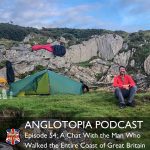
From the Anglotopia Podcast: Episode 54
Some journeys are measured in miles. This one is measured in years, in worn-out shoes, in the thousands of nights spent under canvas, and in the roughly 200,000 photographs it took to capture something as vast and unruly as the entire coastline of mainland Britain. Over five extraordinary years, photographer and adventurer Quintin Lake walked all 11,000 kilometers of it, tracing the perimeter of the island on foot from the White Cliffs of Dover to the storm-lashed headlands of the far northwest of Scotland, and then spent five more years turning the experience into a book.
The result is The Perimeter: A Photographic Journey Around the Coast of Britain, a monumental volume of over 1,300 carefully curated images published by Hutchinson and Heinemann. On this episode of the Anglotopia Podcast, Jonathan Thomas sat down with Quintin to talk about what possessed him to attempt such a walk, the physical and mental toll it took, the surprising discoveries he made along the way, and how spending half a decade on the edge of Britain permanently changed the way he sees the country of his birth.
What emerges is not just the story of a remarkable feat of endurance, but a meditation on inspiration, impermanence, and the strange, obsessive love that Britons seem to hold for their own island. This is a conversation about walking, yes, but it is really about learning to see.
From the Exotic to the Doorstep
Quintin did not set out to become the man who walked the coast of Britain. For about 25 years he had been a travel photographer of the globe-trotting kind, chasing inspiration in what he called “the exotic.” He had visited 70 countries, been to the Arctic three times, crossed deserts, and generally associated creative fuel with distance and adventure abroad. Then, about a dozen years ago, everything changed. He contracted meningitis and was left so physically limited that walking even a few hundred meters was a challenge.
His recovery, as it turned out, contained the seed of his greatest project. As his strength slowly returned, Quintin decided to take a gentle, meditative walk down the River Thames near his home in Cheltenham in the Cotswolds, starting at the source. The logic was cautious: if he grew tired or ill, he could simply catch a bus or a taxi home. He took abstract photographs of the river as he went, purely for himself, almost as a form of therapy. To his surprise, they were some of the best pictures he had ever made.
Then came the coast. As the Thames reached London and opened out toward the sea, the stories and the inspiration seemed to swell. Once fully recovered, Quintin walked the River Severn, Britain’s longest river, where the coastal section boasts a roughly 30-meter tide, the second highest in the world. When that colossal tide goes out, it reveals an entire landscape of sand and mud, and Quintin found it almost overwhelmingly beautiful. Only weeks after finishing the Severn, he made the decision that would consume the next decade of his life. He had found inspiration close to home, and for a photographer, he explained, that is the hardest thing of all to find. This was it.
The Doorstep Mile and the Naivety of Day One
How does a person prepare, physically and mentally, to walk 11,000 kilometers? Quintin’s answer is disarmingly simple. He cites a Norwegian expression, the “doorstep mile,” the idea that the hardest part of any journey is taking the very first step. He is a great believer in simply going. From having the idea, he registered a website, committed himself, and a couple of weeks later he set off, resolving to fix the problems of the journey as they arose rather than over-complicating things at the start.
He admits the walk turned out to be perhaps ten times harder than he imagined. But that early naivety was a kind of gift. Starting from London and heading west along the well-developed south coast felt low-stakes; if he were injured, he could just go home. As Jonathan noted, the south coast of England is gentle by comparison, never more than a few miles from a village or town, with a well-maintained coast path underfoot. As Quintin walked, he got fitter, learned better techniques, and pared his equipment down to lighter loads.
By the time he reached the north of Scotland, the difficulty was of an entirely different order: just a few hours of daylight in winter, near-constant storms and wind, over 20 kilograms of equipment on his back, and sometimes five days without seeing another soul. In Scotland there is no network of footpaths, and for hundreds of kilometers he found himself bushwhacking through overgrown foliage, trying to pick a route, backtracking when the way closed up. Had he faced that on day one, he says, it would have knocked him out. But by then he had already covered around 5,000 kilometers, and the momentum carried him. The journey, in other words, built him up gradually.
Historic Counties and a Big Box of Train Tickets
Crucially, Quintin did not attempt the whole thing in one continuous march. He broke the coast into stages spread over several years, and the book is structured the same way. To divide the island into manageable chunks, he turned to the historic counties rather than modern administrative ones. Historically, these counties carved the country into more evenly sized, geographically coherent areas. In modern times, he points out, almost all of northern Scotland is simply lumped together as “Highland,” whereas in the past it went by evocative names like Inverness-shire, Sutherland, and Caithness.
Even so, some of these historic counties still had coastlines of five or six hundred kilometers. Quintin started in South London, then moved through Kent and Sussex and onward, walking for anywhere between two weeks and two months at a stretch, always carrying a tent to keep costs down. The whole operation was governed by the practicalities of Britain’s wonderful train network. He always took a train to the trailhead and a train home again. When the section was near his home, close to the Welsh border, he might go out for just a few days. When he ventured to the far northwest of Scotland, which could take two days simply to reach, he would stay out for a couple of months. Those trains were, by far, the single biggest expense of the entire project. He still has a big box of train tickets to prove it.
Quintin was no stranger to long-distance walking. At ten, he walked from John O’Groats to Glasgow with his mother, roughly 400 kilometers. At twenty, he walked Land’s End to John O’Groats, the two furthest points of Britain, about a thousand kilometers. For most of his life he had undertaken long treks around the country. Yet, oddly, he had never thought to combine that love of walking with his photography and his work until the Perimeter. His initial estimate, based on other writers’ books and the Ordnance Survey maps, put the coast at around 10,000 kilometers. The reality came in at 11,000: a lot further than he bargained for.
Walking With History, and the Books That Lit the Way
Every great journey stands on the shoulders of the ones that came before it. Quintin traces his inspiration to John Merrill, the first man to record walking the coast of Britain, whose book Turn Right at Land’s End chronicled a walk undertaken in 1978, the year Quintin was born. That book sat on his shelf for years as a kind of beacon, a quiet insistence that it could be done. Other coastal and around-Britain travelogues fed the same fascination: Bill Bryson’s Notes from a Small Island and its sequel The Road to Little Dribbling, and Paul Theroux’s The Kingdom by the Sea. The journey-around-Britain has long been one of Quintin’s favorite genres of travel writing.
That youthful Land’s End to John O’Groats walk, undertaken at around 21 while he was training to be an architect, proved genuinely life-changing. He completed the full seven years of architectural training, but he believes that had he not made that walk, his life would have taken an entirely different path. The memories of it stayed with him vividly, every single day, and in a sense his whole life since has been an attempt to recapture how alive he felt with his home on his back, moving through the landscape, meeting people, seeing new things. He describes himself now, cheerfully, as an addict. His bag sits packed in the corner of the room; he is away every few weeks; he needs to know there is always another journey in the diary. It is a feeling Jonathan recognized from his own trips to Britain, that sudden clarity of thinking, “This is why I’m alive, to experience these places.”
Asked to recommend walks to listeners, Quintin had ready answers. For the hardcore, the sort of hikers weaned on America’s Pacific Crest Trail through-hiking culture, he points to the Cambrian Way, a trans-Wales path running from Cardiff to Conwy that crosses 47 mountains in a zigzag route. For someone with just a week to spare who wants a taste of Britain, he suggests the North Downs Way, the old Pilgrims’ Way that delivers you to Winchester past downs and pubs, or perhaps the Cotswold Way along the escarpment. And Hadrian’s Wall, which Jonathan has long dreamed of walking, gets his enthusiastic endorsement. Quintin has walked all of Britain’s roughly 17 National Trails, and calls Hadrian’s Wall perhaps the most intense, a path where you walk with history and truly feel the presence of the Romans. As he puts it, among the National Trails, “there’s no duds.”
The Gear, the Casualties, and the Frankenstein Camera
For the photography nerds, and Jonathan cheerfully counts himself among them, Quintin was happy to talk kit. His main camera is a Canon 5DS R, a 52-megapixel body. He pairs a long 70-to-300mm lens, which he uses to pull details out of a subject, with a wide 16-to-35mm lens to complement it. It is a deliberately simple two-lens philosophy for an almost unimaginably long walk.
Ten years and 11,000 kilometers are punishing on equipment, and the casualty list is long. Over the course of the project Quintin wore out seven pairs of shoes and two backpacks, their shoulder straps completely shredded. Two lenses were damaged. His camera, he laughs, is now like Frankenstein’s monster, all its various broken parts repaired multiple times over. Remarkably, one companion has endured through it all: his beloved tent, in which he has slept something like a thousand nights.
The human casualties were serious too. Near Liverpool he tore a tendon and had to spend two months in an incapacitating boot with physiotherapy. Up in Scotland he suffered shin splints. Each time he managed to self-rescue and get himself to a hospital, but the injuries changed his whole mindset. A journey like this, he realized, demands proper training and eating well, and early on he was doing neither while still pounding his body mile after mile until it simply gave out. Each injury became a lesson. The upshot is a striking one: Quintin reckons he would be more physically capable of doing the walk now, ten years on, than when he first began.
Farmer Hughes, the Right to Roam, and the Kindness of Strangers
Ask Quintin about the people he met, and one figure rises immediately to mind: Farmer Hughes, whom he encountered in the Rhins of Dumfries and Galloway. Quintin came down off the mountains behind the man’s field to find him, well over 80 years old, mucking out his cows with astonishing energy. Around the farm stood a scattering of crofts, small cottages, all now derelict. Farmer Hughes told him how, when he was younger, five families had lived in those cottages and all worked for him, until one by one they left, the place too remote even for tourists to want to settle. He was, as Quintin describes him, the last of the Mohicans, and standing there Quintin felt he was witnessing the end of an era. A photograph of the farmer appears in the book.
The right to roam: Quintin is a passionate believer in Scotland’s right to roam, which allows you to walk and to camp more or less wherever you like, provided you do not disturb a farmer or landowner. In England there is no such right. Wild camping is only tacitly tolerated in certain places, perhaps above 300 meters in some national parks, so to do it Quintin had to “stealth camp,” part of a community of thousands who pitch late, make no noise, and leave no trace. He did this for hundreds of nights in England. There is a strange irony in it: as someone born English, he felt more like his country belonged to him in Scotland than in England, where the act of sleeping outdoors can make you feel like a vagrant.
His approach to conflict is disarmingly gentle. If an angry landowner approached, he would simply apologize or say he was lost, and nine times out of ten they would just point him in the right direction. The most memorable encounter came on his first day into Scotland, at Gretna Green. Quintin was preparing his usual “I’m lost” line when a farmer beckoned him over, but all the man wanted to know was the best way across his field, whether Quintin needed any food, and whether he wanted any water. It was, Quintin says, unbelievable, wonderful, and utterly different.
A Small Island of Infinite Variety
Seeing so much of the coastline, and meeting so many of its people, permanently changed Quintin’s perception of Britain. Fully half of the journey, and half of the book, is devoted to Scotland, where the scale is epic and the culture rich with connections to the Norse and the Vikings and to Christianity arriving from Ireland. Every zone he passed through felt distinct, in its phrasing, its accent, and its preoccupations, and everyone seemed to love their own particular patch. That patchwork quality left him with a profound new respect for the island. He finds it almost impossible to believe that when he rides the London Underground, he is on the very same piece of rock as the great cliffs of Scotland.
Jonathan, from his home in the American Midwest where the same landscape can roll on unchanged for hundreds of miles, marveled at how a small island can be so geographically diverse: the lakes of the Cumbrian Lake District, the mountains of Scotland, river valleys, coastlines, even sand dunes that feel almost desert-like. Quintin agreed enthusiastically, noting that this very diversity is why so many geological discoveries were made here. Terms like “Cambrian” come from different parts of the British coast, and the geological map of Britain, he says, is simply “everything.” On one stretch of the south coast he recognized rock he had also seen in Namibia, because it had once been part of that same distant landmass.
The Rough Bounds and the Beauty of Northumberland
The most challenging terrain of the entire walk was the Rough Bounds, the area around Knoydart in the northwest Highlands, adjacent to the Isle of Skye. There are no roads and very few paths, huge cliffs and treacherous “micro cliffs” of five or ten meters that make moving on foot extraordinarily difficult. And yet it was also his favorite part, the most inspiring photographically, and the place where he met the most extraordinary people. There is something symbolic, he reflects, in a landscape being at once the hardest and the most profound. His single favorite image in the entire book was taken here after five days of walking around Knoydart: a tiny cottage called Skiary beside Loch Hourn, dwarfed by a huge snowy mountain rising up behind it.
Knoydart also produced his lowest moment. Soaked through in winter, drained of energy, having fallen over for the countless time that day, he collapsed onto the heather and wept, certain he could not take another step. And yet, as he pointed out with characteristic pragmatism, what choice was there? If he did not move, he would grow dangerously cold. So he pulled himself together and kept going. Jonathan, an experienced walker himself, agreed that on a long walk the worst thing you can do is stop, because starting again is always harder.
If Knoydart was the hardest, Northumberland was the most purely enjoyable stretch of the whole coast. Quintin had been sad to leave Scotland and had never before visited the county, but it won him over completely, one wonder after another: Holy Island, the tidal island where the Vikings first raided; the epic sweep of Bamburgh Castle; huge, freeing beaches of sea grass; easy walking; friendly people; and good, traditional Northumberland pies. His crossing to Holy Island was, he says, “a truly cosmic experience.” He walked the six kilometers across the sands by the light of a full moon, camping afterward in the sea grass on the north of the island, at the very bay where the Vikings once landed. The book includes his strange, haunting moonlit photographs of the refuge platforms where walkers can huddle if the tide catches them.
Pylons, Power Stations, and an Honest Landscape
Perhaps the most striking element of Quintin’s philosophy is his refusal to photograph only the pretty bits. He never understood why people don’t visit nuclear power stations with the same reverence they bring to cathedrals; to him they are modern wonders, visually extraordinary, and as worthy of attention as Stonehenge. He resists the idea of Britain as a purely historical relic. Yes, the layers of Norman and Tudor history are everywhere, but so too are the pylons, the steel industry, and the plumes of smoke from working factories, and to him those are just as British and just as honest a part of the landscape as the White Cliffs of Dover. He deliberately did not want the book to resemble the cliched, butter-packet image of rolling English fields.
Much of this industrial heritage carries a melancholy weight, especially on the coast, where huge relics now stand redundant, such as the shipyards of the Clyde in Glasgow, once among the greatest shipbuilding centers in the world and now reduced to a handful of ships. This theme of impermanence clearly moved both men. Quintin photographed three power stations that have since been decommissioned and demolished, and captured Britain’s biggest steelworks at Teesside across a double-page spread, only for it to be completely flattened. One of photography’s strange magics, he observed, is that you never quite know when you are recording the end of something.
The conversation turned to the broader question of a living, changing landscape. Jonathan noted that Anglotopia gets pushback when it features modern architecture, but reminded listeners that the Edwardians disdained Edwardian buildings and wanted to demolish Victorian ones; appreciation is never static. Quintin offered the perfect example: St Paul’s Cathedral, where his journey began, whose dome was once considered outrageous and scandalous, since a proper British church was supposed to have a spire. A few centuries later, having survived the Blitz, it is universally loved. Both men agreed that industrial losses cut deeper than mere economics; when a steelworks at Teesside or Port Talbot closes, where fathers, grandfathers, and great-grandfathers all worked the same place, it eviscerates the entire culture of an area.
200,000 Photographs and the Art of the Edit
How on earth do you distill nearly 200,000 photographs down to the 1,300 that made the book? Quintin’s answer begins with a confession: he is very good at taking bad pictures. His technique is to work a subject hard, moving around it, trying different angles, focal lengths, and lighting, quickly generating 30 or 40 frames to discover what works before digging harder into the best approach. When editing in Lightroom, if he had 80 shots of a lighthouse, he could immediately discard 50 as mere sketches, whittle the rest to four or five strong candidates, then refine tone, color, and gradient fills until the best one rose to the surface. As he traveled, he blogged around 20 to 30 images a day.
The book itself was shaped in partnership with graphic designer Claire Skeats, working from a shortlist of some 3,000 images. It was never simply about choosing the best pictures. Some had to give readers an accessible hook, signaling clearly whether they were in Scotland or Wales; others were purely aesthetic; others carried history, geology, or a factual element; and some provided humor, including Britain’s finest passive-aggressive signage. Each chapter was assessed against a set of questions: Is it beautiful? Is it interesting? Is there humor? Is there something unexpected? Quintin credits Skeats’ brilliance for the fact that the book, remarkably, never tips into monotony. As he puts it, the images work together on the page “as a piece of poetry.”
What he hopes the book conveys, above all, is the lived experience of the walk itself: how in the space of a single hour you might pass through a firing range strewn with blown-up tanks, onto a beach full of windsurfing kids, past picturesque thatched cottages and dog-walkers, and up to a nuclear power station. That disorienting, kaleidoscopic quality, he says, is exactly what it is like to walk the coast of Britain.
Wildlife, Lockdown, and What Comes Next
The wildlife encounters were sublime. Near Ben Nevis, two sea eagles flew over his head carrying a fish in their talons, close enough for him to photograph their supper. In Knoydart he saw otters again and again; one quiet evening, cooking on his stove, having become invisible in the landscape, a family of five otters walked right past his feet. He gently turned down the hiss of his Jetboil and stayed perfectly silent as they passed. Not every creature was so welcome, of course. There is a disturbing number of casualties each year from cattle charging walkers in British fields, the midges of Scotland are a torment, and Lyme disease is a genuine danger. Quintin never met an outdoor worker who didn’t know someone badly affected by it, and he took antibiotics for it himself more than once.
After four and a half years, and having survived shin splints, a torn tendon, and being pinned beneath the fastest-eroding cliffs in Europe at Holderness, Quintin’s journey was interrupted not by nature but by a man-made problem: the COVID-19 pandemic. He was in Norfolk when lockdown loomed, sensing the local mood turn from welcoming to wary as the crisis deepened. The day before the prime minister announced lockdown, he decided he had to go home, unwilling to be seen endorsing the breaking of social distancing on so public a journey. He traveled back on an empty train and walked home through streets populated by nothing but foxes. He finished the walk in the narrow window between the first and second lockdowns, completing his epic circuit just two days before the country shut down again.
And what could possibly follow a walk like that? Quite a lot, as it turns out. The five years of walking gave way to five years of editing, a full decade of work. In that time Quintin completed all 16 of Britain’s National Trails, and he is now roughly halfway through climbing and camping atop all 442 mountains of England and Wales, tackling them in the same self-propelled style, by train, tent, and food, four or five days at a time. There is no official way to do it, which is precisely what he loves; he simply joins mountains together on the map and sees where they lead. Because in the end, as he says, all these journeys are just an excuse to discover interesting things. And often the most interesting thing isn’t the summit at all. It’s the pub, or the person you meet on the way there.
The Perimeter: A Photographic Journey Around Britain is available now from Hutchinson and Heinemann. It is not merely a beautiful coffee-table book, but a testament to human endurance, artistic vision, and a deep and abiding love for the landscape that defines Britain, from its wildest, most untamed spaces to its industrial heart.
—
Want to hear the full conversation? Listen to Episode 54 of the Anglotopia Podcast, with Quintin Lake.


Never miss an episode
Free newsletter
New episodes, full transcripts and long-read articles on British history, travel and culture, straight to your inbox. Join 36,000+ fellow Anglophiles.
Unsubscribe anytime. We never share your email.


