
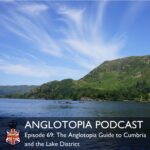
From the Anglotopia Podcast: Episode 69
Some corners of Britain feel like they belong to the British alone. Cumbria and the Lake District are exactly that: a romantic, remote, gloriously hilly stretch of Northwest England that sits so far up the map that most American visitors never make the journey. And yet, as Jonathan Thomas argues in this first installment of a new irregular series he is calling the Anglotopia Guide to Blank, that remoteness is precisely the point. This is where the British go to holiday, where the soul of English literature seems to live, and where a flat Midwesterner from Indiana finally understood just how beautiful Britain’s mountains can be.
Episode 69 is a little different from the usual Anglotopia conversation. There is no guest across the table this time. Instead, Jonathan turns the microphone on himself and walks us through a week in Cumbria in the summer of 2018, a trip that began with an unlikely invitation and ended up reshaping the way he writes about Britain entirely. It is part travelogue, part love letter, and part practical planning guide for the American traveler brave enough to point the rental car north.
What follows is his highlights tour: the geography, the stone circles and steam trains, the pencil museum, the terrifying mountain pass, and the writing retreat that changed everything. Consider it a springboard for planning your own trip to one of the most quietly spectacular places in England.
Cumbria and the Lake District: What They Are and Where They Are
First, a bit of untangling, because the two names get used interchangeably and they are not the same thing. Cumbria is the county. It sits at the tippy top of Northwest England, wedged between the northern powerhouses of Manchester and Liverpool to the south and Scotland to the north. Go any further up and you cross the border. The whole area sits on a kind of peninsula, which is a large part of why it feels so cut off from the rest of Britain. The Lake District, meanwhile, is the area set out primarily in the Lake District National Park, and it lives almost entirely within Cumbria. As Jonathan puts it, all of the Lake District is in Cumbria, but not all of Cumbria is the Lake District, roughly two thirds of the county is.
This is a landscape with a long and often bloody history as a borderland between England and Scotland. It was also, remarkably, the furthest extent of Roman ambition in this part of the country. The Romans built a fort at Hardknott with a commanding view of the Irish Sea, the deepest they pushed into northern England apart from Hadrian’s Wall. That gives the region a deeply, quintessentially English character, a place that has been the edge of things for two thousand years.
And then there are the lakes themselves, glacial, mountainous, and shaped by the fells around them into something akin to Switzerland or the mountains of upstate New York. Jonathan is quick to manage expectations here. He is from Indiana, near Lake Michigan, and by that standard these are small lakes; the biggest is only a few miles long. But small does not mean unimpressive. The way they are carved into the landscape, the way the mountains frame the water, creates a unique and beautiful place that has inspired literature for generations. Americans sometimes ask why they should cross an ocean to see lakes and mountains when they have plenty at home. The answer is partly that they are simply beautiful, and partly that they carry literary and historical connections you cannot find anywhere else.
The Literary Soul of England
Many would argue that the soul of British culture and literature lives in the Lake District, and the reason is largely one man: William Wordsworth. He was born and raised here, lived his life here, and wrote his most famous poems here. As Jonathan says, you cannot throw a stone into a Cumbrian lake without someone mentioning Wordsworth. For an English major, and Jonathan was one, the region is a kind of pilgrimage site, the birthplace of a whole way of seeing and writing about the natural world.
But the literary tradition did not stop with the Romantic poets. It continues to this day, and it is that living tradition that explains how Jonathan came to be in Cumbria at all. Back in 2015 or 2016 he read a book called The Shepherd’s Life by James Rebanks, a lyrical exploration of the life of a shepherd of Herdwick sheep in the Lake District. It is, he says, one of the best British nature books he has ever read, a beautiful picture of a pastoral way of life that has vanished in most places but is jealously held onto by the people who still pursue it.
Rebanks himself is a fascinating figure. He got his book deal because he chronicled his life as a shepherd on Twitter and social media, sharing gorgeous photographs (he is as gifted a photographer as he is a writer) until he went viral and readers fell in love with his way of life. Jonathan even saw him speak at the University of Chicago around that time and had his copy signed, a small moment that would matter more than he could have guessed. Spoiler alert, as Jonathan says: Rebanks would later remember him from that very book signing.
The Rural Writers Institute: An Invitation That Changed Everything
Fast forward to 2018. Jonathan had followed Rebanks online for years when the author tweeted that he was partnering with Kathryn Aalto, who wrote The Natural World of Winnie the Pooh, to launch something called the Rural Writers Institute. They were opening applications for the first cohort of a writers retreat to be held on James’s farm in Cumbria, with the goal of fostering a new generation of writers who wanted to write about Britain’s landscape, culture, and countryside.
Jonathan read that tweet and felt it had been written for him. He had been writing about the British landscape for twenty years through Anglotopia, but not, he admits, in the way he really wanted to. Top ten lists and travel guides are a very different craft from inhabiting a landscape the way Rebanks did in his book. That deeper, more thoughtful kind of writing was exactly what Jonathan longed to do. He submitted an application, an essay explaining his desire to write more thoughtfully about Britain’s landscape and culture, along with some writing samples, crossed his fingers, and hoped.
A few weeks later an email arrived from Kathryn. He had been accepted into the first cohort. He was astonished and thrilled that they had seen something in his writing worth this weekend of learning from some of the finest writers working in Britain today. There was one catch: he was accepted in May, and the retreat was in July. He had roughly eight weeks to plan an entire trip to the UK and figure out how to pay for it. But needs must, and with a supportive wife who stayed home with the children so he could go (he was the only one invited), he figured it out. Since he was crossing the Atlantic anyway, the plan grew to a full week so he could do all the Anglotopia things too.
Getting There Is the Hard Part
The logistics: Getting to Cumbria is genuinely the hardest part of the whole enterprise, and it is worth understanding before you plan. The region is as far from London as you can get without leaving England. Flying into Heathrow or Gatwick makes little sense when your destination is still six or seven hours away by car, or an all-day train or coach ride. In 2018 Jonathan got lucky: American Airlines was running a seasonal direct flight from Chicago to Manchester, a service that sadly no longer exists because demand was too low. Manchester is not especially close to the Lake District, but it is far closer than London, about two hours by car.
He booked it on British Airways Avios through the BA system, since American and BA share a codeshare partnership, so it did not quite feel like cheating on his usual airline after twenty-some trips. The other option worth knowing about is flying into Edinburgh and driving down, which is closer still, though few airlines serve Edinburgh directly from Chicago. Once on the ground, the single most important piece of advice is this: rent a car. The Lake District is poorly served by trains and buses precisely because it is remote, sparsely populated, and heavily seasonal. Unless you are on a coach tour, a car is the only sensible way to explore.
Jonathan landed, picked up his rental, and drove north, stopping (of course) at a motorway services along the way, the famous one that looks like a UFO taking off, which he believes is the Lancaster Services. He loves a good motorway services station. His base for the week was the Troutbeck Inn just outside Penrith, chosen because many of the retreat attendees had corresponded beforehand and arranged to stay near one another so they could carpool. Troutbeck sits just outside the National Park boundary but still within Cumbria, on the very edge of both, next to a main road yet within sight of the mountains. Other than the inn, which doubles as a pub, there was almost nothing around, which suited him perfectly.
A Highlights Tour: Stone Circles, Pencils, and Wordsworth’s Boyhood Home
Jonathan arrived two or three days before the retreat, which gave him time to explore at leisure. Jet-lagged and hungry on that first afternoon, he sought out a National Trust property called Aira Force, a waterfall right beside Ullswater, one of the most famous lakes in Cumbria (and, he confesses, the subject of a beloved IKEA print that hung in his bathroom for years). He walked to the falls, admired the flora and fauna, discovered beautiful purple foxgloves, and then arrived back at the tea room just too late, it had closed, so his dream of National Trust tea and cake would have to wait. A proper meal back at the Troutbeck Inn made up for it.
Over the following days he assembled a proper highlights tour. He began at Castlerigg Stone Circle, one of the Neolithic stone circles of the Lake District, set in a gorgeous, mysterious spot ringed by mountains overlooking the valleys. No one knows quite why it is there, which is true of most stone circles, but that only adds to the atmosphere. From there he visited the Derwent Pencil Museum in Keswick, then a new attraction dedicated to the Derwent pencil company. Jonathan has never met a small provincial English museum he did not love, and this was no exception, though he cheerfully admits there were perhaps more pencil sharpeners on display than any human could truly appreciate. You learn about the history of pencils and lead mining, and then, naturally, you exit through a gift shop full of expensive Derwent pencils. He bought some for his kids.
He did not have time for Dove Cottage, Wordsworth’s famous adult home, but he did fit in one Wordsworth attraction: the poet’s childhood home in the town of Cockermouth. Yes, that is a real place name (it sits at the mouth of the River Cocker), and yes, Jonathan invites you to get your sniggers in; Anglotopia even keeps a list of amusing British place names on the website. Cockermouth is a beautiful town, and at its center stands Wordsworth House, a National Trust property. The Georgian home is set up as it would have been during his childhood, so atmospheric that it feels as if the family has just stepped out for the day. You learn about William and about his sister Dorothy Wordsworth, as important as her brother in the literary canon, and how they grew up there together. There is a lovely garden out back, which sent Jonathan’s hay fever into overdrive, allergies plagued him the entire trip, as they did even some British visitors from outside the region, and everyone traded allergy medicines to cope. And, this being the National Trust, there was tea and cake in the cafe to make everything right again.
From Cockermouth he drove on to Brougham Castle, a beautiful ruin sitting on the edge of a river back toward his hotel. Because it was a weekday, he had the place almost entirely to himself, save for one other American family who had also ventured that far north. This, he notes, is one of the great gifts of traveling in Cumbria off-peak: castles and attractions all to yourself.
The Ullswater Steamer and a Lesson in Slowing Down
One of the quiet turning points of the trip came aboard the famous Ullswater steamers. These old Victorian steamer boats run the length of the long glacial lake throughout the day, departing from Pooley Bridge and cruising down and back. In summer they sometimes stop at additional points, and many visitors combine the boat with a walk, riding the steamer one way, hiking to another stop, and catching a later boat back. Jonathan loves a good steam engine, so even a small lake felt like an hour of pure pleasure.
It was hot, and he was hungry and thirsty despite a snack, but something happened on the return leg that stuck with him. His camera batteries died and he had no phone signal, so he simply had to sit there and take in the glorious view on its own terms, rather than trying to capture and record every moment. He enjoyed the journey back far more than the journey out. It became a pivot point in the whole trip, a Zen moment that taught him to slow down and be more thoughtful about what he was doing rather than racing to tick off every item on his to-do list, a lesson that would resonate through the retreat to come.
Learning to Write the Landscape
Then the tourist phase ended and the retreat began. It opened with a dinner at the Troutbeck Inn where the roughly fifteen participants met one another, and James and Kathryn, for the first time. Jonathan is deliberately protective of the details, it was a private, intimate experience, but he is happy to describe what it meant to him. It was, he says, the most instructive and useful time in his writing career since his college days as an English major, one of the best weekends of his life spent communing with the landscape and learning from working authors who came in to lecture.
Seeing where a writer like Rebanks works was itself inspiring; Jonathan has had desk envy ever since he laid eyes on the oak tables where James writes, with a view of the Cumbrian fells. How could you not be inspired to write about it when you live there like that? There was a poignant edge to the weekend too. The group knew Rebanks was taking a break from a difficult book to teach them, which made his generosity all the more meaningful. That book eventually became English Pastoral, a superb sequel to The Shepherd’s Life about running his farm and improving the Cumbrian landscape not just for himself but for fellow farmers, and about the weight of a family that has worked the same land for hundreds of years.
The retreat rippled outward through Jonathan’s own work. At the time he was wrestling with a travel memoir, Adventures in Anglotopia, struggling to make it cohesive. Workshopping it with James, Kathryn, and his fellow classmates, something finally clicked. He went home, restarted the book almost from scratch, and after another year of hard work finished it. When agents told him there was no US market for it, he knew better as the founder of an American publication devoted to exactly these subjects, and published it himself in 2020 to real success. The experience also transformed how he approached his next book, about walking Britain from Land’s End to John o’Groats, which he tackled far more thoughtfully than he would have before. He is now at work on a third. The friendships endured too, kept alive in a vibrant WhatsApp group, and it has been a joy to watch former classmates finally publish the books they always dreamed of writing.
Britain’s Steepest Road and the Edge of the Roman Empire
With the course over and one final day of freedom, Jonathan set out to do something he had wanted to do for years: drive the Hardknott Pass, Britain’s steepest and most dangerous road. An early Anglotopia columnist had written back in 2008 or 2009 about the achievement of driving it in a manual car, and the idea had lodged in his imagination ever since. His classmates were suitably impressed and warned him to be careful. It is a public road, not truly deadly, but it has a fifteen percent grade, where US highway regulations cap grades at three or four percent. Once committed, you cannot turn around; the road and the curves carry you one way, and there are points where the tarmac seems to fall off the side of the mountain into nothing. It was nerve-wracking, exhilarating, and one of the coolest things he has ever done traveling in Britain. He was very glad Mrs. Anglotopia, who gets nervous in the car, was not along for that one.
The reward at the top is the Hardknott Roman Fort, that furthest reach of the Roman Empire he mentioned earlier. It is a wonderfully atmospheric ruin, partly rebuilt through conservation work, so you use your imagination to sort authentic from restored. From here you can see the Irish Sea and the Isle of Man in the distance, and it is genuinely moving to picture Roman soldiers, many from far corners of the empire, standing at the very edge of their known world.
Descending through the Esk Valley, Jonathan stumbled on a serendipitous delight: a narrow-gauge steam railway, and he simply cannot say no to a good steam railway. This one runs to the seaside at Ravenglass, which he rightly calls one of the best village names ever. He bought a ticket just in time for the next departure and rode the open-air train through some of the most beautiful landscape he has ever seen, out to the sea, where he strolled the small village, visited the station museum, and then rode the hour back. Still not done, he checked his phone, saw a castle nearby, and drove to Muncaster Castle, a name Anglotopia listeners may recognize because Jonathan once interviewed the husband of the castle’s owner in a fascinating podcast conversation. Once again he had the place nearly to himself, wandering the castle and grounds at peak happiness: a scary mountain drive, a steam train, and a castle by the sea all in a single day.
Rather than face the Hardknott Pass again, he took the long, circuitous coastal road back, passing Scafell Pike, the tallest mountain in England, along the way. For a self-described Midwesterner who loves nothing more than a long drive with Classic FM on the radio, the coast road was a joy: diamond-glass sea, views of the Isle of Man and even the coast of Ireland, and curious infrastructure like nuclear power plants dotting the shore. A top day, and a fitting end to his week before the drive back to Manchester and home.
What He Missed, and What You Should See
No single week could capture Cumbria, and Jonathan is honest about what he left for next time, which gives him reasons to return. Top of the list is Dove Cottage, Wordsworth’s adult home and a literary pilgrimage in itself. Then there is Hill Top, Beatrix Potter’s farmhouse. Her story matters enormously here: after growing rich and famous from the Peter Rabbit books, Potter dedicated herself to preserving the Lake District landscape, buying up farms and keeping the farmers on them, and becoming an important stockwoman for the Herdwick sheep that James Rebanks keeps to this day. She is a hero to him and something of a saint in the Lake District, and she was critical to the early foundations of the National Trust. So much of the protected landscape exists because of her wealth and her will.
He would also like to see the Ruskin Museum, home of the Victorian thinker and critic John Ruskin, along with a few abandoned abbeys and more castles. Stately homes, though, are relatively rare here, and there is a reason. Cumbria was always at the economic edge of British society. The hard hills made for a hard living, which is exactly why sheep, particularly the hardy Herdwicks with their Norwegian lineage, thrived where little else could. Unlike the Cotswolds or the Yorkshire Dales, which grew rich on wool, the Lake District never generated much wealth; you do not want Herdwick wool for much of anything, you want to eat Herdwick lamb. It has always been a place where people scraped out an existence.
Practical Advice: Food, Weather, and When to Go
What to eat and do: On the food front, Jonathan did not have a single bad meal his entire visit. Try a Cumberland sausage, distinct from sausages elsewhere in England, and a famous Kendal Mint Cake. Beyond visiting beautiful places, you can sail on the lakes, go fell running up the hills, or even take a dry stone walling course, James Rebanks gave the retreat a memorable demonstration. Some working farms have become tourist attractions, though James pointedly refuses to turn his into one; running a tourist operation would leave no time to write, and writing is his vocation while farming is his job and his connection to the land.
The weather and timing: Beware the ever-changing weather. This is England, after all, and the region borders the moody Irish Sea. Jonathan was lucky with sunshine the whole week, which is part of why Cumbria is such a popular British summer destination, but summer also brings crowds and traffic. He visited mostly on weekdays in July and largely avoided the crush, but driving through Windermere, the most touristy of the Lake District towns, traffic barely moved and he took a diversion to escape it. These places simply were not designed for the volume of visitors they now receive, so patience is essential. His advice is to aim for the shoulder seasons. Do not go in winter, which is cold, wet, and stays that way; unlike milder southern England, Cumbria gets real cold and snow, especially atop the mountains and fells. One magical upside of a summer visit this far north: the sun does not set until around eleven at night, giving a strange, lingering twilight, a little like Scandinavia, though it does make sleeping difficult.
To prepare culturally, read the writers of the place: William Wordsworth, Samuel Taylor Coleridge, Robert Southey, and Beatrix Potter, whose family holidays here inspired Peter Rabbit. And when you go, get outside. You do not need to conquer Scafell Pike; do what Jonathan did and take the Aira Force walk to a pretty waterfall through a valley, an hour well spent. Most lakes have public footpaths that circle them entirely, Ullswater’s loop runs around twenty-five miles, and many visitors combine walking with the steamer to make it manageable. Next time he especially wants to try the Via Ferrata at the Honister Slate Mine, a reminder that Cumbrian slate once roofed thousands upon thousands of British buildings, and that the mine’s gift shop will still sell you a genuine Lake District slate cheese board.
Go North, Fellow Americans
Jonathan’s closing message is a heartfelt appeal to his fellow Americans: Cumbria and the Lake District belong on your radar. Precisely because so few Americans make the journey this far north, your encounters here will mostly be with British holidaymakers, which makes it the perfect place to understand how the British themselves vacation and to get a genuine sense of Britishness. It was, he says, one of the best weeks of his life spent in Britain, and he fully intends to return, next time with his wife, who he is certain would love it. He will be nearby soon enough when he walks Hadrian’s Wall, since Bowness-on-Solway marks the northern edge of Cumbria, and he hopes to catch a lake or two he missed.
Above all, this is a place that rewards effort. Every turn of the road, he says, opens onto the most beautiful place you have ever seen. As a flat Midwesterner, he had never imagined how spectacular Britain’s mountain landscapes could be until he drove among them. They are more than hilly; they are genuinely mountainous, genuinely beautiful, and genuinely worth going out of your way for. Read English Pastoral or The Shepherd’s Life for a taste of what life is like there, then book the trip. You will not regret pointing the car north.
—
Want to hear the full conversation? Listen to Episode 69 of the Anglotopia Podcast.


Never miss an episode
Free newsletter
New episodes, full transcripts and long-read articles on British history, travel and culture, straight to your inbox. Join 36,000+ fellow Anglophiles.
Unsubscribe anytime. We never share your email.


