
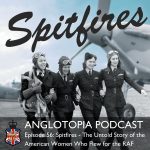
From the Anglotopia Podcast: Episode 56
During the darkest days of the Second World War, a remarkable group of American women pilots crossed the Atlantic to join Britain’s Air Transport Auxiliary. Their job was to ferry Spitfires, Hurricanes, and dozens of other warplanes across the skies of England, keeping Britain’s war machine fueled and flying. They faced mechanical failures, treacherous weather, and the ever-present risk of death. And then, when the war was over, the world simply forgot them.
Author Becky Aikman set out to fix that. Her book, Spitfires: The American Women Who Flew in the Face of Danger During World War II, brings to light one of the most extraordinary and least remembered stories of the entire war. On this episode of the Anglotopia Podcast, host Jonathan Thomas sat down with Aikman to talk about how she resurrected these forgotten aviators, the almost unbelievable lives they led, and why it took eighty years for their courage to be recognized. As Jonathan put it, the book ticks every box: World War II, airplanes, and fascinating women who refused to accept the limits placed on them.
What follows is a story of talent, ambition, and sheer nerve, told through the lives of the women who lived it, one Spitfire at a time.
A Story That Almost No One Remembered
The book began, fittingly, with a conversation between a daughter and her mother. Aikman was searching for a subject, something amazing that no one had heard about, and she mentioned as much to her mother. The answer came instantly: she should write about the American women who flew in England during the war. Aikman had never heard of them. She Googled around and could find almost nothing, and at first she wondered whether her mother had confused the story with something else.
But her mother was certain. She remembered a newsreel, or perhaps a magazine article, from her own childhood. “I thought these women were so noble and glamorous,” she told her daughter. “I wished I could do what they did.” That childhood memory had lodged itself deep, evidence that these aviators had once inspired a generation of young American girls before vanishing almost entirely from the historical record. Aikman dug deeper and confirmed that it had all really happened, and that for some reason the entire episode had been completely forgotten once the war ended.
That forgetting became one of the driving mysteries of the book. How could the first American women ever to fly military aircraft simply slip out of memory? Answering that question meant tracking down names, papers, and eyewitnesses scattered across two countries and eight decades.
Three Sentences in an Idaho Newspaper
When Aikman began, she did not know a single one of their names. Her first lead came from a man who runs a tiny museum in England devoted to the Air Transport Auxiliary, and from him the names began to trickle in. The first pilot she truly came to know was Mary Zerbel, who had been reasonably famous before the war as the youngest woman flying instructor in the United States, certified at the age of nineteen. Zerbel had donated her papers to the San Diego Air and Space Museum.
When Aikman arrived to see the files, the librarian told her that she was the only person who had ever asked for them. Her expectations were low, but the moment she opened the boxes, Zerbel came alive. There were journals, diaries, and stacks of contemporary newspaper articles. Zerbel had been famous not only for her youth but for being one of the first two American service members to marry in the war zone during the Second World War.
And then Aikman reached the end of the file and found the obituary. It ran to just three sentences in a small Idaho newspaper, and it made no mention whatsoever of Zerbel’s flying career. That contrast, a life of newsreels and headlines reduced to three anonymous lines, crystallized everything. This, Aikman decided, was a story she absolutely had to tell.
Hazel Raines and the Women Who Only Wanted to Fly
The book eventually centered on five or six main characters, but one in particular anchors it: Hazel Jane Raines, as she was known to her family. Raines grew up in Georgia in what she called a “hat and gloves kind of family,” the sort that expected her to follow the template set by her sisters, marry, keep a nice home, and go to church every Sunday. She studied music in college. But then she took up a challenge to learn to fly, and everything changed. She went on to join the Georgia Air Show, performing crazy stunts to thrill the crowds and, no doubt, to shock her relations. She wanted nothing more than to fly, and above all she wanted to fly in the military.
What united all of these women was that same pure hunger for the air. They flew for different reasons, some as instructors, some as stunt pilots, one as a crop duster, some purely for pleasure, but they all loved the sense of freedom it gave them, the feeling of control, of being in charge of their own destinies. As war loomed, they all wanted to serve, because they were skilled pilots with a genuinely valuable skill. The problem was that the United States military had decided it would permit no women to fly at all.
Then, out of the blue, a telegram arrived. It came from the famous aviatrix Jackie Cochran, inviting them to join her and cross the Atlantic to fly for Great Britain. For women locked out of the cockpit at home, it was a dream come true, and they leapt at the chance. Raines had left behind wonderful letters describing her experience, her dreams, and her life, and Aikman relied on them heavily to reconstruct her world.
147 Aircraft and a One-Page Cheat Sheet
What surprised Aikman most, aside from the forgetting, was the sheer scale of what these women were asked to do. They became the first American women to fly military aircraft, and not just one or two simple trainers. They were expected to fly up to 147 different models of airplane, everything from the tiniest single-engine trainers to the speediest, most powerful fighters and the biggest bombers.
The method was almost unthinkable by modern standards. A pilot would climb into the cockpit of an aircraft she had often never flown before, holding a single-page summary of how to fly it. She would read it over, and then she would take off. As Jonathan noted, frontline male combat pilots trained for months to master a single aircraft type, while these women had minutes. But because they were so extraordinarily skilled, they could get into almost anything and deliver it where it needed to go.
“It is mind boggling,” Aikman agreed, and in her opinion the people who did this work had to be among the most talented pilots in the world. They were not dropping bombs or engaging in dogfights, which are their own kinds of terrifying and difficult, but the flexibility to take on whatever was thrown at them, with so little preparation, was genuinely astonishing. It was, she stressed, not just trailblazing but demanding, challenging, and very dangerous work.
The Prologue: A Spitfire, a Cloud Bank, and a Thatched Roof
The book opens with a crash scene so vivid that Jonathan asked how on earth she reconstructed it. The answer reveals just how much detective work went into the project. Aikman said the crash scenes took the most work of anything in the book, with any single one drawing on perhaps thirty or forty sources. She would start with the RAF Museum’s crash records, cryptic punch cards that gave only the barest facts to an amateur eye: propeller failure, crashed, pilot deceased. From there she layered in letters and diaries, then tracked down living eyewitnesses, mostly people who had been children at the time and carried vivid, sometimes traumatic memories. Finally she consulted what she called her “kitchen cabinet” of historic aviation experts, who helped interpret what had gone wrong and why.
Crucially, she wanted to tell each story from the pilot’s point of view, not through a technical account of a failed valve, but through the human experience: what did she first notice, did she understand what had gone wrong, what were her options, how did she decide? The prologue tells the story of Hazel Jane Raines, flying a brand-new Spitfire on what looked to be a nice day.
Then everything went wrong at once. The engine failed at the exact moment she entered a cloud bank, robbing her of both power and all visibility. She tried to turn back toward an airfield she thought she could glide to, but in the blind turn the aircraft tipped too far, lost its lift, and dropped into a spin, driving toward the ground at high speed, nauseating and disorienting. Here her past saved her. Because Hazel had been an expert stunt pilot, when she finally broke out of the cloud close to the ground, she knew exactly what to do. She pulled out of the spin and leveled off just before impact, though there was no time to choose a landing spot. She hit a cottage with a thatched roof.
The three feet of straw on top of that roof cushioned the crash. The Spitfire was completely destroyed, and the townspeople rushed over, as they put it, to “dig the dead man out.” They opened the canopy, and up popped Hazel Raines, alive. The shock was total, not only that anyone had survived, but that the pilot was a woman, and an American woman at that. Aikman was even able to speak with people who knew what had been happening on the ground that day. She came to think of the work as running an “historic aviation detective agency,” triangulating what a diary said, what a report recorded, and what a child on a nearby stoop had seen.
The Real Dangers: Weather, Machinery, and No Instruments
Enemy action, it turns out, was the least of it. The real killers were the aircraft and the weather. The planes were often brand new or, in some cases, badly damaged in battle, so mechanical failures were common. And British weather could turn in an instant, conjuring cloud, rain, or snow out of a clear sky. When pilots hit low visibility, they frequently crashed into a mountain or a church steeple.
Making matters worse, they were not permitted to fly on instruments. Often the instruments had not even been installed yet, but even where they existed, the pilots were not trained to use them and were ordered not to. It was deeply controversial, because many believed lives could have been saved. The official logic was to keep pilots cautious, to make them refuse to take off unless conditions were perfect, but conditions changed mid-flight, and so over time most of Aikman’s characters began to cheat. They quietly taught themselves to use the instruments and did so against orders.
The rules could be a trap. Pilots were told that if they hit cloud, they should get underneath it, but in Britain the cloud sometimes went all the way down to the ground. Going over the top, above what they called “the concrete,” meant risking never finding a gap to descend through and eventually running out of fuel. Both choices could be deadly. Jonathan noted the cruel irony that instrument flying is one of the core skills taught for emergencies today, yet these pilots had that arm tied behind their backs. Aikman’s blunt assessment was that in war, people can be expendable. The commanders knew they would lose some pilots this way, and they were willing to accept it. The crash reports, she observed, went on and on about the condition of the aircraft and barely mentioned the pilot. Everyone understood where the priority lay.
Dorothy, Winnie, and Lives Too Wild for Fiction
What makes the book sing is the cast of characters, and Aikman kept telling herself, “You could not make this up.” The man who ran that little museum in Maidenhead had warned her not to fictionalize the story, because nothing invented could be as dramatic and glamorous as the reality. He was right.
Consider Dorothy Furey. She came from an impoverished background in New Orleans with only an eighth-grade education, though she was highly intelligent and self-educated. She was the first American woman cleared to fly military aircraft, after a test flight in Montreal, and once in Britain she treated the whole thing as a chance to reinvent herself entirely. Beautiful and imperious, she was assumed by everyone to be some sort of American aristocrat. Years after the war, newspapers still called her an American heiress. None of it was true. In reality she owned a single red party dress that she recycled again and again, yet her beauty and wit got her invited everywhere. Determined to marry well, she did exactly that, ending up a member of the British aristocracy. Because Dorothy left no diaries, Aikman reconstructed her from the endless diary entries and letters the other women wrote about her, and from Dorothy’s own son, who had grown up hearing her stories.
Then there was Winnie Pierce, perhaps the wildest of them all, a woman who lived for thrills in the air and on the ground. Early in the war she was among the first cleared to fly Hurricane fighters, admired planes that could exceed 300 miles an hour with a forty-foot wingspan. On one of her first flights the engine failed almost immediately after takeoff, the single worst moment for any pilot, too low and too slow to do anything. The standing order was to keep going straight and crash into whatever lay ahead. Only weeks earlier, one of Winnie’s classmates had faced this exact situation, crashed, and died, with Winnie serving as a pallbearer at the funeral.
Being who she was, Winnie decided instantly to ignore the rules. She attempted what pilots call the “impossible turn,” wheeling back toward the airfield under conditions that should have tipped her over and killed her. The calculations would need a computer to do properly, but Winnie did it on raw instinct and landed without a swerve. The British had rolled their eyes at her raucous behavior, but after that no one could deny she was an exceptional pilot. And the war gave her no time to celebrate: they simply handed her another aircraft and told her to deliver it.
Champagne, Claridge’s, and the Art of Compartmentalizing
How did they cope with the psychological toll, climbing back into a cockpit day after day after surviving the unsurvivable? Part of the answer was a fierce ability to compartmentalize. Aikman described a night when Winnie Pierce and another of her major characters, Anne Wood, were at Hackett’s Bar in London, drinking champagne and enjoying the best dance band of the moment. In her diary, Anne noted that a good friend had died the day before, hitting high wires and burning to death. Then, in the very next sentence, she was writing about the champagne and the band. Move on, move on, move on. It was, Aikman thought, an attitude essential to survival in wartime, because otherwise you would ruminate and become too traumatized to keep going.
The other half of the answer was that these women lived life to the fullest. Granted two leave days every two weeks, most headed straight into London’s frenetic social scene, the fanciest clubs, house parties at aristocratic country homes, rubbing shoulders with diplomats, journalists, generals, and spies. Winnie carried on many love affairs and often spent the night at Claridge’s Hotel with a mysterious man about town. War liberated these women, dropping them far from home and far from expectation, and they lived exactly as they pleased. Virginia Farr, an actual heiress connected to the Western Union fortune, had been expected to become a debutante and marry money. Instead she found flying, escaped her gilded cage, fell in love with a woman in Britain, and lived out her life that way. The war let them make their own decisions and disregard what everyone expected of them.
Two Class Systems Collide
The British women who flew these jobs often came from very upper-crust backgrounds, since they were the ones who could afford flying lessons before the war. They assumed the Americans would arrive with a similar decorum. They were in for a surprise. The first Americans crossed in separate ships, so that if one were sunk they would not all go down together, dodging German submarines for three weeks at sea. When the first five arrived, relieved and having had a few drinks while waiting for customs, they came down the gangplank noisily kissing the crew goodbye. The head of the British Women’s Unit, meeting them personally, was shocked. She invited them to dinner in a very subtle British way that the Americans entirely missed, and when they failed to show, she left that night on a train and let them find their own way to London.
First impressions were poor, and a rowdy party at the first air base did not help. It was tough at first for the Americans to win social acceptance. But a couple of more socially adept women arrived on a later ship and helped bridge the gap, and ultimately the Americans proved themselves where it counted, in the air. As Jonathan neatly summarized, all class problems can be smoothed over with good work. Many became close friends with their British colleagues. Notably, the British system was far more accepting of women pilots overall: eventually cleared to fly everything up to the largest bombers, granted equal pay partway through the war, and, in the Americans’ case, paid bonuses for having come from abroad to help. As one British woman quipped when asked how a little woman could fly such a machine: the idea is not for me to lift the plane, but for the plane to lift me.
Fierce Women, Forged in War
The women watched anxiously as the United States, spurred by British success, founded the Women Airforce Service Pilots, or WASP, to ferry aircraft at home, only to shut the program down in 1944 while the war still raged, partly out of fear that women might take aviation jobs afterward. That hostility drove Aikman’s pilots to even greater ambition, determined to fly the most difficult and impressive array of aircraft so they could not be denied when peace came.
Peace, when it came, was brutal. No airline would hire a woman pilot; the military still refused them. Yet these were fierce women who had been hardened in the war, and many found ways around the walls. One formed a company with her husband ferrying surplus military planes around the world through dicey situations with dubious aircraft, and it succeeded. This was the same woman whose obituary ran to just three sentences, and whose life was so dramatic that Lana Turner starred in a 1950s movie based on it. Another came home to a job as practically the janitor at a flying school, used the time to become the second woman in the United States certified as a commercial helicopter pilot, then went to Alaska and founded the state’s first charter helicopter company, flying to oil fields and taking tourists to the mountains. Anne Wood, the great networker who had once attended an embassy party alone and met General Eisenhower, eventually became the first woman vice president of Pan Am. These were not the personalities of people who gave up easily.
“You Don’t Fly a Spitfire, You Wear It”
Asked for her favorite warbird, Aikman deferred to the pilots and named the Spitfire, hence the book’s title. Everyone in England loved it, the plane credited with saving the country in the Battle of Britain, and there was a genuine romance to its beautiful, sleek, aerodynamic design. It was fast, powerful, and so responsive that one pilot said all you had to do was think about where you wanted to go, and it went there. Another said that the first time she flew one she felt like she’d had a kick in the pants and was suddenly at a thousand feet. Its narrow cockpit even fit a woman’s figure better, so the pilots felt it had been built for them. One of them offered the line that says it all: “You don’t fly a Spitfire, you wear it.”
Aikman, cheerfully candid about her own nerves, has never gone up in a vintage aircraft; having heard so much about them crashing, she was too terrified. But she did fly a Spitfire simulator at the Maidenhead Heritage Centre, the little museum that helped launch her research, and by her own admission performed very poorly. Jonathan, who has seen Spitfires in flight through the Battle of Britain Memorial Flight, described the unmistakable noise, that deep, throbbing roar the pilots themselves loved, an intimidating sound at odds with the plane’s feminine grace.
The Recognition They Never Sought
Did these women realize how groundbreaking their achievement was? At the time, no. When they held a reunion in the 1970s, many said, “I didn’t do it for women, I did it for me.” They had simply wanted to fly. But by then they understood that, whatever their motives, they had in fact done it for women, and that recognition, Aikman hopes, is what her book finally delivers. She sees their story as a vital part of the broader history of women’s rights, a corrective to anyone who assumes women of an earlier age were quiet, humble, and content with limited lives. These women wanted it all, ambition, freedom, and the right to live as they chose, and they succeeded, at a time when it was not even expected that a woman could do such a thing.
For Hazel, Dorothy, Winnie, and the rest, flying meant everything. It was euphoric. Hazel, as a stunt pilot, once said that when she could make a plane dance in the sky, it gave her pure joy. The sky represented freedom, challenge, and even danger, and danger was part of the thrill. They pursued it against every obstacle, and in doing so, Aikman believes, they gave the world a great deal in return. Their story, resurrected at last from three-sentence obituaries and forgotten museum files, is finally getting the recognition it always deserved.
Spitfires is available now from Bloomsbury. It is not just a gripping wartime narrative but a powerful tribute to women who dared to dream bigger and fly higher, even when the odds were stacked against them.
—
Want to hear the full conversation? Listen to Episode 56 of the Anglotopia Podcast, with Becky Aikman.


Never miss an episode
Free newsletter
New episodes, full transcripts and long-read articles on British history, travel and culture, straight to your inbox. Join 36,000+ fellow Anglophiles.
Unsubscribe anytime. We never share your email.
