
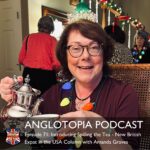
From the Anglotopia Podcast: Episode 71
Every so often a voice comes along that captures something Anglotopia has been trying to describe for years: the peculiar, funny, sometimes bewildering experience of living with one foot on each side of the Atlantic. That voice belongs to Amanda Graves, and we are thrilled to introduce her as Anglotopia’s newest columnist. A Londoner who immigrated to Massachusetts in 1985 and now calls Texas home, Amanda has spent nearly four decades watching the cultural divide between Britain and America from both sides at once, and she has decided it is high time to spill the tea about it.
Her new column, fittingly titled Spilling the Tea, will run twice monthly and cover everything from dinner party etiquette to healthcare systems to the eternal confusion over what, exactly, an Englishwoman means when she invites you round for tea. When Jonathan Thomas sat down with Amanda for Episode 71 of the Anglotopia Podcast, the conversation ranged across a remarkable life: a distinguished British commercial dynasty, a Cordon Bleu cooking course billed as a “Brides’ Course,” a mother invested with an MBE by Princess Anne at Windsor Castle, and a memorable appearance on Jeopardy! that turned Amanda into a self-described quiz nerd. It is, in short, exactly the kind of story Anglotopia loves to tell.
What makes Amanda the ideal person to write about the British-American divide is that she has never stopped noticing it. After forty years in the States, Texans still greet her with, “Is that a British accent?” while her friends back home tease her for sounding thoroughly American. She lives, quite literally, in the transatlantic in-between, and she brings to it a warmth, a sharp eye, and an insider’s understanding of both worlds. Here, then, is your introduction to Amanda Graves and the fascinating life that informs every word she is about to write for us.
A Family Built on Tea, Hotels, and Department Stores
Amanda’s story begins with two distinguished British commercial families, though as a child she had almost no idea of the empire behind her privileged upbringing. Her father’s family owned J. Lyons & Company, the vast catering and food business that, in Amanda’s youth, was still big and very well known, with a sprawling portfolio of hotels, restaurants, and products, tea chief among them. “I really didn’t have any clue that this was anything to do with my family,” she told Jonathan. “Because when you were a child, you really just don’t know these things. I just knew that we went out to eat a lot, and we would go out to eat at all these different restaurants, and I had no idea that this was actually my family restaurants.”
Her mother’s side came from Liverpool and owned Lewis’s, a huge department store with a flagship in the city and, Amanda recalls, another in Manchester. For a time the family even owned Selfridges. Amanda is careful to note that Lewis’s is not the same as John Lewis, a distinction lost on Americans and increasingly on Britons too, since Lewis’s no longer exists. Yet none of this grandeur registered when she was small. “All I knew was that we went out to eat a lot and that we had a privileged upbringing,” she said, “which also, when you’re a child, you really don’t understand until you get a bit older and realize, my goodness, how privileged I was.”
There is a lovely twist in the Lyons name itself. The family, Amanda explained, were actually the Glucksteins, and they borrowed the surname of a cousin, Joe Lyons, when they launched their new venture, uncertain how it would fare and unwilling to risk their own already-successful name on it. That gamble became one of the most recognizable brands in British life. Her cousin, a writer, chronicled the whole saga in a book she proudly held up during the interview: Legacy: One Family, a Cup of Tea, and the Company That Took On the World. Above all, Amanda absorbed one lesson from both sides of the family: that family came first. “If you were going to be in business, particularly the way our family ran it, family was the most important thing,” she said. The entire point of the enterprise was to take care of the family, and not just the immediate one but the extended clan too.
The Starbucks of Their Day
The genius of the Lyons side, Amanda said, was an entrepreneur’s gift for spotting gaps in the market that no one else had noticed, “providing people with something that they didn’t know that they wanted or needed.” Their most successful early insight concerned respectable women who came up to London to shop in the early twentieth century. There was, quite simply, nowhere suitable for them to sit down and have a cup of tea or an affordable lunch. A hotel was too expensive; a working man’s cafe was out of the question; and there was nothing in between.
Lyons filled that gap with its famous Corner Houses and tea shops. “The way I explain it is they were sort of the Starbucks of their day,” Amanda said. Just as you pop into Starbucks for a coffee and a pastry today, a lady could step into a Lyons tea shop for waitress service in surroundings that were clean and beautifully appointed, yet cheap enough to be within reach. Crucially, it was a place where a respectable woman could go on her own and have a cup of tea and a sandwich, and it would be perfectly acceptable. It was a small revolution in public life, and the family rode it to nearly a century of success.
That success did not last forever. In 1976, having overreached itself amid the energy crisis and other pressures of the era, the company was taken over. And here Amanda offers a warning to nostalgic shoppers: the Lyons tea you can still buy today is not the family’s Lyons. Made in Ireland by a company that bought the name, “that’s not actually our Lyons tea.” As for Amanda’s own cup, she is refreshingly unfussy. She drinks Yorkshire Tea, which she notes the English call “builder’s tea,” the strong black brew a workman might sip on the job. She has no time for the fancy stuff. “I don’t like flavoured teas particularly. I’m not a big fan of Earl Grey. It’s a little bit too scented for me. I just like your plain black tea.” Yorkshire, Typhoo, and PG Tips round out her rotation. Jonathan, who drinks Yorkshire in the morning for its caffeine hit, heartily approved.
Crossing the Atlantic in 1985
Amanda’s American adventure began at the University of Bristol, where she met her first husband while he was studying computer science, a field that in the late 1970s and early 1980s was brand new and full of promise. When they both graduated, he was offered a job in Massachusetts with Digital Equipment Corporation. The couple had been dating for five years and were already thinking about getting engaged, so the opportunity to start a whole new life abroad felt irresistible. “We said to everybody, we’re going to be back in a couple of years,” Amanda recalled, “and they all went, no you’re not, we know you’re not ever going to come back. And we said, no, we really are.” They really did intend to. But they settled in quickly, and the years slipped by.
Part of what made the landing so soft was the community of fellow expats they found almost immediately. Many had been recruited around the same time to work for Raytheon, the Massachusetts company known for radar technology, and the newcomers naturally gravitated toward one another. Yet Amanda offers a shrewd observation that will surely resurface in her column: the assumption that expats will automatically become best friends is often wrong. “When you do move to a new country, people assume you’re going to be best friends with your fellow expats, where you may not actually have anything in common with them,” she said. “They just assume, you’re a Brit, you’re going to get along. And that isn’t always the case.”
Life in Massachusetts lasted more than three decades, but not without upheaval. Her first husband left Digital in the mid-1990s to do contract work, and in 1998 the couple separated. Amanda faced a genuine decision: return to England, or stay? Her children were only eight and eleven, born in the States, with all their friends and their whole lives there, and their father was not going anywhere. Uprooting them felt wrong. So she stayed, and a few years later met her second husband, a Texan who happened to be living up north but who always said he did not want to remain there forever.
From New England Seasons to the Texas Heat
As her second husband approached retirement around 2008 and 2009, the couple began escaping the harsh Massachusetts winters for somewhere warmer. They bought a little condo in San Antonio and started spending a month there each winter, then gradually more. When he retired in 2017, the practical question of maintaining two houses forced a choice. “It was a big wrench,” Amanda admitted, “but we sold the Massachusetts house and we moved full-time down to San Antonio.” They bought a house on the outskirts of town and have lived there ever since.
Still, she misses New England, not the weather, but the seasons. Every fall she tries to get back up to admire the changing leaves, a spectacle San Antonio simply cannot offer. Jonathan, who spent part of his own childhood in Waco, Texas, understood completely; the four seasons are among the things a former Texan learns to miss. The exchange produced one of the interview’s most delightful moments, when Amanda pointed out that a two-hour drive means nothing to a Texan but would strike a Brit as an overnight expedition. It is exactly the sort of small cultural fault line her column will delight in mapping.
Which move was the bigger culture shock, Jonathan asked, Britain to Massachusetts, or Massachusetts to Texas? Amanda did not hesitate: Texas. Massachusetts and Texas are, she said, “very, very different,” culturally, politically, food-wise, and above all in climate. She returns to England every summer partly to escape two months of ridiculous heat, though she wryly notes that England is warming too, and without air conditioning a hot spell there can be its own kind of misery. As for how Texans see her, there is no ambiguity. They consider her a Brit. “The first thing they always say is, is that a British accent? And I’m thinking, wow, after 40 years, I suppose I do have one.”
Culture Shock and the Confidence of Americans
When Amanda arrived in 1985, she knew next to nothing about America beyond a month-long gap-year trip and a devotion to the television show Dallas, never dreaming she would one day marry a Texan. She knew almost nothing of American history either, because British schools were so busy teaching British history that American history barely came up. So moving to Massachusetts, the cradle of liberty where the Revolutionary War began, and visiting Concord, was “just absolutely mind-blowing.” What amused her most was the American sense of what counts as old. “This is incredibly old,” people would tell her, “it’s 100 years old.” Amanda, who grew up in a house 500 years old, had to recalibrate entirely. She loves the saying that captures it: “Americans think that 200 years is old, and Brits think 200 miles is far.”
Because she was only 23 and fresh out of university, Amanda embraced the adventure rather than judging it. What impressed her most was American self-confidence. In the England she had left, she said, there reigned a version of what New Zealanders call “tall poppy syndrome,” the instinct not to raise your head too high or draw attention to yourself. “Stay in your lane, don’t get ideas above your station,” is how she summarized the old British mindset. In America, by contrast, “children were told right from the get-go, you can be anything you want to be, you can do anything you want to do, and we believe in you.” It was a strikingly different way of raising people, and she found it invigorating.
Then there was the neighborliness. In England, Amanda had lived in Bristol for a year without ever meeting the neighbors; it simply would not have occurred to anyone to knock. In Massachusetts, neighbors turned up at her condo door bearing cookies and introductions, and she was, in the best way, shocked. Friendlier still, she discovered, was the South. “Particularly in Texas, Texas is very friendly,” she said. Having once thought Massachusetts the height of warmth, she found Texans warmer yet, an irony that clearly still charms her.
Food, Nigella, and the Cordon Bleu “Brides’ Course”
Given the family business, food was woven into Amanda’s identity from the start, and yes, she really is related to Nigella Lawson. The Lyons dynasty comprised two intertwined branches: the Glucksteins, Amanda’s side, and the Salmons, Nigella’s. Nigella’s father was Felix Salmon, and Amanda’s father worked in management at Lyons, running the frozen foods department in an effort to challenge Birds Eye. Amanda’s father and Nigella’s mother were close growing up, which places Nigella somewhere around a second or third cousin, though Amanda cannot pin down the exact rung. Nigella apparently attended some of Amanda’s childhood birthday parties, and Amanda was invited to Nigella’s 21st, an invitation she had to decline because she had just had her wisdom teeth out. This was all long before Nigella became famous; Amanda was 18, Nigella 21.
Amanda’s father took food seriously indeed. Even as a member of the family that owned the whole enterprise, he had been required to spend two years training in the kitchens, at the Regent Palace Hotel, so that he would understand how everything worked. He emerged from those “miserable” two years vowing never to cook again, and instead became a discerning critic, educating his children at every restaurant meal on how a dish was supposed to taste and whether the chef had got it right. The irony is that Amanda grew up knowing exactly what good food should taste like without knowing how to make any of it.
That gap was closed during her gap year, when her parents packed her off to the Cordon Bleu, which in 1980 was known, wonderfully, as the “Brides’ Course.” “You went to learn how to cook meals for your husband,” Amanda laughed, recalling that she had only just turned 18. She learned everything “from how to boil an egg to how to bone a duck,” and, more importantly, discovered a genuine love of cooking, the shopping, the technique, the journey to a finished dish. By university she was throwing dinner parties for the fun of it, always, she says, in the shadow of the giant family business, forever measuring her own efforts against what her ancestors had accomplished.
Boarding School, Fruitcake, and the Dinner Party Divide
Boarding school was simply expected in Amanda’s family. Both parents had gone; her father to Harrow, her mother to a spartan school called the Downs near Brighton, where the girls seemingly swam in the sea most days regardless of weather. Amanda went to Queenswood in Hertfordshire, an all-girls school of about 400, roughly a third of whose pupils had parents living or working abroad and would not see them for three months at a stretch. When she arrived in 1972, there were 12 girls to a dormitory, a bed, a mat, and a small chest of drawers, and a routine as rigid as the military: up at seven, breakfast promptly at 7:40 to the ring of a ship’s bell, chapel every morning, and, of course, tea breaks morning and afternoon, with four o’clock afternoon tea observed without fail.
Amanda, being the eldest and naturally independent, took to it well; she was always happy reading a book or practicing the piano. Her younger sister, who followed a year later, hated it, and Amanda is honest that boarding school suits some temperaments and not others. She does not paint it in a completely rosy light, but she made her own fun and holds genuinely good memories, “more than some of my friends can say.” She notes the American horror at the whole idea, recalling her father’s account of an American visitor to Harrow who told the guide, “If you had to send your child here, you’d cry your eyes out.” In England, Amanda points out, boarding school is elite rather than a punishment, quite unlike the American image of a military-style last resort. Jonathan, who has more than once deployed the “military school” threat to his own children, appreciated the distinction.
The essay that first sold Jonathan on Amanda as a columnist was about fruitcake, and it is a perfect specimen of the cultural collision she does so well. In England, fruitcake is a delicacy: a dense, booze-rich cake preserved by all that alcohol, wrapped in marzipan and hard icing, traditionally served as the wedding cake and again, snowman on top, at Christmas. So when Amanda and her mother, hearing raves about an incredible Texas fruitcake, ordered one, they were baffled by how underwhelming it was. The revelation followed: Americans loathe fruitcake because the only fruitcake they know is the dry, sugary, alcohol-free kind, not the boozy delicacy that takes three months to mature before baking. Her Texan husband, loyal to the local product from the Collins Street Bakery in Waco, was horrified to hear her call it terrible. Amanda even talked her way into a sample at the bakery, spinning a tale about being a British ex who had come all the way from England, “which was a big lie,” to taste a cake she had not had since she was 14. It was, she confirmed, just as bad as she remembered. Her advice to Americans: seek out a proper British fruitcake at a World Market and taste the difference.
Then there is the great dinner party versus potluck divide, another rich seam. Arriving in 1980s America fresh from her Cordon Bleu training and eager to host, Amanda was mystified when guests insisted on bringing a dish even after she told them not to. “I’m planning the meal, I’m planning the menu,” she would protest, only for them to arrive with a casserole anyway, leaving her to wonder whether to serve it. She learned to channel the impulse by requesting a salad or a bottle of wine, though it always felt wrong to ask. In Texas she found a circle of friends who mostly do not cook at all and who eventually declared, en masse, that they would simply do potluck from now on. Amanda has made her peace with it, recognizing the American love of sharing and inclusion, even as she sometimes misses being able to say, “just bring yourselves and I will take care of everything.” She notes, too, a telling architectural shift: more and more American houses are sold with dining rooms repurposed as living rooms, or without dining rooms at all, because people no longer entertain the way they used to. Amanda’s own mother, in her 500-year-old house, swears by the double doors between kitchen and dining room, the ones that hide any dropped dish from the guests. Some things, as Jonathan agreed, are better left hidden.
Tea, Terminology, and the Confusion Americans Can Be Forgiven
If any subject is central to a column called Spilling the Tea, it is tea itself, and Amanda is generous about American confusion over it. The problem, she insists, is not some lingering echo of the Boston Tea Party but simply the word. “The name tea is confusing because it can mean so many different things.” A cup of tea is self-explanatory. But “let’s go for tea” depends entirely on where in Britain you are. In the North, it can mean the evening meal, or supper. Come in from an early shift and eat at 5:30 or 6, and that meal is “tea,” or in certain parts, “high tea.”
Class complicates it further. If an upper-class person says they are “having tea,” they mean afternoon tea, served around four o’clock, never the evening meal. Amanda’s practical advice is to ask the time: tea at four means afternoon tea and its dainties; tea at six means the evening meal. What genuinely annoys her is the American menu that advertises “high tea at four o’clock,” because high tea is emphatically not what is being served. “It doesn’t mean I’m going to be having beans on toast,” she says. “It means they’re going to be serving afternoon tea.” It is precisely the sort of small, sharp correction her readers can expect, delivered with a smile rather than a scold.
Windsor Castle, Princess Anne, and a Very Bossy Mother
Two years before this conversation, Amanda’s mother was invested with an MBE, Member of the British Empire, for decades of work with local charities, above all the North London Hospice, which began in 1989 with a small group of local women fundraising and where she now serves as patron and president. The nomination came about through a secret letter-writing campaign led by her friends and Amanda’s late father, gathering testimonials to petition the palace, all without her knowledge, until the palace called to say congratulations and that there would be an investiture at Windsor Castle.
Amanda flew over specially from Texas. Her mother was allowed just three guests, so the three grown children attended; their father had died during the pandemic. Windsor closes to the public on investiture days, and the family did not know which royal would present the honor. They were briefed by the Lord Chamberlain on the choreography, how to curtsy, how to bow, never to turn your back on the royals, and watched as a magnetic band was fixed to the recipient’s dress so the medal could be attached without pinning. The royal turned out to be Princess Anne, and she left an indelible impression. With around 60 people receiving honors that day, she asked Amanda’s mother about something she had done back in the 1970s, so obscure that her mother had forgotten it herself. The princess had clearly read up meticulously on every recipient. Then she asked how her mother had managed to get everything done, and the reply, “by being very bossy,” set Princess Anne laughing, a moment captured on the official video the family was sent. Standing in that gold room, surrounded by masterpieces on the walls, Amanda felt overwhelmingly proud. Her mother, she says simply, absolutely deserved it.
Jeopardy!, Alex Trebek, and Becoming a Quiz Nerd
The final surprise of Amanda’s life is one she never saw coming. A lifelong reader, she first encountered Jeopardy! in her earliest American days, marooned in a Holiday Inn without a green card or work permit, watching Wheel of Fortune and Jeopardy! back to back. Once her children came along, the family watched it nightly over dinner at 7:30, and the kids kept telling her she should try out. She resisted for years before finally taking the plunge, and the odds were daunting: an annual online test taken by some 250,000 people, no feedback, no answers, just a fast quiz and, if you did well enough, an email inviting perhaps 3,000 people nationwide to audition. Amanda reached the audition stage three times before finally making the show, which takes only around 400 contestants a year, an acceptance rate she looked up and found to be 0.2 percent.
She did not win, and admits it was “a little heartbreaking,” but the experience was surreal and wonderful. “When you’ve been trying to do something for so long, and suddenly you’re actually on that stage and Alex Trebek is walking on, and you’re going, I’m actually here.” More than the game itself, the show opened the door to a whole subculture she had not known existed. Through it she joined a quizzing network, plays pub trivia every week, competes in online quiz leagues and the daily LearnedLeague, and has attended two trivia conventions. “I am now a quiz nerd and proud of it,” she declared, grateful to the community that took her in.
A New Voice for Anglotopia
What emerges from this conversation is a portrait of exactly the columnist Anglotopia has been hoping to find: someone who has genuinely lived on both sides of the Atlantic, as an insider in each, and who notices the differences with affection rather than complaint. From the confusion over fruitcake to the fine gradations of what “tea” means, from dinner parties to boarding schools to the self-confidence Americans instill in their children, Amanda sees the culture clash clearly precisely because she belongs to both cultures and, in some sense, to neither. Her accent, as Jonathan noted, has flattened into a transatlantic middle, much like that of her friend and fellow columnist in the English-speaking world, Tony Harkus, whom Amanda knew at university and through whom she came to know Anglotopia.
Starting now, Amanda will write twice monthly, offering the kind of observations that can only come from someone who has navigated both worlds for forty years. Expect dinner party etiquette and healthcare, college sports and the proper meaning of high tea, all served with warmth, wit, and the occasional bit of family gossip about a certain famous cousin. Welcome aboard, Amanda. We cannot wait to read what you spill next.
—
Want to hear the full conversation? Listen to Episode 71 of the Anglotopia Podcast, with Amanda Graves.


Never miss an episode
Free newsletter
New episodes, full transcripts and long-read articles on British history, travel and culture, straight to your inbox. Join 36,000+ fellow Anglophiles.
Unsubscribe anytime. We never share your email.


