

This transcript was generated automatically from the episode audio, so expect the odd misheard word. Click any timestamp to play from that moment; times marked ≈ are estimated to within a minute or so.
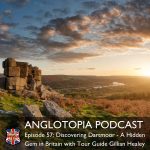
Welcome to the Anglotopia podcast where we explore British history, travel and culture. I'm your host, Jonathan Thomas. And today I'm thrilled to be joined by expert guide, Gillian Healey who helps visitors discover one of Britain's most fascinating landscapes, Dartmoor National Park in Devon.
My guest came to Devon 20 years ago after spending time hiking around the Andes, the Himalayas and Patagonia. And now as a qualified Hill and Moorland leader, she spends her time exploring each of Dartmoor's unique 368 square miles, sharing its rich history, myths, legends, and natural beauty with visitors from around the world. Through her personalized walking tours, she offers experiences tailored to different interests and fitness levels. Whether you're fascinated by the 4,000 years of history on the Moor, the diverse wildlife,
or the literary connections to works like The Hound of the Baskervilles by Sir Arthur Kernan Doyle. Today, we're gonna talk about her journey to becoming a Dartmoor guide, her favorite routes, the unique perspective walking tours provide, and why Americans should put this ancient landscape on their travel bucket list. Welcome to the Anglotopia Podcast, Gillian
Yeah, thanks for coming on the podcast. really appreciate it. Alright, well, let's dive right into the questions. ⁓ So please introduce yourself to the Anglotopia listeners. How did you end up as a walking tour guide in Devon?
It was a little bit by accident, but a little bit by fate as well. I ended up kind of loving the outdoors. I've always loved hiking, walking, traveling. I've loved out more on the Southwest Coast Path as well. I've been walking that for the last 20 years. And several years ago, I got into...
planning walks to take my friends up on Dartmoor and I used to kind plan the routes and look at the weather and I used to go up and take them up and one day several years ago I was up there and the notorious Dartmoor mist came down and I was with my friends and we
We kind of got a bit lost, I have to say. And they all looked to me to say, Gillian which way? And I turned around and said, I have no idea. So at that point, I just thought, you know, I love Dartmoor, but I really, if people are looking to me to get them out in and out of Dartmoor safely, I need to gain some qualifications or experience, navigational training. And that really led me into, you know, doing my Hill and Moorland leader qualification.
So it started off really just to get those skills to feel confident and safe with myself taking friends out. But also that just really expanded to people saying, you know, I've got some people who want to go on Datmah and they're willing to pay for you. So I was like, my gosh, this is a win-win situation. And it just snowballed from there really. And I really found that I just had this real passion to share with my clients and people. And so from then on, it's just, yeah.
Sounds amazing. So your website mentions you spent time hiking around the Andes to Himalayas and Patagonia before you settled in Devon. How did those international experiences help shape your approach to guiding tours on Dartmoor? And what made you decide to make Dartmoor your home after seeing all those mountains? Yeah.
Hmm.
Go, go,
It's true isn't it?
How can you go from there? Well yeah I spent two years in Latin America and I love mountains, I love the fact that you've just got this this kind of huge skies and wilderness and yeah, down more you know it hasn't got the mountains but it's still got that wilderness to it. I spent quite a lot of time in Ecuador near Cotopaxi National Park if your viewers know that, that's just on the Andes and
While I was staying there, I was asked to guide groups to help them acclimatize, acclimatize to the high altitude of the environment, basically. And the challenge was to guide them on a height that was gradual, allowing their bodies to adjust to the thin air and just support them as well and look after them, make sure they're okay. And that for me was a bit of a start off. I really, really enjoy this. I really enjoy getting people outdoors, making sure they're safe and...
and just to have fun as well. And I just kind of forgot about that. So when I came back to, I live in Totnes in Devon now, ⁓ which is kind of, I would say I describe it as a smaller version of Glastonbury. It's a cool version of Glastonbury that's between the seas and the moor. And Doubtmoor just drew me there, I think, just again, just being high up and in that wilderness. And I think...
The experience in Ecuador, just reinforced my love for guiding, connecting people to the landscapes and whether it's dramatic heights or the Andes or the wild expanse of the dark wall, I think for me it's one of the same.
So you're a Hill and Moorland leader, outdoor first aider, and mental health first aider. What do all those acronyms mean? And why are they important for somebody booking an experience with you?
Yes.
Yeah,
good question. Okay, so the Hill and Moorland qualification, that basically just says that I am trained and I'm assessed to lead groups. So, in safely in upland terrain like Datmoor, know, Datmoor's climate can change in a moment from clear, beautiful blue skies that we've got at the moment to the infamous mists that come down that inspire the novels and the poetry and the songs. And you can literally
not see the person beside you, you know, it just sends and it's incredibly disorientating. And it just means that I've got the skills to able to navigate in those kind of conditions of poor visibility and respond to any emergency that could arise. Outdoor first aid, I mean, that just basically means that I'm trained to provide emergency medical care in remote.
locations and if somebody gets injured or falls ill ⁓ I just know how to respond and look after them until we can get professional help out on the moors. ⁓ And the mental health first aid, well I mean this is is coming into its own really and it's a qualification that allows me to spot the signs of mental distress I would say ⁓ and being outdoors can bring up a lot emotionally.
And I'm just, you know, it just allows me to listen to them and respond appropriately and just guides, you know, that person towards further help if needed.
Sounds like you're the right person to get lost in the Moors with. So ⁓ now for those who aren't familiar with Dartmoor, it's this 368 square mile area in Devon. Can you describe it for our listeners? What is there? What is there to see and do?
Gosh, good question. mean, Delmore is so varied depending on where you go and what time of year you choose to visit. I think, you you can expect sweeping moorlands views, dramatic granite tours, which Delmore is really famous for. But you can also just further down, just swim it in ⁓ natural pools, which are kind of surrounded by beautiful ancient oaks as well. ⁓
or we can just watch the world ponies, the Doutmore ponies, which again, I kind of wonder the Doutmores, the hills on Doutmore. And yeah, I think for me, Doutmore isn't just about the nature and the views, it's also a living layered landscape, I would say, where you can walk amongst.
Bronze Age villages and medieval farmsteads and Victorian quarries and you can come across standing stones that are older than Stonehenge and ancient clapper bridges that are still in use today and I think you know the fact that these things aren't fenced off or in museums or behind barriers you know you can walk into Bronze Age roundhouses and really kind of you know get that connection.
with the history and the solitude as well. And for me, Damlo just a chance to slow down and experience that feeling of getting away from it all as well.
So many Americans may be unfamiliar with all of this. know, Dartmoor isn't exactly on our tourist trail where Americans usually tend to go, which is London and the Cotswolds and maybe Yorkshire if they're feeling adventurous. ⁓ Now, so give me a sales pitch for Americans why they should come visit Dartmoor.
Yeah, great quote. I've been thinking about this. I mean, so much, but I think I would start by your viewers just to imagine hiking through vast open moorland where you've got wild ponies roaming free and you can climb up ancient granite tours for huge panoramic views while stumbling across bronze age stone circles which are older than the pyramids. ⁓ You know, there are no crowds.
there. They're just space, stories and sky. And it's a place where the landscape hasn't just been seen, but it's just been lived in for over 4000 years. ⁓ Yeah, so and it's just, it's raw and it's untouched. And it's just a deep sense of history as you actually walk through the landscape, I would say.
All right, well, you've sold me. So you've done a good job. So one part of your answer there, mentioned the word Moorland several times. What does Moorland mean for, because we don't really have an equivalent here. I'm...
Hmm. ⁓ that's us.
Yeah,
that's true, isn't it? I mean, you we do have areas of moorland ⁓ all over the UK. We've obviously got the Peak District and the Oxford Ales and obviously Dalmore. mean, moorland is kind of categorized by, you know, an open space that was actually once populated by trees until humans came along and decided to use those trees for their own
purpose of living basically. So moorlands, yeah exactly, moorlands kind of you you've got you know just wide open spaces of grass and bracken, you tend to get grazing on the moorland as well so you tend to see what you'll see in a moorland you tend to see sheep and cows and obviously doubtmoor you've got the doubtmoor ponies so yeah moorlands definitely a specific kind of landscape.
very similar to our prairie landscape except wetter. ⁓
absolutely,
So ⁓ your website emphasizes personalized experiences tailored to visitors' interests and fitness levels. Can you share a memorable example of how you've customized a tour for a particular client that showcased Dart more in a special way?
Yeah, sure. Yeah, I mean, I really believe from my experience that you should truly get the most out of your time on Dantmore. I always recommend doing a bespoke itinerary rather than a ⁓ tailored ⁓ one fits all kind of route. I think this year, a good example, I recently welcomed back a couple from Colorado for their second visit. Their husband had ancestral roots here.
which I believe a lot of Americans come over to the UK to explore. And his ⁓ forebears were Dartmoor tinners, which was fascinating. So we set out to explore areas that still, you know, were still etched with the scars of post-medieval tin mining, which you get all over Dartmoor. ⁓ And they were also fascinated by the prehistory. So we kind of woven.
ancient stone rows and bronze age settlements in that walk as well. you know, we had a full day, had a full day with them. And it was, it was fantastic. It was a journey through their own personal history and human history laid onto the moor itself. So yeah, you know, it was, yeah, you know, for me, I get so much more out of those walks as well, because I see, I see them really connecting with, with that history of their own.
family histories.
Sounds really interesting. Yeah, I didn't realize that Devon was known for the 10 mining. I thought that was a Cornish thing. So ⁓ how do you decide which areas to showcase on your tours? And do you have any personal favorite routes or locations you believe capture the essence of Dartmoor? And I realize that's two questions.
that's fine. That's fine. It's greedy, greedy, but I'll go with it. So after a discussion, either by email or telephone with the client or WhatsApp, their preferences, can then plan a route. So I've got two personal favorite routes. One is around Hound Tour and Hay Tour. And that just really covers a lot of features of Dartmoor in such a really small area.
⁓ So if a client only has half a day, they can see a lot within that walk. So we've got Bronze Age, we've got granite mining, flora fauna, stunning views. We've even got a medieval village and the Daltmore ponies tend to hang out quite a bit there as well. It is a honeypot of Daltmore, which means it attracts a lot of visitors, but it is a honeypot for a good reason.
So that is one of my favorite places. And another favorite walk is towards the west of Dartmoor, which is just beyond Princedale. And that walk ⁓ covers one of the finest Bronze Age sites on Dartmoor, which has got three stone rows, a stone circle, standing stones, and a number of cairns and kists, which is a Bronze Age burial chamber.
and it also covers some of the largest quarries on Dartmoor as well. So we re-delve into the history of industrialisation on Dartmoor and what that meant for Dartmoor and the wider area as well. yeah, that's definitely an area to cover. And the thing about that area as well around Prinztown, it has actually got a real American connection.
because the quarries were actually used to build Dantmoor Prison ⁓ in 1806 and it's ⁓ widely known for housing UK criminals and prisoners of war and which included the American prisoners during the world, sorry, the war of 1812. So there is a connection there and we still get a lot of Americans coming over to Dantmoor, to Princedown.
Interesting ⁓
specifically to really trace their ancestors who were either imprisoned in the the Dartmoor prison or they sadly died during an event there that happened called the Dartmoor massacre where some Americans were tragically shot during a protest. So there is, there's actually an American graveyard as well that you can with permission from the prison you can go and visit. So again that's another little
general walk I tend to cover.
not to ruin your tours, but you can't drop that one. What's the... Tell us about this massacre. What was the context around?
yeah. Well, was, yeah, was one of the, unfortunately, one of the darkest moments that came after the war had officially ended, really. So due to the delays in communications, the British authorities were slow to release the American prisoners and the tensions started to rise, of course. And on April the 6th, 1815, a protest inside the prison turned deadly when the British guards opened fire. So they ended up killing some American
prisoners and injuring over 30 others. ⁓ yeah, so memorials, you can find them ⁓ inside the church as well, which is just across the road from the prison, which was partly built by Americans and partly built by French prisoners from the ⁓ war with Napoleon. So there's a lot of history going on.
I I, you know, I pride myself on knowing a lot about British history for an American. I had no idea that this happened. So, ⁓ you, you've educated me. I'm, I'm thrilled to, I'm thrilled to learn something new. ⁓ and speaking of learning, ⁓ something. So you've mentioned the Dartmoor ponies several times. I know about the Dartmoor ponies. I've, I've watched country file ad nauseam in my years of anglophilias, but can you explain what the Dartmoor ponies are and why they're special?
Mmm good question. I mean technically the ponies out and wild I would say even though they are just roaming they look wild because they're out there roaming and roaming. Yeah exactly so yeah but I mean they look beautiful so ⁓ that's really important for us but they are some of them are owned they are really looked after by the Dapmoor
Pony Trust who do a fantastic job of just making sure they're okay. ⁓ If there are any ponies that are in trouble, they will come look after them. They also are responsible for managing the numbers on Dartmoor, I would say, because we don't want too many ponies to unbalance the balance on Dartmoor really. they do every year, they do two or three roundups where they're counted and
some of the ponies are taking off that more and you can buy one. So they go to market. I think the going rate, don't get me wrong, is about 50 pounds, which, you know, it is, it is. So, you know, so anybody with a spare bit of lamb or paddock, you know, they can, they can just take them and look after them. so yeah, but they are, yeah, they're amazing site and, and you get different kind of,
species of downmour pony as well. Some of them look really shaggy, they look like they've got like a little teddy bear coat on, they're really thick coats and then some have been bred with more like traditional horses as well. If our viewers have been watching War Horse, Steven Spielberg's War Horse, that's an interesting film that I recommend, that was filmed on downmour and that goes into the history of using the downmour ponies for during the wars.
and also industrialisation as well. But there's evidence that they've been on the moors for a long time.
Wow, yeah, hundreds of years, right? Or at least maybe even longer. Yeah.
Here we have deer wandering around there. They've got horses wandering around.
see them.
⁓ So you clearly you cover many numerous topics on these walks that you plan from history and archaeology to wildlife and legends and how do you prepare for these tours to ensure you can provide the most information? you do hours of research in the library or Wikipedia or what?
Yeah, mean the first thing I do is preparation is key, isn't it like anything really. So it's all about ensuring that every detail is there and I can focus on the experience of the stories I'm sharing. So first of all, for every walk I do a recce. So I have to do a recce walk of the route and that's to make sure that the route is still safe and it's accessible and it's appropriate for the group I'm taking out.
⁓ This includes checking the condition of the paths, assessing river crossings, sometimes we've got to cross rivers and after heavy rain we may not be able to or it's not safe to. And yeah, just kind plan for any alternative routes in case of unexpected changes which Doutmore is very famous for, such as the weather really. So yeah, so once I've done that and I'm confident with the route,
I can just shift my focus then to the content of the walk itself. So, many of the stories and the historical facts about Dormer are well established, there is a continuously updating of my knowledge, things like the latest archaeological digs. Currently, there was a Bronze Age Kist, which is a burial chamber, that was discovered last year.
currently excavating that and we're finding out new information about the Bronze Age people, which is really exciting because really we don't know that much about Bronze Age people. you know, this is exciting. So anything that I find out from that I can pass on. And also things like rewilding projects, lots of things happening on Datmoor at the moment, you know, conversations about how to restore ecosystems, ongoing debates.
Land access ⁓ is a big thing on Dartmoor at the moment. so yeah, so it really is just kind of updating my knowledge on what's happening politically on Dartmoor because it's such an important part of the whole story.
Well, that's a great segue into my next question is, in addition to discussing the past, you like to discuss the present as well. So what are these conservation issues and challenges that Dartmoor faces that visitors should kind of be aware of?
Great, okay. So yeah, I think this is one of my passions of Dartmoor really, about how to communicate and have those conversations. Because it's not just about Dartmoor. I think for me, it's having the conversation about what's happening in the country of the visitor as well. What are you doing? What's happening in your country and how we can learn from each other than that really. So, the biggest things really, I would say,
rewilding of Dartmoor, the ecosystem's restoration, would say. Things like More Trees, MWR Trees, they're a fantastic charity who have planted over thousands of trees now in Dartmoor, and are doing some great work on Dartmoor. You've got things like the Southwest Peatland Restoration Projects.
where the peat on Doutmau has been really severely degraded over thousands of years and they are trying to restore the peatland to avoid flooding basically further down and also to create habitats for just habitats for animals and plants as well. things like big debates at the moment about swaling, I don't know if that's a term that's used in the state, swaling, control burning.
okay. Yeah, we do that. We do that. Yeah.
yeah, yeah, so big, we've just had a big wildfire here actually about a week ago. So there's lots of debate whether swilling would have helped that or it's increased. yeah, lots of talk. Sheep grazing is a really, really big thing. know, farming has been on that more for thousands of years, but there's now a debate about, you know, the amount of sheep and how that affects that more. So yeah, lots of
lots of things to be addressed and the exciting thing is, I one of the biggest landowners on Dattmore is the Duchy of Cornwall.
⁓ okay. yeah, yes. Usually, right. Well, yeah, Charles and now William, they both care very much about the landscape.
Well, this is
it. know, I think since Charles obviously became king, he's had to be a bit, you know, take a step back. But I think Prince William has taken that mantle and they are coming up with lots of ideas of how to really encourage restoration on their land. So, you know, that's really exciting for us really.
Yeah, so I was gonna ask now, so who owns Dartmoor? Like, you know, like the new forest is like has a weird ownership thing with common rights and like so who owns this 368 square mile area? Is it a park? Is it an authority? Is it the duchy or is it a mix of all these?
Yeah,
yeah, great question. And this is one of my passions, I have to say. This is one. And basically, so I start with a question to my clients is, who owns your national parks? And they look at me saying, wow, it's a state, of course. And I'm like, okay. So really different here is everything you say is privately owned. And they're saying, yes, but it's a national park.
Well, we do.
Yeah.
How can it be privately owned? then I kind of delve into our history of 1066. William the Conqueror comes in, conquers and divides upon our land and creates his private states, leading to the enclosure movements, leading to what we still have today, which is only accessed to 8 % of our land, which is quite a shocking statistic really.
So it's a real passion for me to really let people understand how land ownership works in the UK. The biggest landowner on Dartmoor obviously is the Duchy of Cornwall with a mix of lots of different landowners. I am currently part of a campaign called The Right to Rome and the Stars are for Everyone which is really fighting hard to keep access. ⁓
to Dartmoorland because we are losing access.
yeah. I find this stuff really interesting and it's kind of into the weeds. like, now, are there ample public footpaths across Darmor? Because obviously that's where you work. So there's got to be a network of public rights of way, but are they being restricted in some way?
Mmm.
Yeah, mean, yeah, I mean, we have, we do have a fantastic network of footpaths that is, that is the joy of being in the UK. But again, we had to fight for those, you know, that came from ⁓ the Kindertresspaths and, you know, we've really had to fight for those paths and we still have to fight for those paths, you know, we can report paths being closed, but we do have a network of paths.
Yeah, the trespass, yeah.
on Dartmoor, but we also have an open, if you look at the OS map, there's like a yellowish color and that means on the map that it's open access that we should have open access. we're finding on Dartmoor that micro enclosures are happening. little farms going up here or little fences going up here. this is, before we know it, we've got big swathes of Dartmoor that suddenly starting to close up. So yeah.
So it's something that I'm very very passionate about but we don't lose that because if COVID taught us anything it is we need access to outdoor space for everything, just to survive. ⁓
Yeah, and that's one of the things I love about Britain is you say only 8 % of the landscape is open, but that is way more of the landscape than is open here. And even where I live in a rural area, I live in between two towns. I'm surrounded by farmland, but I cannot walk on any of it. It's open, it's beautiful. There's plenty of places that a person could walk, but I can't walk on any of it because...
Yes.
I know. Yeah.
I would be trespassing and in this country everybody owns a gun, especially farmers. And especially during hunting season. Yeah, I gotta wear high vis and orange and that's the...
You don't put your deer outfit on. Yeah. So it's really interesting
because this is what I hear a lot from Americans going, well, you're so lucky because, you know, we can't do this in our country. ⁓ yeah, it's, I find that very, very difficult to go, gosh, you know, but, but I think that, I think we are as Britons, we're very good at fighting. You know, we've had this...
⁓ system of serf and peasants on their aristocracy for a long time and you know we do rise up to reclaim those rights I the Ramblers are very good at kind of keeping those paths open and if we're not careful we will end up like a system where we can't access anything I don't know if you know but Dartmoor is the last place
No.
in England and Wales, that you can actually legally wild camp. yeah, but we are losing that ⁓ slowly because of one particular landowner who is challenging that right in the High Court. now the Supreme Court. So we're fighting that because it's incredibly important that we maintain those rights.
Hopefully not the dutchie.
Oh, good luck in the fight there. So, well, so we've kind of touched on this a little bit. So for American visitors who might be used to our vast national parks, which are really our only open public spaces that are owned by the people, what are some more unique aspects of Dartmoor that you would like to highlight that offer a distinctly different experience in going to a national park? Is it rougher, is it wilder, is it, you know?
Hmm.
Is there more history than there would be, let's say, in Yosemite National Park or Yellowstone National Park?
Mmm, mmm, I love Yosemite, it is an amazing place. But you're right, think Dartmoor just offer, it isn't just a national park, it's a wall through time, I would say. And you're really experienced, like I said before, it's not like a stonehenge where you can't, you just step back from it and you can see it, you can touch it, you can feel it, you can ask permission to go inside.
a beautiful roundhouse or a stone circle and sit there and watch the sunset. So I think for me that's one of the things that Dartmoor has that a lot of national parks, even in England don't have. And it's just this plethora of ⁓ history everywhere that you can see that you won't experience anywhere else.
So on that note, many Americans are fascinated by English deep history. That's kind of what attracts us to it, because the joke is that America has no history. We've got 250 years of history, and that's it. It's not true, but that's the perception. So how do you help American visitors connect with Dartmoor's 4,000 years of human history in ways that makes it tangible for during a day's walk?
No, great question. Yeah, definitely, mean, every walk that I do, I definitely make sure that we there is some Bronze Age on the way, because I think that for me is a real fundamental part of Dartmoor. ⁓ Dartmoor was once heavily populated during the Bronze Age, it was quite heavily forested as well. So yeah, there's lots to see in regards to that.
We don't just look at the sites. think I would say, you know, we pause at the sites and we try and imagine the people who built them. I think that's a really important thing, that, you know, the lives they led, the hardships they would have felt and how the landscapes would have shaped their survival as such. And I often bring stories and maps or even short readings as a background to that as well.
just talk about how the landscape holds memory, I would say. ⁓ And yeah, just how the landscapes have just been so sacred grounds to generations before us as well.
So the perception of Dartmoor has been heavily influenced by literature and many Americans, ⁓ Anglophiles would be familiar with it from the Hound or the Baskervilles. So what are some other cultural influences and connections that international visitors might be interested in?
Mmm, yeah, gosh, yes, Arthur Conan Doyle, yeah, he loved Dartmoor. yeah, inspired to write, I mean, he kind of was inspired to write Hand of the Bascuals after hearing about the myths and the legends of Dartmoor. I would say the brooding atmosphere of Dartmoor is central to the story.
And I must admit, sometimes when I take visitors up during a beautiful sunny day, it's really difficult for them to imagine this kind of misty, brooding, eerie, desolate in Moorland, because it's so beautiful on a sunny day. yeah, we're trying to incorporate as many of those kind of myths and try and get the imagination going on those myths and legends.
Right.
Yeah we try and make connections with especially with Hand of the Baskervilles. Arthur Curnandall used quite a lot of the landscape, there's those points of the landscapes which are in the book. So the Great Grimpen Mire is actually based on Foxtor Myers which is a huge big area of Mire that's very very difficult to cross and if you were to misstep you could end up you know...
like the bad guy and handed the basketballs up to your neck. And the Dutchie Hotel in Prinztown is where Sir Arthur Clonidour used to stay as well. So there's all those connections that you can get with the... there's also kind of things like Doutmore's used for quite a lot of film locations. So Doctor Who is quite a well-known one. And I think recently we saw them...
filming witches of Netflix. So you know there's quite a lot of film locations because it is kind of seen as a bit of an outy, outerworldly kind of landscape that you can imagine another planet being.
Alright, well so for my final question, ⁓ walking tours offer a unique way to experience a landscape compared to driving through it or other forms of tourism. what do you believe visitors take away from a guided walking experience on Dartmoor that they couldn't get any other way?
Hmm.
mmm yeah I'm really passionate about this because I sometimes see people just driving around and going ⁓ you know when you're on foot you really feel the contours of the land you feel the soft peat beneath your feet and that peat is from thousands and thousands of years of degraded trees and flora and
And just you hear the silence between the wind and the birdsong of the skylarks and you notice the detail that are just invisible from the car window. So often I take out little microscopes that we can explore the moss, know, the Dantmore moss, the Dantmore's famous one. We can just have a look through those little magnifying glasses, you know, the lichens, this kind of bright yellow, ancient.
liking on ancient stones and the shape of a Bronze Age hut circle and just the shifting light across the moor as you're walking through it as well. for me it is about, know, it's connecting not just with the place but with the time and the culture and the nature as well. So yeah, get out of your car, get your walking boots on, go for it.
Well, I suddenly feel really guilty for the two times I've driven through Dartmoor and didn't stop because I was on the way to somewhere else. you have sold me on that I need to come back immediately and explore it properly. So I will be giving you a call.
Absolutely, absolutely.
Excellent,
excellent, to it.
So, well, thank you so much for appearing on Anglotopia podcast, Gillian. Check out Gillian's website. The link will be in the show notes. ⁓ If you are going to go to the West country, look her up and have her book a plan, a route for you. I don't think you'll regret it. So if you enjoy the Anglotopia podcast, please like us, subscribe, or join the friends of Anglotopia club to support great long form writing about Britain until next time. I'm Jonathan Thomas. And thank you for listening to the Anglotopia podcast. Thank you, Gillian.
