
This transcript was generated automatically from the episode audio, so expect the odd misheard word. Click any timestamp to play from that moment; times marked ≈ are estimated to within a minute or so.
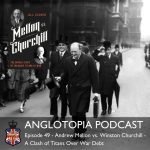
Welcome to the Anglotopia podcast, where we explore British history, travel, and culture. This week, we're going to do something a little different and explore the history around the period when American and British diplomatic relations were evolving in the aftermath of World War I. I'm your host, Jonathan Thomas, and today I'm joined by Jill Eicher, author of Mellon vs. Churchill, the Collision of American Money and British Power. In this fascinating new work, Eicher uncovers the largely forgotten rivalry between two financial titans, American Treasury Secretary Andrew Mellon and British Chancellor of the Exchequer Winston Churchill, as they battle over war debt repayments in the 1920s. We'll explore how their clash over billions and international debt influenced Anglo-American relations, examine the fundamental differences and how each nation viewed financial obligations incurred during the war, and discuss how their personal ambitions shaped post-war economic policy.
Her detailed research offers fresh insights into these two powerful men whose dispute over money strained the special relationship between Britain and America at a critical moment in history before World War II. Welcome, Jill.
Thank you for being on the podcast. So when we do Churchill interviews, I like to start with, what's your Churchill story? How did you end up writing in the Churchillian world?
Mine is perhaps a different story than many of your other guests. I did not find Churchill. Rather, I think he found me. I was doing research in a completely different world when I came upon one paragraph mention in the New York Times that Churchill had hosted a dinner at the Ritz in London for Andrew Mellon in 1926. And that, that those few sentences just grabbed my imagination. And that's what started it all.
That's, that's a great way to, it's always those little threads that you pull that, that lead to something unexpected.
Well, first of all, I never imagined writing a book. I had, I, because of that New York Times article. I did some research, you know, not knowing what to expect. But I failed to find any confirmation of the dinner, either in official biographies of Mellon or Churchill. So I contacted the Churchill Archives in London. Interestingly enough, they could not find any confirmation of the dinner either, but they were intrigued and mentioned my finding of the dinner to the International Churchill Society. Maybe you know them. I became the most fortunate research ever a few weeks later when I received a call from the International Churchill Society and met with one of the trustees.
And shortly thereafter, I received a grant from them to write a paper about the relationship between Churchill and Mellon. By that time, I had discovered that they had met several times. And several months later, the International Churchill Society invited me to present the paper on a Zoom meeting. Fortune struck again. One of the participants, author Cita Stelzer, listened in and she followed up on that presentation by introducing me to her publisher. And so it was the most fortuitous journey you can ever imagine. I'm writing notes
done so I can copy this journey. Okay, so set the scene for us. So what is going on in history in the 1920s? Andrew Mellon and Winston Churchill are two very famous historical figures, both at the top of their careers. And in the case of Churchill, he's still quite far away from what we most know him for. So can you set up where these two figures are and how they're going to interact?
Yeah. Interesting. Mellon and Churchill were both moving on to the world stage virtually at the same time. While Mellon was one of the wealthiest men in the world, he was unknown outside of Pittsburgh where he had amassed a fortune as a banker and pioneering venture capitalist. He became Treasury Secretary after that career at the age of 66. And so that was when he entered politics for the first time. Churchill had established himself as the leading political expert on the United States during his service in the Lloyd George government, but he lost his seat in parliament when that government fell out of favor. So this is 1922 or so.
And it was a surprise to everyone several years later, including Churchill, when he was appointed by Chancellor of the Exchequer Stanley, when he was, I'm sorry, when Churchill was appointed Chancellor of the Exchequer by Stanley Baldwin, who was the Conservative Party Prime Minister. So, essentially, this made Mellon and Churchill rival debt collectors as both the United States and Britain had loaned money to France, Italy, Belgium, and the other allies to fight German aggression. So, that's how it all began.
Okay. So, Churchill's term as Chancellor of the Exchequer is generally a period that hasn't been explored much by historians. So, was it challenging to find the story and the sources for this?
Yes, indeed. It was challenging because the five-year battle of wills between them wasn't recorded in either official biographies or histories of the period. It was, however, covered briefly in newspapers. So the story emerged by piecing together newspaper articles and then checking them against government documents. So it was a slow process because there really wasn't much to follow. It was kind of noticing something in a newspaper article that would prompt a question and then trying to look in government records to see if there were any more clues and then trying to put them together. It was a real mosaic.
Sounds like a fascinating puzzle to put together. And British newspapers are so different than American newspapers. So I can imagine finding the voice between these two men in these newspapers must have been a lot of fun.
It really was. And what really struck me was the detail. There would be, say, just one detail in a news article. It would be just so-and-so did this on this day. But there would be a little bit of a detail, and sometimes that would unlock the real event that took place. So it was really fun. It was like a treasure hunt.
So in your book, you describe both men as ambitious, yet they had fundamentally different approaches to diplomacy. How would you criticize or characterize these differences?
You're so right. Both Mellon and Churchill aspired to greatness. They were patriotic. They both had exceptional work ethics. And their intent was to serve their respective countries well. However, they were all oil and water in how they approached being statesmen. Mellon was reticent and reserved. He would let facts and figures make a case, and he operated by choice behind the scenes. I don't think none of those qualities were ever associated with Churchill. Churchill thrived in the public eye, and he could change hearts and mind in a speech or on paper. Two very, very different figures and temperaments.
I imagine, yeah, Churchill would rather have a battle in the press rather than have a battle behind closed doors, because where's the fun in it being a secret?
So one of the big issues that you talk about in the book is the capacity to pay. So how did that principle guide Mellon's approach to debt collection, and how did it create that core tension between Churchill and his view of the war debts?
You know, interestingly enough, it was Britain that developed the capacity to pay principle when everyone was working together on crafting the Treaty of Versailles. So it was really a British invention. The Americans thought it was a very good principle, and it certainly resonated with Mellon. As a banker, he knew that a creditor could only be repaid what it was possible for the lender to repay. So he believed in keeping the debt alive by restructuring it so that the lender could at least pay something and maintain his credit. Churchill was a sympathetic creditor too, but he was an indignant debtor. when it came to repaying the United States. He fervently believed that all the war debt should be canceled. And that was not on Mellon's radar or within his thinking at all.
It's kind of funny. It sounds like his professional management of money kind of mirrored his own personal finances, which were always a mess and getting constant debt.
So you detail several face-to-face meetings between Mellon and Churchill. Which do you consider the most significant? And can you tell us the story of that meeting so that kind of set the scene?
Oh, they are actually great scenes. I believe their unexpected meeting at Westminster Abbey really set the course for their relationship. at that time, Mellon had succeeded in negotiating a settlement of Britain's war debts to the United States just months earlier. Churchill was out of office at the time, but he was deeply aggrieved by that settlement that Mellon had negotiated. And so here they are. It's 1923. The setting is Westminster Abbey. They're standing outside the chapter house, which is this beautiful, beautiful room, huge dome ceiling. And the meeting was to celebrate Anglo-American friendship. There was singing of the British and American anthems. And interestingly enough, they were standing in a very intimate space just outside the chapter house, which was underneath them held the ancient crypt that had once served as royal treasury.
The spirit of friendship at the moment, however, eluded them. So, it was a really incredible meeting because it was a very formal event. But even though they were in close proximity to each other, formally introduced, the day was about that special Anglo-American friendship. It just didn't extend to Mellon and Churchill that day. Another meeting, the dinner at the Ritz, which was, of course, what started this whole journey. It was another opportunity for them. This is now 1926, and this war of words between them had been going on for years. And so, it was an opportunity for them to work out their differences, perhaps even to join forces. But yet again, they just could not bridge their differences to find common ground. The truth is they just never got to like one another.
Moving on to Stanley Baldwin, who Stanley Baldwin always seems like, he always seems to be playing an intermediary role between Churchill and somebody else who Churchill is working against. So that seemed to be what he was fated to do, is just to be the guy that dealt with Churchill. How did he navigate between these two strong personalities in this episode?
Oh, I love Baldwin. And you're so right. He really was an important intermediary. So Baldwin knew both Mellon and Churchill well, and he also understood their respective points of view. Baldwin had come to the United States when he was chancellor of the Exchequer. And it was Baldwin who negotiated Britain's settlement with Mellon, which a lot of the negotiations actually took place in Mellon's private residence. So Baldwin learned while he was here that just how strongly Congress had tied Mellon's hands. Congress had dictated impossible terms, and Baldwin came to respect Mellon for having found a middle road that really required him to go and use a lot of his political capital to get Congress to agree to the numbers, the only numbers that he could make to have the deal work.
And so Baldwin witnessed that firsthand. And as far as Churchill, you know, Baldwin and Churchill were cabinet officials in setting British foreign policy, specifically as it related to war debts. He knew Churchill, you know, fervently believed that the debts should be canceled. and Baldwin himself believed that Britain had to repay its was honor bound to repay its debt to the United States if the United States insisted on collecting it but as he famously summed up British policy he said we will pay you if we must but you will be cads if you ask us to I thought that was so perfect. It's such a great statement. And you can imagine Baldwin saying it. But that's really what British policy boiled down to.
It's perfection. I'm sorry if you could hear my dogs barking. They're not behaving. So moving on, what surprised you most during your research about either Churchill or Mellon?
I had surprises from both of them. First, that Mellon turned out to be a much more sympathetic figure than I thought he was that I ever imagined him to be. Most accounts of Mellon depict him as a villain in economic history and a heartless and delusional man in his later years of government service. I'm hopeful that the story of Mellon versus Churchill might add a new dimension to that stock image. I found him to be very sympathetic, and it was that work ethic, the intent. I mean, even Mellon's critics believed that he was a very serious, trustworthy, and dignified person. In studying, as far as Churchill, in studying his speeches and published work during this period, I was absolutely ensorcelled by his gift with words.
I mean, we all look up to Churchill and, you know, he is, we know him as this great statesman. But when you actually, when your task is to analyze his speech and to really understand what he was saying, it's the writing that just, it takes your breath away. So even if you disagreed with him about what he was writing about, you were still happily in his thrall. And so I just, I found that just extraordinary. I hadn't expected to be so taken by his writing. There was one disappointing surprise in all of this, though, and it really was that these two brilliant patriotic men could not overcome their differences. That kind of broke my heart. I kept looking. I kept thinking, oh, please, I know they must be able to do this, but they just couldn't.
So that's a good segue into my next question is, how did the personal backgrounds of these two men, Mellon as a banker and Churchill as a politician and writer, influence their approach to these
international finances, these big picture things? Well, Mellon believed absolutely that you honor your debts full stop. Churchill was more creative on the point. It is somewhat like, I'd say the difference between math and poetry. There you go.
So the Balfour note emerges as a pivotal document in your narrative. Can you explain what it is and Churchill's role in promoting it?
I'm so glad you asked that because it really was the pivotal document in this story. Churchill had been in government during Britain's diplomatic efforts to persuade the Wilson administration to cancel the war debts. So this is, you know, just as the peace talks were beginning, the British government made overtures to the Wilson administration again and again, trying to prod them into discussions about canceling the debts. The frustration from those failed efforts, I think, coupled with the Harding administration's declaration that it was intent on collecting the debts as well, led to the policy enshrined in the Balfour note. And it was not a surprise to me to find that Churchill had provided the conceptual framework for the Balfour note.
While Arthur Balfour did actually draft the note, which Lloyd George then said he actually wrote, it was really Churchill that provided the conceptual framework. And he believed, I'm thinking that he believed that given the previous failed diplomatic efforts, that the best course of action for Britain was, as Cabinet Secretary Maurice Hankey said, to put the United States in an invidious position before the world, that that was Churchill's intent. And that literally does crystallize the thinking that Churchill brought to those cabinet discussions because all other efforts seem to fail. And the British government never, ever expected that the United States would actually want to be repaid.
And the United States, it never occurred to them that Britain, having signed the loan documents, did not intend to repay. And so it became clear to both governments that they were working under completely different thinking.
Oh, interesting. Especially when you consider on the opposite thread that the issue of Germany's reparations in the war is such a flashpoint and causes the next war that even the two democracies are arguing over who knows who what.
Exactly. I mean, that's the big question of the story of Mellon versus Churchill. It raised that question of what do nations owe one another, you know, in terms of trust and honor. And it's a very difficult, complex question. We still are struggling.
Yeah, we're still, I mean, looking at the current Ukraine war, we're still struggling with, you know, what do they owe us? What do we owe them? And it's a flashpoint that we don't do current events on the podcast, but it's something that we're still dealing with. So how did press coverage of Mellon and Churchill's rivalry affect public opinion on both sides of the Atlantic? You know, were the Americans like, they should pay the money? Were the Brits like, shouldn't have to? And, you know, how did they sort of coalesce?
The rivalry affected public opinion significantly on both sides, but at different times. In the wake of the Mellon-Baldwin Agreement, which was struck in 1923, newspaper reports in Britain led people there to realize that they would actually be paying the United States back out of their own pockets through, of course, more taxes. They also realized that Americans were traveling in splendor across Europe as tourists. So the contrast between the British economy and people there still suffering in the post-war while Americans were enjoying a return to prosperity really did impact current thinking and current tensions. So the British campaign, looking the other way, the British campaign to portray the United States as the greedy character, which is essentially what the Balfour note did, It took root in American universities and led to public calls from many demanding that the debt settlements be either revised or canceled outright. So that campaign that started accusing the United States of being a greedy creditor really did start to take root, and it really did impact public opinion and academia in particular.
Makes me think of the characters The Sun Also Rises in Hemingway's classic 1920s book, wondering if they care at all about war debts.
So how did the, going ahead a little bit, how did the stock market crash in 1929 affect their relationship and the broader issue of war debt?
Well, the crash was the participating event that led eventually to the breakdown of the system created on Mellon and Churchill's watch for the repayment of war debts and reparations. was in the United States in 1929, promoting his book. But he had lost a small fortune in the crash. But he magnanimously absolved Mellon, writing that Mellon had repeatedly warned that investment in the stock market would be unsafe. And he counseled his readers, and that Mellon had counseled, sorry, I made a goof there, and Mellon had counseled people to invest in bonds instead. Churchill, it was interesting to me that Churchill made that part of his writings, and he was hired by some magazine, he had a contract to write articles of travels across Canada and the United States.
And so he chose, even though he had lost every penny he earned during that tour in the stock market, it was just interesting to me that he chose to actually single melon out and say, you know, he did warn us.
So that actually leads into my next question. How did that North American tour sort of change the perspective, his perspective on the United States going forward?
Well, Churchill was impressed and ensorcelled by American industry and innovation, from his meetings with Hollywood royalty to captains of commerce and dining on Park Avenue with the swells of society. Churchill was wowed. He was so enraptured that he invested all of his earnings, as I said, from his book tour in the market, only to lose it just before he sailed back to England. But he went home with bearing no ill will towards the United States, only for a new respect for the power and influence it commanded.
So then looking at the bigger picture, what legacy did this dispute between these two men leave on Anglo-American relations? Any insights into how it colored Churchill's view of America as World War II approached and he had to begin dealing with FDR?
Absolutely. The World War I had cost Britain its financial supremacy and forced it to cede to the United States the role of banker to the world. That cost was seared into Churchill's heart, I believe. As Britain once again needed America to fight German aggression, Churchill persuaded Roosevelt to find a way to lend military support to Britain instead of selling military support. And so that, of course, became the lend-lease policy of World War II. And to your question of the legacy of the Mellon-Churchill dispute, I think what came out of that was that the United States and Britain realized just how much their economies were operating in an interdependent world. And I think that was something that really did persuade new government officials to take a different look at Anglo-American relations to realize that the United States needed Europe to prosper and vice versa.
So that kind of, at risk of getting into spoiler territory for the book, were the debts repaid or were they lumped into World War II's debts that were incurred? How did that work?
The debts are still on the books of both treasuries. It is never discussed. But the debts are there on the ledgers, on the balance sheet. Well, perhaps not on the balance sheets. But only Finland and Hungary repaid their World War I war debts to the United States.
Yeah, that's really interesting because I know famously a big deal was made back in, I think it was 2006, that Britain had just finished paying back its World War II debts. So I figured they think that's enough, right?
Yeah, I don't think there's any interest in opening discussions about the World War I debts.
So, you know, thinking in the bigger picture, what are some lessons that today's financial and political leaders could draw from this rivalry, this dispute over debt?
I love this question. Thank you, Jonathan. And I would say, beware of enshrined assumptions. You know, today, economists argue that the spiraling U.S. national debt poses little threat because the U.S. only borrows from foreign governments and American dollars. Well, what scares me is the assumption that the U.S. will always be in a position to dictate that to foreign governments. the story of Mellon versus Churchill is a subtle cautionary tale if you really look at it when Britain was desperate during World War I and needed to borrow from the United States to avoid defeat American Treasury officials dictated that it would only make the loans to Britain in US dollars
yeah and all it would take is for one or two greater powers in the world to drop the dollar as a reserve currency. And then suddenly, you know, U.S. credit isn't as good as it used to be.
So my final questions are, I like to do my Churchill rapid fire. And I'll go easy on you since I know you said you're new to the Churchill world.
Well, I also love Dinner with Churchill by Cita Stelzer. Those are my two favorites. I love them.
We will put the links in the show notes for those. Oh, thank you. What's your favorite Churchill movie?
It will be Mellon versus Churchill. Perhaps your followers might send me suggestions for which actors should play that.
Yeah, because it's a much younger Churchill. So that's an interesting thought experiment there.
Yeah. Well, Hollywood, are you listening? This is right for the pickings. A Churchill movie in an era that hasn't been explored. Come on. Yeah. So and then finally, what's your favorite Churchill quote? Bonus points if it's something that you had to find for your book.
Well, there are too many wonderful Churchill quotes to pick just one. even if you limit it to just the time period of this story. So I will answer with a title of an article Churchill penned way back in 1919 because it captured the uncertainty that weighed on hearts and minds in Europe during the period. The title of the article was, he asked, Will America Fail Us? The United States had just voted against joining the League of Nations. And Churchill wrote an article titled, Will America Fail Us? And it just captured the moment. And I really believe it set the course for the interwar years.
That is a fantastic spot to end on. So thank you for joining us on the Anglotopia podcast, Jill.
Her book, Mellon versus Churchill, The Collision of American Money and British Power, is available from Pegasus Books. For links to purchase and to learn more about the author's research, check the show notes. If you enjoyed today's discussion about this forgotten chapter in Anglo-American relations, please subscribe, like us, or leave a comment. And if you like the Anglotopia podcast, please consider joining the Friends of Anglotopia Club, where you can get early access to new episodes. So join us next time as we continue exploring the pivotal moments that shape British and American history. Thank you, Jill.
