

This transcript was generated automatically from the episode audio, so expect the odd misheard word. Click any timestamp to play from that moment; times marked ≈ are estimated to within a minute or so.
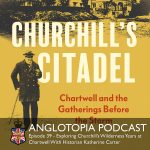
Welcome to the Anglotopia podcast, where we explore everything related to British travel, history, and culture. This week, our guest is historian and author Katherine Carter, currently the property curator at Chartwell, Winston Churchill's beloved home in Kent. Katherine has worked at Chartwell for over a decade and has taken her extensive experience researching Churchill's home life and turned into a fantastic new book, Churchill's Citadel, which is right here for those watching on YouTube. Churchill's Citadel, Chartwell, and the gatherings before the storm.
Today, we're going to talk about Katherine's new book and her revelations on one of the most fascinating periods in Churchill's life, his wilderness years when he was a lone voice, warning of the coming dangers of Adolf Hitler's Germany. Welcome, Katherine.
Thank you for being on the podcast. So, when we talk about Churchill, the first question I like to ask is, what is your Churchill's story? How did you get to where you are?
So I am one of those people who got bitten by the... history bug, very, very young. I am from a town in England called York. If any of your listeners are familiar. It's a very, very historic town and you can't sort of go around a corner without, you know, stumbling upon a thousand-year-old building. So it is somewhere where you you're hard, you know, you'd be hard-pressed to come out of York, not loving history. In terms of my connection to Churchill, I remember I had a birthday when I was quite young and it happened to be the 50th anniversary of VE Day.
I won't say how old I was. I don't give that away. But I remember there was a lot of sort of bunting and celebration. And I remember thinking at the time, I'm pretty sure this isn't all for my birthday. And so I remember asking my dad, you know, what was the occasion? What were we celebrating? And he explained it to me. And I just thought, you know, how incredible that, you know, Churchill could be so associated with this phenomenal victory.
And from that point on, I was really keen to learn more. That led. me through to studying history. I then did a master's in museum and artefacts studies. And then in due course found myself at Chartwell, where as you say, I've been for over a decade now.
I've, if, if you had history dream jobs, I think my dream job would be your job. And I think it's incredible. And I love, I followed you on social media for years. So I love seeing all your updates from Chartwell, especially about Jock. Because as you can see, I have my cat right here. Oh, hello.
I have Jock actually asleep. on me, but he's just out of camera. You might be able to see this sort of ginger a little bit down there. He's just, he's just behind me. Love it.
Love it. So this book, so obviously you know a lot about Churchill. You've studied him for years. You've lived in his house for years. What was the thread that you pulled that got you to write this book that was this, this is a topic I'm going to do, and what led to where we are today with the book being out now?
So for me, the 1930s has always been a fascinating period of Winston Churchill's life. I think that, understandably, most people's focus is his wartime leadership, and that is, of course, what secures his place in history. But actually, to me, the 1930s are just as, if not possibly even more important, because it's so much harder fighting for a cause when you are a lone voice, effectively, and you are almost sort of, you know, fighting against the tide of this consensus of determination to avoid war.
So Winston Churchill really was going out on a limb sort of declaring that, you know, war was inevitable and we should be preparing for it. In terms of the Chartwell link, what's really interesting about the way one sees Chartwell when one visits it today, and I should say if anyone is listening who hasn't been, if you ever get the chance, do. It is brilliant. In my mind, there is nowhere more authentically Churchill in the world than Chartwell.
But it's very interesting that having lived there for 40 years when the Churchill's were deciding what period in their their time there, it should immortalise. They chose the 1930s. And so to me, that says a great deal about even their own recognition, that that was the moment of its greatest historic significance, is that decade where they are a younger family, but also there's, you know, this crucial time where essentially Chartwell becomes like his own branch of the foreign office out in Kent.
And so it was then that I started to explore, well, what happened in that day to make it so crucial. And the research from which went towards this book.
Yeah, I've been to Chartwell a few times. And when you visit there, one of the most prized artifacts is the visitor's book. And that visitor's book, I believe that was your kind of inspiration for this because it was just filled with a wealth of interesting figures, right?
Well, it was partially informed, but I should say as well, the visitor's book, it is indeed one of the most important objects in the collection at Chartwell. And from the 40 years the Churchill's live there, there's over 750 signatories. So it really is a phenomenal record. But actually, that tended to be overnight guests, largely. For whatever reason, the Churchill's didn't tend to document anywhere nearest frequently their day visitors. And actually, a lot of the people coming to meet with Winston Churchill, have these top secret meetings, you know, passing on intelligence about Germany's preparations for war.
They weren't always the sort of dine and stay guests, as the Churchill called. So actually, though the visitor's book is an amazing document, actually, less than half of my visitors feature in it. So actually, my book is going one step further of wanting to interrogate everyone who came, whether they were a dine, wind and dined guest or someone who was really quickly running in for the afternoon to bring a brown envelope of intelligence and then get back to London.
And that's a key thing there is Chartwell, for my American listeners who don't know geography, Chartwell is very close to London. you can get there in under an hour, even in 1930s. Today you can as well.
Yes. So Winston Churchill bought this house in the north of Kent, largely because his childhood nanny was originally from the county of Kent and so planted the seed very early on that Kent was the Garden of England and this wonderful place to live. By being in the northern most corner of the county, he was exactly right within an hour of London. But for Chartwell itself, you know, why did he pick that house? If anyone hasn't seen it, the view from Chartwell is just astonishing.
It's one of the best views in the country, in my opinion. So he needed to be there for that proximity to London, absolutely, but Chartwell itself was because of the view.
Yeah, the Weald of Kent View. It's one of the best in England, which is why he bought the house. So talking about a typical, let's say, overnight visit, what were the elements that sort of the Churchill family kind of put into one of these visits to wine and dine these important figures.
So for the sort of person who was staying overnight, they were probably someone that the Churchill's knew beforehand. So a lot of the visitors who are one-off visits, you know, the likes of Albert Einstein, for example, he has a limited period of time, he comes for an afternoon, so he's not an overnight guest. Whereas someone like Lawrence of Arabia, actually Churchill has a much longer standing relationship with T.E. Lawrence, or in fact, T. E. Shaw, as he is known by that point because he's going by a different name.
And because he is a long-standing friend of the Churchill's, Clementines as well as Winston, it is the case that he is the sort of person who would stay overnight. And so he would arrive probably mid-afternoon, typically, on one of his many visits. There's a brilliant moment, actually, in the visit, which is the one that is the sort of primary one for the book, because it takes place in February 1934. And there's this astonishing moment when all of the Churchills go out for a swim in their swimming pool.
in the garden. It's February. It is freezing. Absolutely freezing. And poor T.E. Lawrence has been on his motorbike for about an hour to get to Chartwell. Poor guy's probably absolutely freezing. And the last thing he wants to do is then go for a swim. So that could be, perhaps, what greeted you on your arrival at Chartwell, you know, swim time. But it could be, for example, a walk in the garden, a trip to Winston Churchill's painting studio, who he often showed off his paintings very, very proudly to his guests.
Then Winston Churchill would go off for his daily afternoon nap. There was always a nap for about half an hour, about four o'clock. And then everyone would get ready for dinner. And this was, I mean, dinner at Chartwell, to be a fly on the wall of those dinners would have been a wonderful thing. We're talking fine cuisine, excellent champagne, you know, discussion until 11 at night, maybe even midnight at the table. And then after that, Winston Churchill would go and actually work in his study until about two in the morning.
three in the morning. So you would have wonderful conversation, you know, it'd be such an entertaining evening. Like I said, fine food and wine. But over the course of that meal, either Winston Churchill would be trying to glean insights from you, if you were someone he'd invited there with a particular purpose in mind, or you would be someone Church was trying to persuade to come around to his way of thinking. But either way, dinner table diplomacy was what awaited you.
One of the interesting details I loved in your book is that the table in the dining room is a round table so that he could see all of the guests rather than talk to guests individually.
Yes, absolutely right. The elements that dinners and meals at Chartwell were so important to Churchill because he wanted you as a guest to not want to leave. and he wanted it to make it the optimal environment for discussion for as long as Winston Churchill wanted you there. So yes, absolutely, a round table, so no one felt like slightly awkward on the end and maybe a bit out of the conversation. But Churchill's attention to detail in this regard even extended to him once writing a thesis about the ideal dining room chair.
It had to have a slightly curved back and it had to have arms. All the chairs had to have arms, not just the head of the table, because Winston Churchill didn't want any fact. factor, potential discomfort in your seat being one, to make you want to leave early. So there was so much thought that went into making this perfect environment for discussion and debate.
Yeah, when I think about Churchill, I don't really think about him as this really conscientious host, thinking of every little detail like that. That's fascinating.
I think he certainly, well, he wanted it to be optimal to make you on to stay. That's not to say that he was always kind of sitting back and quiet listening to debate. If you went to Winston Churchill's house, he was probably holding court, but it would have been so much fun to watch, you wouldn't have wanted to leave.
I know, I wouldn't. So throughout the 1930s, Chartwell was kind of his stage, and there was many different things that happened there. And he famously wrote about this in his own book, in his World War II memoir series. Now, one aspect I'm really interested in is because earlier this, earlier this summary, talked to his story in Jane Tippett about the abdication crisis in Edward the 8th. Can you tell us how Chartwell was a center of almost a rebellion on Winston Churchill's part in support of the king?
Certainly. Well, whatever the campaign Winston Churchill was working on in the 1930s, whether it's his campaign against the Nazis or his campaign in support of Edward V.8, for example, Chartwell was his headquarters because he could have these meetings away from the prying eyes of Westminster, where the ears have walls. He knew he had, you know, complete control over the situation. And the abdication crisis is a really good example. So there is an entire chapter on the abdication crisis whereby Winston Churchill, he's acutely aware that the institution of monarchy is not guaranteed.
He sees it as this really positive, stabilising influence. And yet, if you look at the aftermath of the First World War, there are numerous, European royal houses that topple and lose their monarchs. So actually, at this point in 1936, there is a potential constitutional crisis. And Winston Churchill is desperate to ensure that that not tip over into potential rebellion and unrest and a, you know, permanent impact on monarchy as an institution. So he wants to buy time for Edward VIII, essentially.
And, you know, there's a number of reasons for this. Firstly, Edward the Eighth has had other great loves. Wallis Simpson is not the first. And he is tired of other great loves in the past, including a lady called Freda Dudley Ward, who was another visitor to Chartwell, who had rather unceremoniously called her beloved Edward Edward Edward VIII at that point, Prince of Wales, and been told one day that he was no longer having her calls put through.
So he was capable of falling out of love very quickly. Winston thought, well, why put the monarchy at such risk when there's a chance that Edward the 8th might move on anyway? And there's other things as well. Churchill thinks perhaps that if they buy time, there could be investigations into constitutional precedent, which might help calm things. But also, he's a, I mean, he's a politician to his bones. And he, in his opposition to the government at that time, Stanley Baldwin's government, thinks, okay, there's a lot of people in Britain who seem to be actually quite in favour of Edward VIII having this love match, where the Churchill agreed with it or not, that, you know, if there is a lot of people who really want that to happen, could he use this as a device to win him kind of support among the British electorate against Stanley Baldwin?
So there's numerous reasons where it works in Churchill's favour to just kind of put the brakes on things. And that's when there's this meeting at Chartwell where he and a number of his colleagues create something that becomes known to history as the Chartwell formula, which is essentially a planned by time. But without spoiling too much, his plan doesn't go quite as he'd hoped.
Well, exactly, yes. I think Churchill thought he had control of more than he did in that moment.
Yeah, that's definitely a Churchillian hubris there. He always thinks he's more in command of the situation that he actually is. So my next question is, when researching this book, what was the most interesting story or visitor to Chartwell during this time that you came across? Really, like, I can't believe this happened and I have to write about this.
Do you know what? As I progress through writing the book, and there are 12 chapters, so there's 12 protagonists where there are particular meetings focused on. As I went through, every single one was my favorite. I think, no, this is the best one, this is going to be the highlight. And then I go to the next one and the exact same thing would happen again. And the wonderful thing is, I didn't really have to work too hard to curate a cast of characters, because Churchill was inviting the right people at the right time, which coincided with wider sort of political or geopolitical events.
So I have this extraordinary luxury of just this remarkable cast of characters making their way to Chartwell at the perfect time. In terms of my favourite visitors, I think that, I think Heinrich Brüning is probably, up there. He is a rather serious character, but he is a former Chancellor of Germany. So he held the role of Chancellor before Adolf Hitler, between 1930 and 1932, so during the latter years of the Weimar. And the fact that he flees from Germany and becomes a pretty regular contact of Churchill's for several years.
He goes to Chartwell on quite a few occasions. And the first of which, I love I loved it when I found in the Harvard archives, which is where Brüning's papers are, reference to the fact that the most drunk he had ever been in his life was his first visit to Chartwell. And I thought that was so human of him to admit. And I love the fact as well that he was very honest and he said, I'm not even going to try and remember what we were said that evening because quite frankly, I had too much to drink.
And I think actually things, things like that, I mean, how remarkable is that that? That a former Chancellor of Germany, just, you know, a year before Adolf Hitler is at Winston Churchill's house, but they're clearly having a hell of a time. And Churchill becomes, you know, becomes pretty reliant for a time in the mid-30s on this intelligence being brought directly to him that Brüning is getting from his contact still in Germany. But again, without giving too much away, it's another one of those moments where actually, for reasons completely beyond Churchill's control, that bridge is burned almost as quickly as it's built.
So, yeah, a really interesting moment in terms of Churchill in the 1930s in that dynamic.
Yeah, and that's one thing when, you know, we've, both of us, I'm sure, have read so many history books about this time period. And it's easy for the fact that these are people with personalities can get lost in all the historical fact and that this took place and this took place. And the idea that, you know, Churchill is conducting this diplomacy on a personal level and relying on his own, his own allure and his own charm to, to achieve his own goals.
It's fascinating. Absolutely.
And I think as well, one of the things that I've tried to do with this book, beyond the meetings themselves and the really sort of high diplomacy, is balance that alongside the everyday of life at Chartwell. And actually, some of my most fun discoveries were ones about, you know, the maids or the chauffeur or the secretaries, where, thanks a lot of those records of those individuals has survived as well. They're not as easy to find, but they're there if you look really hard.
So, for example, referencing the abdication crisis, I found it fascinating and very human that the chauffeur got fed up with all of these late nights driving Churchill back and forth around that time. And for some reason, at one point Clementine, you know, chastised him for something and he handed in his notice. And it's a very human thing to think, do you know what? I am tired. This is not worth it. You know, I mean, they're one straw too many and I'm off.
And so you've got things like Churchill being devastated that the chauffeur he gets on really well with has left. But that's going on as well at the same time as him kind of dealing with the abdication crisis. So you've got both sides of the coin of the domesticity and the diplomacy happening at Chartwell.
Yeah, that risk of my interview turning into a review, I would say I love the detail in the book. Like, I love the domesticity and the the day-to-day operation stuff. I ate that up. So, well done on that one. Thank you. So you mentioned that, okay, so there's 12, there's 12 sort of individuals and stories that framed the book. So who didn't make the cut? Who didn't quite fit into the book that you really wanted to get in there, but your editor or whatever was like, no, that doesn't fit?
Do you know what I, when I started sort of collating my research notes and I sort of looked at what I had in the end. I had 28 protagonists. And initially, you know, this is my first book and I sort of rather naively went to both my editor and a couple of writing mentor friends I have and sort of went, so here's my 28. And they all just went, no, don't do it. So immediately I then had to sort of prioritize.
But the brilliant thing is all of those meetings have still been woven in, even if to a lesser extent. So I feel very fortunate that there's none, the I deemed significant that have been completely taken out of the book. But there are a very particular 12 that have sort of risen to the surface as the, as the primary ones for that decade.
Yeah, it reminds me, I was, I interviewed Robert Schmuhl about his new book, Churchill in the White House earlier in the summer. And when he was doing his proposal, he was talking to the editor. And the editor was like, don't do a book about Churchill. You're going to have to do so much reading.
Well, I mean, my, my, my, my, my, My book was done in my spare time. So even though I have my day at Chartwell, it was a evenings, weekends, and holiday endeavour. But it took me four years for that reason to get from the first conversation with my publisher to it being published, you know. So there is an extraordinary amount, even if you're just looking through the lens of Winston Churchill's going on, let alone alone his family, let alone sort of the wider household at Chartwell.
So, so yes, anyone considering a Churchill book, brace yourself. There's a lot to read.
you know who else wrote giant books in their spare time? Winston Churchill. So if he can do it, you can do it, right? There we go.
So that actually leads into my next question. So this period in Churchill's life was filled with a dizzing array of activity at Chartwell. He was writing books. He was laying bricks. He was making speeches. He was taking these meetings. Not to mention, you know, being a family man. How do you, how do you manage to do all these things?
Oh, it's, it's an extraordinary sort of amount of productivity, which, you know, most people would, as you say, you know, find impossible. For me, that afternoon nap I mentioned is really, really key. Because by taking a half an hour nap, about four o'clock, he can then work until about two in the morning. So by having this very unusual sort of rhythm to him. his days, he can get a day and a half's worth of productivity out of a single day.
Now, the tricky thing is, those around him have to keep up as well. You know, so the secretaries who he's working with, I mean, there are some wonderful letters in the book where they're writing to people saying, I have no social life. I never see my family, you know, because all I do is, you know, be there at Chartwell, you know, taking dictation till two in the morning. And it says a lot for the level of dedication of these people who are supporting him that they can keep up with this extraordinary routine of his, which, as you say, allows him to write so many books, paint more than 500 paintings, hold almost every major office of state in British politics, you know, five children and so on and so on.
So that nap, I think, is the crucial factor.
I can't confirm. I, you know, I've found my day, my day's productivity improves if I manage to sneak in a nap. My wife is still skeptical that these naps are necessary. She's like, what are you doing? I can never take a nap in the middle of the day. I'm like, well, Churchill did it. It worked for him.
Exactly. I mean, there's probably a science to it, you know, something about circadian rhythms or something, but yeah, if it works, go for it.
So in, so in addition to his nap superpower, you know, I think it's important that he had help. You know, that, you know, how many staff did he have? Like, because he had multiple staffs. He had his political staff. He had his staff who, his historians who were working with him on his books. He had, then there's the staff at Chartwell. So, like, you know, he almost needed a manager for all that. Is that where Clementine came in?
Yes. Well, Clementine and the secretaries. So the secretaries were almost the sort of day-to-day administrators of the household staffing. But Clementine was the boss. overall. And you know what? One of the loveliest things about my research is I have befriended a wonderful lady called Gwen, who was the last surviving pre-war resident of the Chartwell Estate. And her father was the head gardener. And she was born in the gardener's cottage on the Chartwell Estate in 1928. And she lived there until she was 16 in 1944.
And so from her, I've been able to get these extraordinary insights into, you know, what the Churchill's were like as employers because she was, you know, in her mid-teens by the time that she stopped living there. And absolutely, it is the case that in terms of Winston Churchill, his attention was always beyond Chartwell. It was to whatever crisis was happening in Westminster or to what was happening in Europe or even, you know, beyond the war, the kind of the special relationship and the Soviet Union.
Whereas Clementine was the boss at Chartwell. She was the one who got the bills paid, who said how she wanted the gardens. You know, it was, it was her domain. to make it exactly as Winston needed it to be. You're absolutely right that it's a lot easier to achieve greatness when you have a lot of very skilled people around you delivering your day-to-day tasks.
I'll have to put that in my book proposal. I need a staffing budget for the research phase. So shifting focus to more about Chartwell in general. Would you say that Chartwell and all the work that Churchill did to it was his vision of an ideal, England?
So in terms of what Winston Churchill hoped for when creating Chartwell, and the phenomenal thing about Chartwell is from the house through to the gardens and the wider estate, there is his handprint somehow across everything. So for anyone who isn't aware, Chartwell is a much, much older house. The core of it is Tudor, so 16th century. And then over subsequent centuries, a succession of different families inherited it and added. And over time, the more, I say, modern, in quotes, elements, the sort of Georgian and Victorian elements were made with poorer quality techniques and materials.
So by the time Churchill first season in 19, It has water leaking quite badly, there's rot, there's mould. I mean, to call it a fixer-upper is a massive understatement. So Churchill, when he buys it, he knows it's going to be remodelled massively. And part of his desire in the sort of end product is that he wants the rooms to be flooded with light. Because by this point, he's been painting for quite a few years, and he has this artist's eye.
But that extends to the grounds as well. So, for example, the lakes, even through to the planting, he had a childhood love of butterflies. And so he wanted particular plants that draw butterflies to be near the house. So there was so much thought in making it ideal for him. I don't know if I'd necessarily say it's a sort of ideal England, but it's an ideal Churchill domain. And he was able to shape the landscape and the building to perfectly suit his tastes.
And in some cases, you know, gardeners, you know, diggers, there's quite a bit of, yeah, infrastructure and support happening. But it's Winston Churchill kind of directing what he wants.
One of the things that surprises me about Chartwell, I've been there twice, but I haven't been there since 2017, is how it's not a grand house. Like, there are grander houses in England. You know, I mean, he was born in Blenham, palace. This is, this is, but it's still a microcosm of everything he required and everything he needed. When you walk around there, it feels very intimate, like you feel like you're walking around his head, because it feels like this is the space that he wanted and be idealized.
I think it's important for men to take a more active role in their interior decoration so that their own, their own spaces can, uh, can inspire them.
Well, it's interesting you say about kind of perceptions and what people imagine Winston Churchill's, has to be. You're absolutely right. You know, Winston Churchill, you know, A, he's, he's Churchill. So people often picture something much bigger. But he is also the grandson of a duke. So, you know, often people imagine what we would call a stately home, so a very sort of neoclassical kind of building. But the truth is that Winston Churchill didn't inherit a great amount of money.
His writing was always his main source of income. And the Churchill's finances over the course of their marriage oscillate hugely. I mean, this is someone who decided to dabble in, you know, the stock exchange in New York in the late summer, early autumn of 1929 and lose, yeah, well, exactly. I mean, poor guy for him to get bitten by the bug at that point in history. But he ends up losing equivalent to about a million pounds in modern money, just in one fell swoop.
So the oscillation of their finances is so extreme. So they go from moments of kind of wanting to expand the building even more when they're feeling a bit more flush. They draw up plans for increasing size of it that never happens. Right down to at the lower points of their finances, in the 1930s at least, where they are having to essentially lay off staff. They're scaling down the sort of, you know, the rooms that they live in.
Some rooms are being dust cheated to make it cheaper to run. So you have this extraordinary fluctuation. As a sort of a strange backdrop to political events, you also have the Churchill's dealing with these kind of recurring financial crises that happen continuously over the course of at least the first half of their marriage.
Well, and a lot of people don't realize that politicians weren't paid in this area. And so he didn't have, he didn't have his political salary to rely on. He, they survived from book advance to book advance.
Well, he was, he was paid by the time of this book, but certainly for the first kind of decade or so of his time in politics, politicians weren't paid. And it certainly wasn't the sort of. some that the grandson of a duke, you know, could live on. So the money he was getting from writing absolutely eclipsed any income politically.
And a lot of other writers, much to much to their chagrin, right? He committed the big celebrity advances, right?
Well, yes. I mean, he was, he was among the best paid writers of his age. So there are, there's really interesting times when, you know, in this decade, when they are at the most sort of financially straight. and you have him writing articles just to be able to pay the bills. You know, it can be at that sort of knife edge level, really.
So, this is, I don't know if you haven't answered this one, but this is something I've always wondered about. And during World War II, Churchill famously didn't visit Chartwell at all, mostly for security reasons. Do you know if he wrote or talked about missing it while he was busy fighting the war? Was it, you know, was it the England he was fighting for? How soon after the war did they return to Chartwell and to their old habits?
So I should say he did come back a couple of times. There are a handful of instances when he comes back, but we know how much he was missing Chartwell. I should say for anyone who's not aware of where Chartwell sits geographically, it's not only in Kent. It's on the sort of main flight part. So if you're coming from Germany, flying across the channel towards London, you are flying over a part of Kent that became known as Bomb Alley.
And Chartwell is in that point of the county. So there was a great fear, particularly once he'd been made Prime Minister, that his home would be a target. I mean, imagine the morale hit if Winston Churchill's home got destroyed. So that was the main reason that they weren't back more often. But from some photographs, I'm. managed to find in the National Archives, which I'm delighted to say, it doesn't seem that anyone knew about this seems to be a completely new discovery, where the RAF undertook aerial reconnaissance of Charwell to try and ascertain how identifiable it was from above.
So at the very end of my book, there's some aerial photographs done in 1941 as part of this exercise to try and work out how safe it was for Winston Churchill to go back to his home. And that would only have been undertaken. If he was chomping at the bit, if he was asking, you know, I really would, I really would like to go home more, you know, and then the, you know, the security services sort of went, well, hang on, let's just check.
And the reason that Chartwell wasn't hit, because it is quite an identifiable sort of T-shaped building from above, and it has these two very large lakes. So if you're flying particularly at night over that part of Kent, you know, and you see two large bodies of water where, you know, stars reflected and a T-shaped building as well, you can, you know, you know, you know, that's Churchill's house. And the way that they managed to make it so it couldn't be seen, or at least that, you know, the Germans didn't seem to find it, was by having one of the lakes covered in a net and leaves put over the top.
So that actually, they were flying over a house that only had one lake, and so it couldn't have been Winston Churchill's house. So a really extraordinary intervention to keep Chartwell safe. And thank God, because it keeps me in a job.
So what's a story from your research into Churchill's life that's particularly inspired? You're giving you solace during a hard time because I know for me with Churchill, like when, you know, I'm depressed or have a really tough time, I try to, you know, think Churchill, how would Churchill handle this situation? Is there a bit, is there a story that you have? have that kind of helps you in a hard time?
I think, to be honest, his conduct in terms of not giving up over the course of this entire decade, to me, is inspiring. There were times when it would have been extraordinarily difficult to take the stance he was taking. But he had such belief and such courage in his convictions that powered him through, even, you know, moments when he was being accused of being a warmonger and the like. And, you know, a lot of people might well have sort of.
of, you know, compromised or modified their stance, you know, due to such pressure. And don't forget, this is a country that, you know, the First World War is very recent memory. It's in a way understandable that so much of the political establishment were determined to secure peace at all costs, particularly with the development of aviation and the understanding that if another war to take place, it would play out in the air and, you know, could potentially sort of look apocalyptic if you to see attacks on civilian populations.
So even with this extraordinary sense of fear and determination to secure peace, Winston Churchill really hears out on a limb saying, war is going to happen. You know, Nazi territorial expansion is happening before our eyes. And we're not preparing for war. And so for me, that courage to remain true to what you think is right is truly inspirational. And something that I think, you know, is a guide. light in terms of remaining true to what you think is right.
I agree with you. And it's almost like he had everything to lose, but also nothing to lose, by sticking to what he really believed in. And it is a, it's, it's, it's, I think it is the most fascinating period of his life. Um, because, you know, he didn't, and I like to, I, I, I talk about this all the time when I, when I get, you know, ranting about Churchill, that, you know, the thing that we all know, know him for and achieving his greatness, you know, didn't happen until he was in his 60s.
It was, this was like his third or fourth act in his life. But before that, there were so many events and things that had to happen to get there that are inform his, you know, greatest hour that it's, it's important to know it all because if you don't understand what led up to it, you don't understand why he was so successful and dirty war at all.
I completely agree. I mean, he has this wonderful quote where he. said that, you know, reflecting later on his appointment of prime minister, there's this quote of his saying, you know, I felt I was walking with destiny and that, you know, the trials had gone before had essentially led him to that point. And my book, Churchill's Citadel, as you say, zooms in on a particular chapter. But my argument is that were it not for the meetings that happened at his country home over the 1930s, which brought him the intelligence and the intelligence and the information he could then weave into his articles and his speeches.
That information was ultimately what put him in a position of knowledge and authority to be returned to government when war broke out as First Lord the Admiralty in 1939 and then in due course to be appointed prime minister. So had Winston Churchill not had this epicenter of intelligence and, you know, this arsenal of knowledge, he might well not have been made prime minister. And it doesn't bear thinking what might might be. happened had he at that point in 1940 not been leading the Bush government.
Fascinating. So changing track, this is like a 180, but I just thought of this question and I wanted to ask it while I have you here. A few weeks ago, the Wallace Collection announced they're going to do a big exhibition of Churchill's paintings in 2026. Are you involved in that or is the chart wall property involved in that? Can you tell us anything about that?
Yes, not only are we involved. I first entered into discussions with the Wallace collection in 2020. So this has been something that has been bubbling away for some time. From straightaway, we were very keen to support the exhibition and we are the, I believe, the largest lender of paintings to that exhibition. The director, a gentleman called Xavier Bray, has a fantastic vision for what he wants the exhibition to be. He wants it to be the absolute sort of creme de la creme of Churchill's artistry.
And, yeah, we're really exciting to be a contributing lender to that show.
Yeah. And it's, it's interesting that in the 50s and the 60s, there were major, like, touring exhibitions of his paintings, but in recent decades, there haven't really been massive exhibitions. So it's going to be a real street to see so many of his great paintings in one location, but having to go out of way to Chartwell.
I think for me, what's really a positive shift about the Waddis collections approach is that we get approached by museums and galleries that want to borrow Churchill's paintings pretty frequently. But it's always the case that they are doing a biopic exhibition of Winston Churchill, or I just say a lot of the time it's the case. They're doing this biopic exhibition and they want a painting or two in order to sort of convey a, here's an interesting thing you might not have known, he painted, which is, enriches a narrative about his life, certainly.
But he doesn't delve into kind of analysis of him as an artist. And that's exactly what the Wallace Collection wanted to do. They want to look at his techniques. They want to look at his influences. And there are, or there were, I should say, artists who saw Winston Churchill's works and actually said, you know, had he been full-time at this, he could have been a professional artist. So John Lavery famously said that, among others. So the fact that he was able to have this phenomenal output clearly show skill, given that he was really just doing it in his spare time alongside everything else he was doing.
So I'm delighted that the Wallace collection of. are giving it a sort of serious art historical interrogation and analysis.
Well, it's already on my travel calendar for 2026. I'm not going to miss it. So there was a few years ago, there was an exhibition in Atlanta of Churchill paintings. And I was like, I'm not going to miss that. So I literally flew down for the day and flew back in the same day because I was like, I'm not going to miss this. It was worth seeing that. They had the one painting he painted during World War II that's now owned by.
owned by Brad Pitt, I guess. It was really interesting.
I think it is wonderful when you can see a considerable grouping of them together. I mean, at Chartwell, on, you know, any given day, we have the largest collection in the world, including some of his favorites, because we have a number that came to us directly from his family, from his children, and, you know, they then came to Chartwell. So Chartwell has an astonishing collection, but it's also really exciting to compare those alongside ones in private collections as well.
So that's what we're going to be working with the wellness on.
So if you are going this exhibition in 2026, you must also go to Chartwell and see the paintings there as well. So this is hopefully, I think, a fun question here. It's 1934, and you've been invited as a guest for breakfast at Chartwell. What question would you most want to ask Churchill?
Do you know what? That's a really tough question because I think on any given day, something will come up and I just think, you know, oh, this would be so much easier. I could just ask him. But actually, do you know what? We are so lucky with Winston Churchill as a historic figure that there is so much surviving correspondence and paperwork. So you are able to get a pretty reliable sense of what he's thinking at any given time.
Do you know what? I think if I were to have a conversation with him, I'd want it to be quite a fun one. I'd want to ask him about a favourite memory or something like that, you know, or, you know, the most cherished day of his life so far. You know, something like that where you could get him kind of really happy and buoyant about a subject and get maybe a different side of him than the sort of very, you know, serious.
figure. I'd like to, I'd like to make him crack a smile.
All right. So before we wrap up, I like when I do Churchill-themed episodes, I'd like to do a couple really quick questions. So what's your favorite Churchill quote?
Well, it's got to be never given. I mean, you know, for me, that is such a classic, and it's, you know, it's timeless. So that could be my vote.
And it's a very useful advice in any difficult situation, ever given. So, okay, what's your favorite Churchill anecdote slash story?
Oh, do you know what? There's a really great one I love. It's features in a brilliant book by historian called Cita Stelzer, who's written dinner with Churchill. And she describes a dinner that happens at Chartwell. And Winston Churchill decides that he wants to discuss the Battle of Jutland. So for anyone who's not familiar, that's a First World War naval battle. And Churchill being Churchill, he can't just sort of sit back and narrate it. He ends up using the sort of wine glasses and the salt and pepper shakers to depict the boats.
And then he's blowing the cigar as like gunfire, as he's describing the course of the battle. And I just think moments like that make you think, gosh, to be a fly on the wall of that dining room, you know, it would have been just so much fun to be that.
So other than your book, which you're here to plug, what's your favorite Churchill book? Can I have two?
Okay. I mean, for me, in terms of single volumes, I think Andrew Roberts is exceptional. His book, Churchill: Walking with Destiny, I would highly recommend. In terms of something with a bit narrower focus, if anyone is wanting to know a bit more about Winston Churchill's finances, which is a fascinating area of his life. There's a great book by historian called David Lough called No More Champagne. And not only does it chart Churchill's finances, which are such a roller coaster over his life, at the top of the page, he also converts the numbers he's talking about to what they would be in modern money, which is the most brilliant tools.
You can kind of get your head around how much he's up and how much he's down. So I think for general, Andrew Roberts, Robert's walking with destiny, and for specific David locks, no more champagne.
You're the, like, the second or third person to recommend those books, so I can recommend the books as well. They're great. Those books are great, and I will put those links in the show note. So finally, and this is, what's your favorite Churchill movie? Because there's a lot of virtual movies cannot be very good or not very historic, be accurate. So as a historian, which one do you love the most?
So do you know what? So I had the fortune of Gary Oldman coming to Chartwell when he was researching for Darkest Hour. And actually, I remember when he and I were walking around Chartwell at one point, he asked me who's who my favorite depiction was. And I told him. And he said, you know, my mission's going to be to beat, to beat that. And I have to say, the one I love before, I still love, but I do think Gary Oldman did very well as well.
So again, if I'm going to give myself two, I'm going to cheat slightly. I'm going to say Gary Oldman, Darkest Hour was brilliant, but I also still love the Gathering Storm with Albert Finney playing Churchill. I think that there's a, there's a brilliant story that I've heard. I didn't bear witness to it, but I was once told that Mary Soames came to Chartwell when they were filming the Gathering Storm. So the Churchill's daughter. And when she saw the actors playing Winston Clementine, you know, she kind of stopped in her tracks because they were so good.
So I think if, you know, if the Churchill's daughter thinks highly of a depiction, then who am I to argue?
And it's my favorite as well. That film has, I wore the DVD out. It's a, it's a, it's a, it's a great film. So, well, thank you so much for joining us on the Anglotopia podcast, Katherine. The book is called Churchill's Citadel, Chartwell, and the gatherings before the storm. And it's now available from Booksellers everywhere. We will put a link in the show notes. And if you enjoy the Anglotopia podcast, please don't forget to subscribe, leave a comment or hit the like button.
So see you next time.
