

This transcript was generated automatically from the episode audio, so expect the odd misheard word. Click any timestamp to play from that moment; times marked ≈ are estimated to within a minute or so.
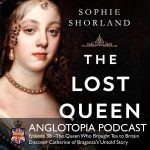
Welcome back to the Anglotopia podcast, where we explore everything related to British, travel, history, and culture. This week, our guest is historian and author, Sophie Shorland, who has written a fascinating new book called The Lost Queen, The Surprising Life of Catherine of Braganza. We're also running a contest to give away a copy of this book, so the link is in the show notes. So this is the book. You can see right here if you're watching it on YouTube.
Catherine of Braganza may not be a name that is widely known as some of her royal counterparts, but her influence on British history is undeniable. and sophie's new book tells the incredible story of this portuguese queen who became the wife of charles the second and helped shape the political and cultural and social landscape of restoration era england from her pivotal role in anglo-portuguese relations to her love of tea that sparked a national obsession katherine's life is full of surprises so today we're going to dive into katherine's remarkable legacy how she navigated a court filled with intrigue and scandal and why her story has often been overlooked in history it's a captivating chapter in british history and that you don't want to miss.
So welcome, Sophie.
Thank you so much for having me and for that lovely comprehensive introduction.
All right. So let's start at the beginning. What inspired you to write about Catherine of Braganza, a historical figure who has been largely overlooked?
Yeah, I mean, I think it was, I hadn't really heard of her until I went to the National Portrait Gallery here in London. And I found this one queen kind of surround. by other women. And I knew that lots of kings had had mistresses and, you know, that there had been influential women who weren't queens throughout history. So I wondered why this woman was kind of singled out as one among many for Charles II. And then I think I read her Wikipedia page because I was interested and it said something like she failed as a queen because she was barren, which just seemed such a kind of, it seemed a bit cruel really.
It's so mean, yeah. Which is, they're usually supposed to be impartial. So that kind of got me interested. Because obviously she was, she was still a queen in a time when, you know, if you compare the level of power available to even the weakest queen in the 17th century, it's still unfathomable compared to monarchs now. And, you know, I don't think anyone would call Elizabeth the second a failure because she had comparatively. less power. So yeah, I felt like she must have been a bit hard done by.
We're all good research starts Wikipedia, right? So let's please give an overview of Catherine of Braganza, give a bit of background of who she was and kind of explain the context of people who haven't heard of her.
Yeah, so she was born in a really interesting time. So she was Portuguese. She was born in 1638 at a time in history that a lot of people outside Portugal don't really know about, because it was when the Iberian peninsula was under one rules. Portugal wasn't independent. It had been taken over by Spain. This kind of, at the time when she was born, the Portuguese were beginning to not be very happy about being ruled by Spain.
It hadn't proved great for them economically. Socially, they were kind of becoming a Spanish province. So her father, Joao, was pretty much the only possible heir to the throne of Portugal, but he was much more interested in music and hunting than being king, whereas Catherine's mother, Louisa, was very, very keen on the idea of being powerful and ruling a country. So Catherine's first sort of rush with international politics, was when she was two, and her mother brought her into the room as a kind of emotional blackmail saying to Joao, something like, would you deny your daughter future opportunities by not taking the throne?
And I don't know that this actually convinced him, but anyway, eventually there was a coup. They asked the Spanish and then found themselves fighting a war for independence, which was obviously incredibly costly and difficult in terms of just finding troops as well, because Portugal, even today, it's not that big a country. So they were looking for alliances, they were looking for troops. And this is where the idea of marriage to Charles II came in and how Catherine ended up, Queen of England, as part of that negotiation.
Fascinating. So, can you set the context two of Restoration England? This is right after the interregnum, you know, England had decapitated its king. We had a, they had a a pseudo-republic for what almost 10 years then? So what happened then?
Yes. So then it's all a bit of a surprise, really, because Charles is still, I can't think a better word than farting around the continent, trying to whip up money and support while the interregnum government, is still kind of going on. Eventually, General Monk up in Scotland decides he's had enough, things are going badly, he comes down with all his troops to London and says, we're having a king again, I've decided, and sends a missive over to Charles on the continent, being like, you're back.
So Charles really is such a surprise for the whole court. They didn't have very much to do with it. He gets reinstated. Part of the policy is to, and kind of heal the country after this incredibly difficult, contentious period where, you know, brother's been fighting brother, different sides of the civil war. So he, Charles is fairly merciful towards most people, parliamentarians who fought against him unless they were involved in actually signing the warrant to kill his father, and then he gets rid of them, basically, or sends assassins after them.
Yeah, yeah, exactly. Yeah, and his sister was very involved in it as well, which is an amazing chapter, but, you know, not relevant for Catherine's story, but another interesting woman. Anyway, so, and part of this trying to kind of repair the country after such a difficult period is this real focus on manners that you get with the restoration. So people become very, very careful around each other. maybe you don't delve too deeply into the political side they're on, and instead, you're very careful with your pleases and your thank yous, which some people argue is why British people today are so obsessed with saying please and thank you, which is true we are.
I love it. So Catherine's marriage to Charles II came with significant political implications, such as Bombay and India becoming a British territory. How do you think this marriage shaped Britain's imperial future? Because, you know, Portugal had this. this big empire and Britain's empire at this stage is still pretty tiny. So, like, what, how did this influence that?
Yeah, I think it's really interesting. And it's almost quite difficult to say what would have happened without this marriage because you're in the realms of alternate history. So Portugal discovered the sea route to India. They navigated the vast sea of darkness, as it was cool, because it was such an unknown. And they were the first to do it. So they were the first to sort of find that. that way through to India. Partly they were there actually to find lost Christians.
So when they found people worshipping Krishna, they got really excited. They got a bit confused. But anyway, that was worked out by Catherine's time that actually Krishna and Christ weren't the same person. So Catherine's marriage brought Bombay, which is now Mumbai, into British hands, which at the time, it was seen as this actual, actually a kind of pestilential swamp. I think it was described as. So it wasn't seen as this huge territory that would change things very much.
But the British kind of developed it into, I think, still one of the biggest ports in the world. And without Catherine's marriage, would they have gained such a foothold in India so quickly? It's really difficult to say, but possibly not, and possibly more of the country might I think Portuguese or even French or Russian. Fascinating.
So one of the things I'm very excited to talk about because I'm drinking my tea as we're doing this interview is...
How would you describe Catherine's role as a cultural influencer, particularly in bringing tea drinking to the UK? What's the story behind that?
I love that you've used the word influencer because it's sort of like she's this kind of social media influencer before her time, which is quite fun. So, yes. I mean, and actually that's maybe a good analogy because as a queen, she's all eyes are on her and kind of, you know, when she ate dinner, people would literally gather behind railings to kind of appear at her and see what she was doing. So her kind of manners and tastes were incredibly influential.
And when she got off the boat from Portugal in 1662 to marry Charles, she'd had a terrible journey, she'd been horribly seasick, it was grim, the boat really sank. So she'd got off the boat and she instantly asked for a cup of tea, which the British were then just very confused by.
Yeah. It's hard to imagine. Yeah, there's like really strong medicine that some really rich people have. And so anyway, they couldn't find any tea and she had to make do with beer, which she can't. have been very impressed with, but she started to introduce tea drinking to the aristocracy, and it's kind of, you know, where the elite goes, the rest will probably eventually follow. It wasn't just her who popularised it, but she certainly did make quite a big difference.
And it's kind of interesting as well, because at the time, coffee was drunk much more in England, but mostly in all male spaces. of the coffee house. So this was a drink that's popularized by a woman, so you can have it at home, and it was women who really spearheaded the consumption of tea.
So where did the Portuguese get their tea from, or was it from that colony in India that Britain just got its hands on?
Same as India. So that's why in India it's still called chai often, because that's from Chinese, I believe, Chow. word. I believe at the time only the Dutch could buy from China. So tea could also be grown in India. So they were beginning to have tea plantations in India as well. But initially from China and the whole culture of tea drinking being poured into lovely cups was from China.
A ceremonial aspect of it, which I'm sure instantly appealed to the English as they're trying to to introduce ceremony and politeness back after the rough time of the interregnum and all the dirty Republican years, you know, of Cromwell. Yeah, drinking teas enjoyable, or as Cromwell was famously anti-joy.
Yeah. And anti-Christmas and such things. Although opera flourished under his rule, so it's a funny one.
That is weird. So you, in your book, you mentioned Catherine's interest and baroque art and fashion and music, can you talk about her impact on the arts in England during her reign? Because I know that this era of British arts was, it was flourishing after the kind of the state boring Republican era.
Yeah, and even earlier, kind of England had always for a long time, even under Elizabeth First, had been a bit of a cultural backwater because she had favoured really flat portraits that were kind of iconographic. But yes, Catherine, she came from an incredibly musical, cultural family. Her father, we think, may have written the tune of O Come All Ye Faithful, among other kind of impressive musical compositions. So she had this background and she came to England with a group of Portuguese musicians who were singing this kind of weird new tonality called the Baroque.
And at the time, diarists like John Evelyn or Samuel Pepys record, but kind of, I think Evelyn said something like they sing very ill, like these strange voices. They're not at all convinced by this new music. But after a few years, they're beginning to appreciate the rock. It's less shocking and alien to them. And it becomes really, really influential. And Catherine's chapel at Somerset House becomes one of the best places to go and hear music. So, and this is kind of like a deliberate strategy on her part, because not only is she really into music, but also she wants to kind of quietly convert as many souls as she can to Catholicism, because she's very pious Catholic.
So if she kind of hooks people in with the music, they might be tempted to see the benefits of Catholicism and maybe come to her chapel to worship as well. And then she was also one of the first patrons in England of Baroque art as well. So when she first came to England. Lili was the kind of court painter and he's known for painting women kind of very loosely robed, very heavy, heavy littered eyes. They looked like they've just kind of rolled out of bed.
And Catherine wasn't particularly impressed with this way of presenting herself. She wanted to kind of say different things in her portraits. So she fairly quickly found a new up-and-coming Dutch painter called Jacob Huysmans, who would become her favorite painter, and he did things like painted her with different angels to kind of signify that she's a queen and has the divine right of queens, and also painted her as her namesake, St. Catherine of Alexandria, so with Catherine Wheel and the quill, denoting both of their learning.
And this portrait in particular kind of started a fad of women being painted as Catherine of Alexandria.
Interesting. Is the portrait on the book, is that one of his, or is that a different one?
That's one of, it's a different portrait to the English copy. So I think that is the lily of her, actually, I think, because it's got the heavy-lid eyes.
It's a very interesting portrait, I think. Um, you mentioned Catholicism. So let's, let's, let's, let's, let's, let's, let's, let's, let's, let's, let's, let's, let's, let's, let's pull that thread a little bit, because this is, you know,
Yeah. I mean, the reformation is still happening. Um, we've gone through the, the, the, the very Protestant interregnum years. What is, you know, like you said, Catholicism is not something that you should be publicly, you know, professing right now. So how, how, how did she adjust in that, in that, in that world?
Um, in some ways, um, in some ways, not very well because I would say she was fairly unrealistic about returning England to Catholicism. She was a real believer in the divine right of kings, and so sort of thought that you could just push stuff through without necessarily consulting the population. So she really tried to push to have English cardinals and to have a relationship with Rome. But luckily for her, she was never, as interested in English politics as she was in Portuguese politics.
So she tended not to push too hard for kind of English Catholicism, which saved her a bit from kind of accusations that her mother-in-law, Henrietta Maria, had kind of been through meddling and petticoat government and things like that. And also helping her was the fact that Catherine was genuinely very pious, which ironically the Puritans actually really respected because it kind of goes full circle in a funny sort of way, you know, she was so devotedly pious.
They were kind of, in a way respected her conviction. And she also kind of deliberately positioned herself in contrast to her husband's mistresses as having a kind of very simple faith. So she decorated to her bedroom with very simple devotional images and not too much ostentation. And of course, at the time, bedrooms weren't really private spaces. This was a public space and with people going through it all the time. So this was a kind of deliberate projection that,
you know, Catholicism wasn't necessarily this big, ostentatious, scary. speaking of Charles II's mistresses, let's talk about that. So, you know, he's well known as the man of many mistresses, many bastard children who, you know, the current British aristocracy loves to claim dissent from one of them at one point or another. So Catherine's personal life was marked by many challenges, including her childless and her husband's numerous affairs. So how do you think she navigated this and still maintained her influencing dignity with all this going on with this notorious husband of hers?
Yeah. I mean, I think actually on that point of the aristocracy, I think William will be the first king to be descended from Charles II because his mother was a descendant of one of the illegitimate children, say. That's great.
That's fascinating. That's, that's going to be one of the social media clips for this episode.
So yeah, I think we'll have a Stuart on the throne again, so maybe some Jacobites will be quietly rejoicing. But yeah, I think it was, especially at the beginning of her reign, I think the way Charles flaunted his mistresses was really, really difficult. So we have to kind of understand that Catherine came from a really different culture. Portugal was in some ways much more formal. It wasn't acceptable to have mistresses who are in the aristocracy. You could sleep with a servant.
That was fine. But they're kind of tucked away and they're not really anything to do with your social life. So she comes to England. She already knows that her husband has at least one mistress and has been warned by her mother never to have anything to do with this, you know, common hussy.
and so she tries her best not to have anything to do with Charles' mistresses, but Charles insists on his principal mistress, Barbara Palmer, Countess Castlemaine. He insists that Castlemaine be one of of Catherine's Ladies of Bedchamber, which is a really kind of intimate role that involves dressing her and kind of getting her ready for the day. and just being a constant companion, which, yeah, it's pretty horrible.
Yeah, it's mean. It's so mean. It's so not tactful. And it's actually not, like, much like Charles's personality. Otherwise, he's actually generally relatively tactful. But in this case, absolutely not. Anyway, when she first gets to England, they have all these screen matches about it. At one point, she faints and has a nosebleed because of all the emotional. or stress, it's causing her. Basically, Charles eventually calls her butt her bluff and says, you know, fine, if you really don't want me to have a mistress, then go back to Portugal, see if I care.
And Catherine knows that English troops and English money are really important for winning the war against Spain that Portugal is fighting. So she basically has to choose whether she's going to be humiliated by having this mistress as her constant companion or go back and potentially will lose the war for independence. So she chooses to stay. And later she kind of talks about sacrificing herself for Portugal. And she also realizes that Charles is never going to be swayed on this matter.
And if she wants to have any kind of influence in the English court, she's going to have at least, she's going to need to at least pretend to be okay with the situation. So she publicly makes up with Castlemaine, they drive out together, and she does her best to remain very tactful around the mistresses. And Charles is very appreciative of this. And in times of later difficulty, he kind of says, you know, she's been so understanding about me, I have to stick by her.
So it does pay dividends in the end. And also, interestingly as well, the mistresses become a kind of focus of popular discontent because they're seen as wasting public money being a kind of sight of immorality. So in some ways, it makes Catherine more popular because she's this abused wife in the public imagination. She really plays into that narrative as well by kind of casting herself in this role of obedient wife. So that also gets her out of a couple of scrapes through her reign as well.
Yeah, it's a strategy still very effective and in public scandals to this day.
Yeah, yeah, yeah, yeah, yeah. And she, it's a kind of like a PR coup, I suppose, is how you'd put it today.
My wife would love that. She works in PR, so. Perfect, yeah. So what are, as you were researching this book, what were some of the most surprising discoveries you made while researching her?
Gosh, there were loads actually. because, I mean, we talked at the beginning about how I just had looked on Wikipedia. So obviously, there were loads of things that I found really surprising. I think one of the more surprising ones, strangely, is that Queens in New York was named after her. Yeah, so I knew that Kings, or now Brooklyn, was named after Charles II, and New York was named after his brother, James II, back when he was Duke of York.
I'd never heard about Queens. And that's partly because it's sort of weirdly contested. So we know it was named queens during Catherine's reign and during a time when things were named after her. So there are a couple of streets in London, for example, that were named Queen Street after her. But because it was never written down, people have sort of contested that it might not have been named after Catherine. But it would have been really strange of the British to have named a county queens after you know, like Louis the 14th Queen?
Right, somebody else. Yeah, yeah. It was definitely Catherine. So I found that like a very interesting one because I'm not quite sure why it's a site of contention,
Yeah, yeah, yeah, yeah. Fair enough. I mean, that's how historians make their money, I suppose, having a good argument and like, oh, everyone who's gone before me had history totally wrong. So fair enough. So, yeah. So yeah, that's. That was a really interesting one. And I think another one maybe as well was that she's got this reputation for being kind of this boring, obedient wife. So I didn't really expect her to have popularised wearing trousers or pants, which was a kind of very risque fashion.
And she popularised partly through sheer vanity because she had really great ankles and wanted to show them off. But also it was a bit of like a, we're wearing the trousers, political statement as well. And she dressed all of her ladies in trousers and they kind of ceremonially dashed around the parks, kind of looking very scandalous. Scandalous, exactly.
They live about an hour from here, so you never know. You never know. They might love British history and culture as much as I do.
Well, some of them use cell phones these days. So, you know, you never know. So I hope I didn't offend any of our Amish listeners. So any other interesting tidbits that you also found while doing your research.
Yeah. I mean, I think other titbits that I found were sort of how there's, she was almost always this figure. that most histories haven't talked about, but she's kind of there at every great event. So kind of when England is going to war against the Dutch, she's there kind of inspecting the ships and advocating for war, partly because the Dutch had been at war with Portugal. So, you know, she was fairly biased. And when plans to rebuild London after the Great Fire were being discussed, she was there kind of looking over plans, when kind of, I believe, sorry, let me just, check my notes.
I didn't want to say this wrong. Halley's Comet. Yeah. When Halley's Comet was seen going over London and Isaac Newton was kind of making his calculations based on that comet, she was there kind of witnessing it as well.
It's really amazing looking at his journals, actually, which I did a little bit. Unfortunately, didn't manage to put much in the book because it's not very relevant. I would have liked to kind of segue more into Newton, but it didn't really work. But yeah, as he's, as he's, it's kind of at the beginning of his career and he's really trying to work things out. And so, yeah, she's this figure is kind of involved in every great event of the second half of the 17th century, and yet you just never hear about.
So, yeah, I was, I was really surprised to kind of find her in all these places that I just haven't expected.
It makes you wonder who else in history we've kind of forgotten about who was at all of that major events like that. So this may seem boring to other people, but I'm always really interested in process. So, like, what was your research process? Did you visit archives? Did you enter library alone some really old books? How did that go?
Well, it was quite difficult parts of it, because parts of it was in COVID. So I was kind of contacting Portuguese libraries, like, please, could you take a picture of this for me? Or, like, do you have this digitized? Because I couldn't really get to Portugal. And also, I didn't speak Portuguese. So that was a difficult challenge. And then it was, yeah, a lot of, luckily we have lots of her letters in the British Library. And I also found this amazing cache of letters from John Methuen, who was the Portuguese ambassador, which hadn't really been mined before.
So that was very exciting as a discovery. And he was writing very extensively about her time in Portugal. So after Charles II died, she went back to Portugal and became queen there. And he gives loads of detail about her, what she was doing and kind of taking asses, milk, and all this kind of private information that you wouldn't find anywhere else. So that was quite amazing. And then, yeah, it was, I kind of, I unpicked quite a few fallacies, I suppose, because a lot of history gets repeated without necessarily double-checking.
And I'm sure I'm guilty of that as well. So there were a few kind of aspects of her life that I couldn't find evidence for, which was a shame and had to kind of leave out of the book. But yeah, it was a real sifting through a lot of manuscripts. And obviously also her correspondence with heads of state, like Louis 14th, was quite amazing to kind of like touch in person as well. So when you're touching Louis XIV's letters.
That was very exciting.
Does sound exciting. I'm a little jealous. Yeah, come to the British Library. Oh, I have been there. I went through for an exhibition once, and I was just in awe of the place with the whole central stacks behind the glass, and, like, it was most impressive. It's amazing. I need to get a book deal that will allow me to go do research at the British Library. You do.
You definitely do. Yeah, yeah, yeah. It's been hacked now, though, so it's...
Yeah. Are they still having issues with that? Is it still hard to get in and out of there?
Wild. I work my day job as at IT and internet marketing, and that's just wild that's just wild that's been going on for so long.
So your book touches on Catherine's role as a diplomat. Can you elaborate a little more on how she used her position to main ties with Portugal and other European powers? Like you mentioned the letters to other European heads of state.
Yeah. So at the time, a really important aspect of being queen was seen as being a diplomat to other powers. And this was at where Catherine's Catholicism came in quite handy because she was kind of corresponding with the Pope and with Louis XIV, who as he aged, became a lot more Catholic and conservative. So she was very important in kind of maintaining ties with these powers. she also, some of her staff were also used to negotiate the secret treaty, which was basically Charles II negotiated a treaty with Louis V where he would be paid a vast sum of money and in exchange would convert Catholicism and try and encourage England to become Catholic as well.
So which was why it's called the secret treaty because it was so inflammatory. It could never sort of see the light of day. And there is a possible. that Catherine was involved in that, but we don't really know for sure. And then she was constantly really, really interested in what was going on in Portugal and helped to smooth over kind of scandals that happened in Portugal as well and kind of maintain diplomatic relations with England. So, for example, her younger brother Pedro, this is some very complicated family politics, but basically her younger brother Pedro had an effect.
affair with his elder brother, King Afonso's wife. I don't know if that's, if that's followable.
And then Pedro and the wife decided to depose Afonso. So Afonso is no longer king and Pedro and Maria Francisca get together, become king queen. But awkwardly, Afonso is still alive and is just consigned to prison. England, it's a real, really kind of debated subject, whether they should cut off diplomatic relations with Portugal for this incident. Because obviously, Charles the second is thinking, like, I have a younger brother. Maybe, maybe I shouldn't be encouraging this kind of thing.
But anyway, Catherine kind of supporting Pedro helped to maintain that alliance. And, yeah, I think it helped that she and her brother, Pedro, had always been their mother's favorite children. So poor Afonso had a bit of a terrible time of it, really. And there's a palace in Sintra just outside of Lisbon where allegedly you can see the markings on the floor from where he was imprisoned and just paced up and down.
Oh, interesting. That'd be imprisoned in a palace. Yeah. So Catherine's dowry not only included land, but also significant wealth. How did this financial contribution influenced Charles I second's reign in England's economy at the time. Was it a big influx of cash for Charles?
It was a big influx of cash, although, yeah, they were promised an astronomical dowry of two million cruzados, which I think is approximately $62 million today. Yeah, quite a lot. And this, because Charles, as is quite understandable, always had a bit of a fractious relationship with Parliament. He never wanted to call Parliament. So wherever possible, he tried to find money elsewhere. So this was a huge inducement for him to marry Catherine. But when it actually came to paying the dowry, obviously Portugal at the time was at war.
They were really stretched. So Louisa, Catherine's mother, loaded lots of kind of sugar and bills of exchange onto the ship with Catherine, rather than actual money, which the English were a bit miffed out. And I think they had kind of expected this money to be life-changing and to kind of pay off all the cavaliers who had lost land and money in the civil war. But obviously, you know, this much money, when you try and split it, kind of 500 ways, doesn't actually.
go that far when you're kind of trying to split it between a nation. So it definitely had an impact, but I would say more in making Catherine popular in the early years of her reign rather than necessarily changing England.
Your book touches on the broader political landscape of Catherine's time, including her role in Portugal's independence. Could you talk more about her importance in this period of English-Portuguese relations, because a lot of people don't realize that Portugal and Britain actually have a really close-knit history. Like, there's still English families in Portugal who are wine merchants who have been there for hundreds and hundreds of years.
Yeah, which is quite amazing. And it was partly down to Catherine, actually. So the Anglo-Portuguese or Anglo-Lusitanian alliance does predate Catherine and goes back to the marriage of one of John of Gaunt's daughters, Philippa, which is quite amazing. But when Catherine, after Charles died and when Catherine went back to Portugal, they were kind of flirting with the French and were kind of making an alliance with the French. So Catherine kind of helped put a stop to this stallion and brought them back into the Anglo-Sphere.
For better or worse, because lots of Portuguese historians think that was a terrible thing. They believe it stifled Portuguese industry because they bought British goods and said. But anyway, she did sign the treaty. that kind of is still the longest alliance England has with any country. And it did things like make port wine a lot cheaper to import. So that kind of 18th century obsession with port is in large part thanks to Catherine. And all those wine merchants still living in Portugal and Porto can in some sense be ascribed to Catherine, which is quite fun.
And also, yeah, it was very important for World War II as well, the alliance. Portugal kind of secretly sided with Britain and allowed military to be stationed on the Azores and things like that.
Yeah, and the idea was that Portugal was secretly on Britain's side because if they declared, then Spain might declare.
So back to Charles II, Catherine was often remembered for her devotion and loyalty to him despite all his infidelities. How do you think their personal dynamics shaped her public and private life?
So I think that she quickly, kind of as I said, learned to be very tactful with Charles. And he, in the end, did really appreciate that. So in her kind of greatest period of crisis, the 1670s, when it was clear that she wasn't going to be able to have a child. And there were lots of calls for Charles to divorce her and marry a, you know, blooming young, and Charles really kind of stuck by her and also during the popish plot in 1678, which was when, um, a great period of persecution for Catholics, when basically one man, Titus Oates, just denounced everyone, um, and was believed and there was a bit of like a McCarthy-esque witch hunt, Charles, uh, refused to believe that Catherine would ever contemplate harming him or would ever be involved in any plot against him.
And he very publicly kind of drove out with her and was seen dining with her and one commentator said the wife has now become a mistress during this time period. So I think her earlier tact and willingness to kind of work with Charles. meant that in the end they did have a very supportive relationship and he did really appreciate that because if there was one thing in the world, Charles didn't like it was being told what to do.
And I think Catherine realized that she couldn't do that. So had to kind of work with him in other ways to get what she wanted.
Super interesting. I always love hearing about these these great marriages and how they made things work and it's fascinating stuff. So So from my last question, what is one lesson from Catherine's life that you came across when you did your research that really stuck with you since finishing the book? Yeah, I think something that really struck me about Catherine's life.
So it wasn't always particularly easy. She was also kind of subject to fits of depression throughout her life. She had quite a lot of illnesses, but she had one very clear goal throughout her life. and that was whatever was good for Portugal. And she really stuck to that and was incredibly devoted to that cause. And I think, you know, that's something that stuck with me as however difficult she could be, you know, she wasn't always the easiest person, but she was passionate about this aim.
And I think that for better or worse is a very admirable trait.
I think it's interesting that when when Charles I second died, she went back to Portugal and became queen there. So she was rewarded for her loyalty.
Yeah, and she's really well-known in Portugal. So she's forgotten in the Anglo sphere, but the Portuguese has not forgotten her. So you see her statue everywhere in Portugal. And yeah, and there's like a Portuguese shop down my road. And as soon as I was like, Catherine of Braganza, it's like, oh, yes, she's amazing tea.
She has a book sign. in there, right? Yeah, yeah. Well, on that note, thank you so much for joining us on the Anglotopia podcast, Sophie. The book is called The Lost Queen, The Surprising Life, of Catherine of Braganza, and it's available from booksellers everywhere, and it just came out in the USA. We will put a link in the show notes. We are also giving away a copy, and so we'll put a link to the entry form for that as well.
So be sure to enter. And if you enjoy the Anglotopia podcast, please don't forget to subscribe, leave a comment, hit the like button. So we'll see you next time. Thank you.
