

This transcript was generated automatically from the episode audio, so expect the odd misheard word. Click any timestamp to play from that moment; times marked ≈ are estimated to within a minute or so.
Welcome back to the Anglotopia podcast. This week we have with us Tim Riley, the Sandra L. and Monroe E. Troutt, Director and Chief Curator of America's National Churchill Museum, located in Fulton, Missouri on the campus of Westminster College. America's National Churchill Museum has special connections to Churchill and also includes a genuine Sir Christopher Ring Church that was relocated from London to Missouri, a fascinating story that we will be talking about. This episode is part of an ongoing series of podcasts about Winston Churchill, which we will be releasing in the lead-up to me attending the International Churchill Conference in London in October.
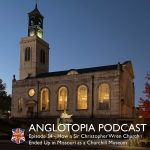
So, welcome to the Anglotopia podcast, Tim. Thanks, Jonathan. It's great to see you virtually. Thanks for taking the time to speak with us. So I'm looking at the screen and I'm seeing you're in this beautiful Sir Christopher Renera church. So let's start with the church. How did a Sir Christopher Rennarer? for a rind church end up in Fulton, Missouri.
You know, it's like so many things associated with Winston Churchill and Fulton, Missouri, and Westminster College. It's the most unlikeliest of stories. But this church, and I'm sitting in right now, was dated to origins to the 12th century. You know, it was originally built the earliest records in London where from the 1180s stood proudly in London through the 1180s. The 12th lived a block away from this church. Two of his actors attended St. Mary, the Virgin Alderman Berry, this church.
In fact, it was the two actors who published the first folio of Shakespeare's plays, attended Alderman Berry and were the church wardens here. And Alderman Berry had a very distinguished pass in London until that fateful night in 1666, the Great Fire of London. St. Mary, the Virgin Alderman Berry burned down and was in rooms like so much of London when Christopher Wren got the call and said, we'd like you to rebuild Alderman Berry and 50-some-odd other parish churches in England.
Of course, St. Paul's Cathedral was rebuilt after the Great Fire of London, and the church stood proudly in London from the 1670s when it was rebuilt in its current design until another fateful night, December 29th, during the Blitz in World War II, the German. dropped an estimated 20,000 incendiary bombs over London, and it rained down fire. Historians call it the second great fire of London. And once again, Alderman Berry was badly, badly damaged. The roof was gone.
The interior contents were engulfed in flames, and the church was left in ruins the next morning. Winston Churchill, actually, on the night of the Blitz in 1940, the night December 29th, told all the volunteers, the firewardens, and everyone else who were putting out and dousing the fires as it was raining down over London, Churchill said, at all costs. Stayed St. Paul's. And they did. There were a volunteer firewardens on the balconies, putting out the fires. Churchill knew full well that if that iconic dome of St.
Paul's would crash down, the British morale would be dashed at a critical moment when Britain was fighting alone for the most part in World War, too. Alderman Berry was suffered a different fate, and it was gutted. And it stood in ruins after the war for 20 years. It was an eyesore in the neighborhood. The post-war economy in London and in the UK was such that Britain couldn't afford to rebuild it. It really couldn't afford to take it down.
And Westminster College here in Fulton made a play in the early 1960s to say, you know, we'd like to recognize. Winston Churchill's visit to Westminster College and the Iron Curtain speech, which we'll talk about a little bit later on. And there was a committee that was formed. And you can imagine that the folks sitting around the table say, well, let's put up a plaque. Let's put up a statue. Let's put up a little gargand or a sundial.
And then someone said, let's bring over Christopher a Red Church from Central London to Missouri and re-doled it in honor of Churchill's visit to Westminster College and the Iron Curtain speech. Well, that was the idea that stuck. It was not audacious idea. And over the course of the 1960s, West Winter College gathered fund roughly $2 million in 1960s money, which is a lot more today. It was a national effort. President Kennedy was the first honorary co-chair of the Churchill Memorial Project, as it was called, when he was assassinated, President Johnson came on board.
President Truman and Eisenhower came out of retirement and left their names to the project. Churchill himself was 88 years old in 1963, knew about the project, endorsed it, and really, the entire country, the United States, got together, and with the permission of the Diocese of London, and the city of London, every stone was removed, ruined stone, taken apart from Central London, and shipped across the Atlantic to the east coast, and by rail car to the middle of America, and slowly over the course of, well, five years from 66 to 66 to 6th, 9, this church was rebuilt.
The Sunday Times called it the greatest jigsaw puzzle in the history of architecture. And so we're here today. A rebuilt went to risk Christa church by Americans, originally built by the Britons, the British, destroyed by the Germans, and rebuilt by the Americans. As I say, it was the most unlikelyest of story. And as you see it today in its majesty and glory, it's very much like Christopher Renwood is recognized. it, but not in central London, but in the heartland of America.
Wow. What a fascinating story. That's so, wow. It's like, I'm blown away that, like you said, world's largest chigsaw puzzle. Like, how much of the original church is there and how much is the restoration?
The majority of the exterior masonry is original. You know, you can see from historic photos after the Blitz, that it really was a stone church. shell of a building. You know, the roof was gone, the tower remained, but the original Portland line stone stones remained. The windows were gutted and bom and gone, but imagine just a stone shell of a church, you know, a classic room, but the interior furnishings were gone, the roof was gone. There were shrubs and tumbleweeds almost growing in the interior.
The columns, the interior columns remained, and those elements were removed. So actually quite a bit. the external fabric of the building remained. And it was our charge in the 1960s to hire many, actually, British craftsmen to come over and do the plaster work and the woodwork, rebuild the organ, and slowly bring it back to life. So I'd like to say that it's a little, a blend of 1670s and 1960s. The interior is very 20th century, but the majority of the majority of the exterior is definitely 17th century, all rent.
Wow. Amazing. So you mentioned a little bit of it in the story. So are Westminster College's connections to Winston Churchill and the Iron Curtain speech?
Yeah, that's another unlikely story. And I really think to understand it, we have to go back to 1945, May, V.E. Day, the Allies were victorious in Europe. Churchill is making his famous speeches from the balconies at White House. Hall, you know, saying, this is your victory to the British people. And after many long years of war, the war was won in England and in Europe. And I think a lot of Americans forget that just a few months later, there was a general election.
And as general elections of the UK go, they're often unpredictable. And Churchill, while he won the war, his party lost the election. And he's out of office. he famously campaigned poorly, and the British people knew that Churchill was, in fact, a great leader for war, but wanted to go in a new direction in peacetime. And the Conservative Party lost the election, and de facto by, as leader of the Conservative Party, Churchill was out. He was now the leader of the opposition party.
Clementine famously said, you know, Winston, I think this is a blessing in this. disguise, his wife quantity, to which he famously retorted him.
So, you know, he took the election loss, I think, hard. But, you know, he relaxed. He went out of painting holiday in Italy. And that's really the moment when he received, in October, really, of 1945, not long after the election loss, a few months, he received a letter from Westminster College, inviting him to come to Fulton, Missouri, here to speak, to give the John Finley Green Foundation lecture, because of an endowed lecturership at the college. And the then college president, Frank McClure, invited Winston Churchill.
Now, I'm convinced, and we have a copy of the letter in the archive here, the originals in Cambridge at the Churchill Center Archives. I'm convinced that letter would have been given to a secretary or an aide, and Churchill would have said, you know, tell them politely, no, I'm not sure where Westminster College is, but alone Fulton, Missouri. However, in the bottom of the page, is it one page? A written note, utter, was a handwritten note by a distinguished gentleman that said, this is a wonderful school in my home state.
If you come, I'll introduce you. Best regards, Harry Truman.
So when Churchill saw this handwritten note from the President of the United States, he knew that the world would tune in. And Churchill had more to say. I mean, that election loss came suddenly. And he was a very keen on an astute observer of global affairs in the post-war geopolitical scene, particularly with what was happening with the Soviet Union. And Churchill knew that if the President of the United States would decide, no matter where it was in the world, but alone the country of the United States, even in Fulton, Missouri, the world would tune in.
So he accepted the invitation. And on March 5th, 1946, Churchill, together with Truman, he was true to his word, traveled to Fulton, Missouri overnight by train from Washington. and arrived in Fulton, and in the gymnasium on the campus of Westminster College, which was the largest building at the time, Churchill gave the Iron Curtain speech, which he knew full well was probably the most important post-war speech in his career. And he used the opportunity to say famously that an Iron Curtain had descended across the continent of the United States.
And that unless the United States, and Greg Burton would ally the English-speaking peoples, together with the joint forces and belief in democracy, freedom of law, only these allegiance and alliance, the special relationship. I mean, we use that term all the time now, but it was really coined in the Iron Curtain speech to describe the relationship between the UK and the United States to fend off the expanding threat of communism. And that Iron Curtain speech, which Churchill actually called.
called the speech the sinews of peace, see things that bind us together, that make us stronger, that alliance that ages together was, was made to do in the defense in Missouri, and that Iron Curtain speech became prescient and really became a blueprint, really, for how to last would wage and ultimately win the Cold War by standing up to tyranny, in this case, Soviet communism, using democracy, liberty, rule of law, and all the things that Churchill read in so deeply.
It was a pivotal moment in the 20th century, and as I say, Churchill knew it. I mean, he knew it was one of his most significant speeches, and it really changed the world on the course in the current century. So that's the audacious move from an idea of, let's invite Churchill to give the Green lecture to the Aaron Curtis speech. And then ultimately, the idea that we ran church to recognize Churchill's speech. and the nation's museum.
And this is, this museum is a product of that reason we're here in Fenton, that was in Chittaker Power, just because he's speech. And the United States Congress designated us as America's National Church and Museum, as the nation's depository for Church of Things. A little bit like the presidential library for a British Prime Minister, all because of the year and for his speech.
I love it. That's what's so interesting about the Iron Curtain speech is that, you know, a year or two before, you know, the Soviets were, our allies and brothers and arms and then to make such a shift and and to make this speech, it's such a sort of a shattering of that of that post-war consensus that existed at the time.
It was, and a lot of Americans didn't know what to think of Turkey on the United Teddy Hoggway didn't and saying, you know, we're going to react to our former allies and our adversaries. Eleanor Roosevelt hated it. She thought, you know, Trit Vincent wouldn't do it. Franklin would have been rolling around his grade. and, but Churchill stood his round and, and, and, and, and, and, and, and, and, and, and, those, that criticism, and I think one of the most poignant lines in the young curtain speaks that resonates to me, you know, you know, here, in fact, West Hamster Fowl and she says, you know, the last time, meetings in 1930s, he said, I warned and no one would have been listening, talking about Hitler and, and, and the rise of Nazi public, you said, surely, ladies and gentlemen, we cannot let that happen again.
And, uh, that was really, really true. in life. The shift from allies to adversaries was a hard one for some to take, but Churchill, as often he did, he kind of saw around the corner of that and looked up the geopolitical landscape in a way that any he could, and understood what was coming, and in warned in the speech of that threat.
Well, in that period of time for when he was out of office, to when he was in an office again, is sort of like a second wilderness years for him. and it's a, it's a weird interregnum where he's still this authority on the international stage, but he has no power, no authority. But, yeah, what he says is...
In the beginning of the current speech is funny in the first, you know, a couple minutes. He tells the audience here that, you know, he's acting as a private citizen. He has no ambitions. He says, you know, I've done all that in my life. And I am here, and he says, what you see is what you get to the audience. And they all laugh because right next to him was the President of the States, and it's Winston Churchill.
So they know that, and Churchill knew, too, that he was an authority on the world stage and had more to say. And it was really an iron curtain speech. And then the other speech he made in the fall of 1946 in Zurich, talking about the United Nations of Europe, was those two speeches together revived his career and made up for that election loss. And ultimately, you know, the Marshall. plan, the strategic alliance between the UK and the driven doctrine that followed a year later, all of these things came out of these ideas that Churchill exposed here and rehabilitated his career again like so many times.
It's like this church. You knock it down and it keeps getting up and that's Churchill's career. And you're right. In 1951, during the next election, the conservative backing party in East PM for the second time. time. It's an extraordinary time period.
Yeah, it's like, it's like if Roosevelt had lived, if he had stopped being president and then decided, you know, four years later to run for president again, it's such a bizarre, you know, it's unprecedented in sort of the American political system that, you know, once people are done with their job, usually, they go away and you don't hear from them again.
That's for sure. Okay. So now let's move on to my next question. So give us a sort of an overview or in a rundown of the development of the museum and what you guys do to sort of broadcast the message of Churchill in North America.
The, you know, since 1960, I know, only opened. It was originally opened as the formal name was called the Winston Churchill Memorial and Library in the United States. And that was the name that stuck really until of 2009 when the U.S. Congress designated us as America's National Church Museum to recognize the speech and the contents. And we are a little bit like a presidential library, you know, for the British Prime Minister, Winston Churchill. We have papers and collections.
We've got 10,000 objects, you know, from a draft of the Iron Curtain speech to some extraordinary Winston Churchill paintings to a Wren church. You know, we've got these these great collections that are available and on display for not only students at Westminster College. We're very fortunate to have a world-class liberal arts college on our campus and are deeply part of it, but also for visitors and scholars from around the world to come and study, use the collections and learn from the legacy and leadership of Winston Churchill.
That's really our mission and is to use that the interactive exhibitions, you know, it's a timeline and a story of Churchill's life from birth to that. It's not all about the Iron Curtain speech or this Redmond Church. It does give you a immersive and interactive experience in Churchill's life and his legacy. But also, the museum seems to have an uncanny ability in Westminster College to attract other global leaders to the campus. They realize and recognize the Iron Curtain speech in Churchill's message.
And, you know, since Churchill came and left, you know, President Truman came back to speak several times, President Reagan was here to dedicate a Berlin wall sculpture, the concrete manifestation. We are in current speech came down and was rebuilt in part on our campus, and President Reagan dedicated it. Mikhail Gorbachev, you know, the Soviet president who was at the helm at the end of the Cold War, came to our campus and museum to really declare the end of the Cold War from the same lectern that Churchill used to arguably start it.
And ambassadors and statesmen of by the ministers, Margaret Patrick was here in the 1990s, these leaders keep coming back to Fulton Missouri at Westminster College. When it's time to make an important speech or observation on global affairs, leaders seem to come here. And I think that really separates this museum. It's not just a collection of items and artifacts that we can learn from. It's that and more. It's a place where leaders continue to come and talk about it.
build upon the Churchill's observations, which is pretty extraordinary. So what, I've always kind of wondered about this, this might be inside baseball for listeners, but what is your relationship with the Churchill Center in Washington and the broader International Churchill Society?
Very good question. In 2016, for many years, you're based in Chicago, you probably know, there was a Churchill Center. And then here in Fulton, there was the American National Church Museum. There were two kind of organizations, both nonprofits, 501s, with a similar mission to promote the life of legacy of Churchill. And in 2016, we had an alliance, a formal partnership, and created the new version of the International Churchill Society. So ICS, as it's commonly known, is a partnership between America's National Church of Museum at Westminster College.
I'm the Eastern Churchill Leadership Center at George Washington, D.C. So we're two branches of the larger equity. So, you know, in many ways, we are part of LICS. But our mission is a little, is the same, but we have a storefront and collection and do exhibitions and education programs that not only here in Fulton, but across the country. So we're two parts, a left-hand and a right hand of the same entity.
Interesting. Speaking of exhibitions, what is currently going on at the museum? I heard you've got some new Churchill paintings. We do.
We've got some extraordinary Winston Churchill paintings. You know, I think the public is, who know Churchill as a war leader, as a statesman, or as a speaker, as an orator. Many are surprised to learn that he painted, and some of his paintings are quite good. He always declared himself. amateur. It probably would be astounded that his paintings are in museums today and selling for a strong astronomical suns. I mean, it's amazing that these paintings in the market have gone through the roof.
But we have an exhibition of five Winston Churchill regional oil paintings right now. Many of some are recently donated to the museum. We've been collecting for years and just required in the last few years to new triple old ones. role. People can understand a little bit of Winston Churchill's creativity and mind by looking at his paintings. And he used paintings to refresh and relax. It's art fair to him. We know that Churchill's subword is. He called it the black dog from time to time and moments of situational depression.
And he always said that painting came to his rescue. And there was a chance for him to refresh, relax. Eyewitnesses would say that, you know, when he was behind a canvas with a paint brush, it was a few times and shut up. You know, he just, he was immersed in the canvas and he used that space to look at the world and the natural world in many ways in fresh ways. You know, for me, I'm an art historian by training, I look at Churchill's painting and try to get inside his head, right?
Just the way he saw the geopolitical landscape, you need a little alliance over here. It's the kind of way he looked at a canvas. You need a little blue over here. Or you need a little blue over here. You need a little white over here. You need a shadow. leader. And as the way you looked at the world, when he looked at him, you know, popping a speech, or an algae night is the way he approached a canvas.
And he used that creativity, I think, to good effect. And, and so his paintings are more than just, you know, quite a way of objects or free objects to land streams. We're Churchill there's something deeper, and we explore that a little bit of the exhibition here. But we also have other exhibitions. We're about to open a new exhibition on Blenheim Palace, you know, Churchill's birthplace, uh, in honor of this, uh, 2020. a year, the 150 anniversary of Trippin's birth.
So we do, in addition to the permanent galleries where we call the life and whole career picture, we do these deep dives on certain products of Winston-Prinful Shoal.
What are some of the highlights of the collection that you have other than the paintings?
You know, the, um, some of the, my favorite things in the collection really are, um, this features, you know, we have a, the near final draft to there in current speech. She was the draft that Churchill was working on in the British Embassy in Washington, D.C. the night before he got on the train to come to Missouri. And you can imagine he's reading it and his secretary, Joe Sturdy, is taking the notes and making the last minute rhetorical flourishes and edits.
I like to tell with students at Westminster College that, you know, they're not the only ones who wait to the last minute to finish their papers. So did Churchill. And, uh, and we have those edits. And, um, that, that, that item is really an amazing document because you can, again, get inside Churchill's head. a little bit, uh, and see, uh, how he's thinking about crafting this, this desperately important message. That's certainly a highlight, uh, in our collection.
Yeah, but we also have, you know, dispatch boxes, a top hat that was passed around at Yalta. They literally passed the hat and President Roosevelt, Churchill, and Stalin, I'll autograph the hat. Um, it's kind of a clever little eyewitness to the Yalta conference, uh, that's in the collection. The Wren Church, you know, is a highlight. The Berlin Wall sculpture, uh, is also a highlight, but you know, a fraction of the many objects, letters, paintings, sculpture, uh, other items that are related to, Churchill.
Yeah, that's fascinating that you have the speeches because many people don't realize that he won the Nobel Prize for literature and that, you know, his politics was his career, but his vocation was writing and he was one of the finest writers of the 20th.
He was and it was a necessity too for Churchill because for much of his life, uh, he was financially struggling. And I think jokingly, he said he used to live pen to mouth. Uh, you know, he had to write these articles for income, uh, and, and whether they were essays on art or an essay on Queen Mary or science, whatever it may be, He would, um, he would write these, these, these, these essays in books, uh, and often spend his advance before the book was published, but, uh, but, but, but, but, but, but he needed to do that.
And thank goodness he did, because as you, as you suggest, he's an extraordinary writer. He was a, a man who was so curious about somebody's subject. It wasn't just history, you know, art, science, technology, uh, you know, Winston Churchill, when he was, uh, into a subject, he was all in. and, um, and he wrote about it and researched it, and, um, it's, it's, it's quite something, one of the essays we have here in the collection, it's, uh, in its form that it's here, it's an unpublished essay called, are we alone in the universe, uh, where Churchill posits the, um, the existence of extraterrestrial life, you know, is there, is there life on other planets?
Uh, and it was started in the 1930s, uh, in 1939, on the, um, the, um, the, uh, Eve of World War II. Uh, so, you know, he's, he's, he's, he's, he's contemplating, you know, the Nazi threat, but he's also contemplating, are we alone in the universe? It was, he picked up the essay in the 1950s after retirement and treat them a little bit. Um, and, uh, it's, it's, it's a set piece for scientific method. I mean, he said, well, if there is going to be life on other planets, we need a, a planet that's not too hot, not too cold, you know, that can support oxygen and water in life.
He uses the scientific method to go down this long before any, uh, any, you know, the Goldilocks theory that we're talking about today and NASA scientists are saying, well, I think this was, Churchill said it in the 1930s. So this is his writing, you know, that essay was something that he, he, he, he wanted to do, uh, but his curiosity was ruled today. And we forget that about Winston Churchill. And I think it's one of the, the, the, the, another layer to, what's fascinating about him.
It's, it's really fun. And I shared it a couple of years ago with Mario Livio, who was a, an actress physicist. He was here on campus speaking, and I said, yeah, I'd like you to read this. And he gave him a copy of it, and he, on the plane ride home, he looked at it, he called me the next thing, this is fascinating. Did Churchill write this? I said, yeah. And he said, he was absolutely right.
He published an article about it, and we, it went viral in 2017-18, I think.
You know, the headlines in the UK papers were Churchill. on aliens. You know, it was kind of fun to see Churchill get his day for that essay long after he wrote it. So circling back to the church itself, I understand that during the upcoming International Churchill Conference in London, that there's going to be a special event related to the church. Can you please tell us about that?
Yeah, the site where the church stood is now a park. It's operated by the city of London, and it's a lovely green space. You can still see that the sandstone bases for the columns. They're still there and kind of the outline of the church. And it's this lovely little green space sanctuary. And over the years, you know, it's needed a little refresh, you know, the shrubs may replace, the tree dyed. We worked with the city of London over the last year or so and contributed some funds to help restore that garden.
And we'll rededicate the garden in October 26th. That's part of the International Churchal Conference. London. So we're inviting all the attendees to come over and celebrate with us to refresh this garden and have an even-song service at St. Vodost. Another Red Church, we can walk in distance, and it'll be a really nice way to commemorate and memorialize the special relationship that still exists between London and Fulton. So that's a really, really great experience coming up. We're all looking forward to that.
I was on the phone. with the leaders at St. Fidast, and they're very eagerly anxious to welcome us and show off their beautiful spot, you know, their church, which was also bombed in the Blitz, but rebuilt in London. And so a lot of great parallels. The work in the garden will be a great reminder of this relationship. We continue to share between the UK, I've said.
I love that. I love that. I love that even though the church is gone, the church is still there. and spirit and you're still supporting that special space for London. That's amazing.
It really is a special place. I mean, you're towering modern office buildings surrounding the space. You know, Christopher Wren would not recognize the neighborhood at all. But of course, after the Blitz, it was largely ruined. So it gave these modern buildings, you know, space to grow. I was there a couple of about a year and a half ago. And suddenly, all of these people sort of in business attire, started walking down and coming into the garden.
But there must have been 200 people out of the garden. What the heck is happening? There was a fire drill from one of the skyscrapers nearby. And so the evacuation route was, you know, go to the garden. And they all did. And the irony was, I thought, these people have no idea that this church was destroyed by fire twice. And they were in the garden. But it was a great, great space. And it's a sanctuary for Londoners.
You always see people having a set of lunch in this garden. And today, the garden is really also honors. the Shakespearean section. There's a monument and the statue to the publisher Lutherford's full of the Shakespeare's place. So there's the Churchill connection, the Holton connection, the World War II connection, but also they acknowledge and remember this whole other part of the church in Shakespeare. You know, John Milton was married in that church. The angle of connections abound.
Can't swing a cat in England without hitting any kind of history, right? Layers and layers of it. I know. And then I see, on the website, or I saw on the website, that the church itself is currently going under preservation work. Can you tell us what's happening and when it's going to be done? You can. I hope you can't hear in the background, some of the jackhammers and the saws.
After 50, almost 55 years now in Fulton on the campus, Westminster College, you know, we've had reducing preservation of the stone, the masonry, and we just completed stone-by-stone cleaning and conservation treatment of every stone from the tower and every facade. And now there's on the concrete decking that surrounds the church, the platform upon which the church stands is being completely replaced and waterproofed. I'm afraid that waterproofing is desperately needed. We've had a few weeks spring in the last about 10 years or more, and we're investing about $6 million in this building to pre-lived it.
the old lady's worth it. And when we're doing Excel, just as we're refurbishing the garden in London, we were revishing the church of the real deal here in Oakland.
It's a nice parallel. Yeah. So changing track a little bit. I want to know more about you. What's your Churchill's story? How did you end up where you are?
Well, some of your listeners will recognize and you remember us what what happened when and I'm not going to get politically, I'd always tell the facts, when President Obama became president and opted to send the bust of Winston Churchill out of the Oval Office. I was working as a director of an art museum in Wisconsin, and one of our benefactors said, did you hear what happened? I said, no, sir. And he said, well, the Bustas, said, St.
Churchill was removed from the Oval Office. And if the president doesn't want it, I want it. And he's a man of some means. So I He said, see if you can buy us to the museum, Tim. So I did some research, and I realized that the bus was actually on loaned from the British Embassy, and the bus was returned to the British Embassy. So I did mind indifference and then collectively called, knowing that the British Embassy probably wasn't going to court with it.
But I asked if they might sell it. And the answer was no. But then this benefactor said, well, why don't we do a Churchill exhibition? Really? Okay. And so I did a deep dive into Williamson Churchill and realized he was a painter, and he was anchored in speech. And I did a cold call to the National Church Museum at Westminster College. And I didn't know anything about it. And I said, I'm doing a Churchill exhibition. Can you help?
The International Churchal Society or Churchill Center, as it was called Ben at Lee Pollock, somebody know what we call it, February. You really ought to call Edwina Sands, who was Winston Tricking's granddaughter, and see if you can do this. And I had just a couple of months to put this all together. together. And so I, the exhibition was a success. And Edwina Sands, who's Churchill's granddaughter, came to Appleton, Wisconsin to open the exhibition, and the rest of history.
I got involved with the Churchill world. I thought I was done after the exhibition. And then Edrema called me and said, we're doing a major exhibition of Winston Churchill's paintings in St. Louis. Would you like to be a part of that? And in 2015, 2016, I came back into the Church of World. And then they asked him to be director of this place at the end of that exhibition. So that's my story.
You know, it's funny. The Brouhaha is complex because when President Obama returned the bus to the British embassy, it was loaned to the White House. by the British government after 9-11. You ought to have a Churchill sculpture to remind you to stand fast in times of diversity. Great. George Bush retrieved it, loved it, and then President Obama returned it. And as new administrations go, you know, they were still learning the ropes, and the Obama administration said, no, no, we didn't return it.
We still have it. So we thought a controversy, and they said, no, let's return. It turns out there were two busts, two cats. of the same sculpture by Jacob Limstein. One was returned to the embassy, and I think it may still be there. And then a second bust casting, which is still in the White House. So it's up in the residence, and occasionally it's made a every election year. It's, you know, will it be back in the Oval?
We'll not be back in the Oval. But it's a complicated story. But Churchill is somewhere. the White House. So the question is he a little old.
Yeah, usually when it's anything involving Churchill, it's complicated. It's, you know, it's, so now we're going to do kind of the fun, rapid fire part of this conversation. I've been asking the other people I've been interviewing about Churchill, because I've done a few interviews about Churchill in the last few weeks. What's your favorite Churchill quote?
good as to you. Churchill not only studied history, he made history and understood the importance of it. And I think, you know, as he looked to the past, he informed what he was doing in the present and was always an optimist and looking to build a better future.
One comes from a visitor to the museum. You know, in retirement, Churchill was sailing under Christina, Onassis' famous yachts. And he was on a holiday retirement in the 1950s, late 50s. And they were sailing at night through the Straits of the Dark Nals and Gallup. The scene of, in 1914, 15, one of Churchill's greatest disasters. The first world was, first Lord of the Admiralty, he was the architect of the clan, to not be out of Turks out of the war, but it was a disaster.
And when it haunted Winston Churchill, the great loss of life, and those who were killed and wounded, they had collectively stayed with Churchill through this entire career. And fast forward, in the 1950s, as an old man, there was a visitor in the museum and said, I was, I was on the staff of the Christina, and we were all concerned about sailing through the dog mouths, because we had Churchill. on board, what's he going to think? We're going back to the scene of the crime.
And this gentleman told me, they were trying to keep it, you know, so to voce, so Churchill wouldn't hear, and he did.
So they sailed through the divinels, and Churchill was on faced. So those kinds of stories from eyewitnesses who knew or heard Churchill are precious and were lucky that, you know, people who, you know, the Catholic visitors come to the museum and reveal some of these stories.
I love that. Again, I've not heard that story, so that's great. I'm sure. Yeah, that's lovely. I know. If I ever get around to writing the book about Churchill, I want to write, I'm going to have. My first time is going to be in the museum to talk to you. What is your favorite book? What book would you recommend about Churchill to others?
I always encourage people to read Winston Churchill. himself. You mentioned earlier, he won the Nobel Prize for literature, and he was a gifted, gifted reader. And, of course, reading Churchill is a primary source. So as a museum person, I always like to go back to that. You know, his small essay, which is now in book form, called paintings of pastime, and I realize I'm biased to come at this through the lens of an art historian, but it is an incredible essay.
And very personal, because Churchill knew that painting came to his rescue in a dark period of life during the Dark Nells, right after the Dark Nells. And that is one I recommend. It's a short, easy read. You'll be captivated and I want to learn more. So start with reading Churchill and perhaps with that essay.
Yeah, highly recommend that essay because it's an excellent window into how he thinks about a lot of things, not just art. And a few years ago, they made a book. I bought it at Blenham. I bought my copy at Blenheim Palace, and it's, it's a catalog of almost all his paintings, and it has the essay in it. But it also shows his thought process as he was writing the essay and how in the different drafts of it.
It's super interesting stuff. So I will link to that in the show notes.
Great, great. And you can buy it on our museum store. You don't have to go to plan on it.
All right. Even better. I'll link to the, I'll link to your store. And so finally, what's your favorite Churchill film? I am partial to the gathering storm.
However, I'm also quite fond of Darkest Hour. Not only because of Gary Oldman's performance, but we have a relationship with that movie here. The producers called. And before the movie came out, I knew it was being filmed and we had worked with a family and others to promote us on. before it's a release. And the producer said, we'd like to do the Midwest premiere of the film in Fulton, and it's advice of advice. And my mind got rolling, and I thought, wouldn't it be cool if we showed the film in the Wren Church?
So we turned this space into a theater. We had to kind of move the chandelier. In retrospect, I almost wish I could take those words out of my mouth. Like, let's do it in the run church. Because it was, you know, we put a red carpet out. And, you know, we had to, we had to put a rent a $20,000 camera to show the film and, you know, bring in all the audio equipment to make sure the Dolby sound was all right.
All the kinds of things.
You don't just put a DVD player and show a film for a premiere. But we did it.
And Darkest Hour was at its Midwest premiere. He had his lead carpet. It was a grand affair. So I'm also partial to it. film because of its, it's a choice and took with his place.
And those are both great films. And that's a great place to stop. So thank you so much for being on the Anglotopia podcast, Tim. I thank you for your time. Well, thank you. We'll see you here at Fulton. And London. Yeah, I've got to come to this museum. It's one of those things like, I'm only eight hours away. I mean, it's not that far in Midwestern terms. You know, I need. Well, I always remind people of church.
can come. Anybody can go. You're right, 1946, when he had to ride a train overnight, you know. It's, yeah. Awesome. Well, thank you again so much for your time. Thank you for chatting with us. Thank you.
