

This transcript was generated automatically from the episode audio, so expect the odd misheard word. Click any timestamp to play from that moment; times marked ≈ are estimated to within a minute or so.
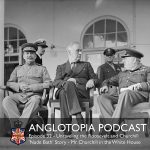
Welcome back to the Anglotopia podcast. This week we have with us Robert Schmuhl. Robert is the inaugural Walter H. Annenberg, Edward P. Joyce, Chair Emeritus, and American Studies and Journalism at the University of Notre Dame in South Bend. Robert has recently published a book called Mr. Churchill in the White House. And for those watching on YouTube, this is what it looks like. And Robert has chronicled the American Adventures of Winston Churchill during and after World War II, taking a look.
at the fascinating aspects of Anglo-American relations at the beginning of America's involvement in the war and all the way through the end, and then takes a look at Churchill's later visits to the USA during the Eisenhower administration. And there's a lot of fun stories about Churchill being a house guest and staying for weeks at the time, and it's a really fun book to read. So welcome, Robert. Thank you very much. It's a pleasure to be with you.
Thank you for joining us on this Friday before a holiday weekend. So the first question I wanted to ask is what's your Churchill story? What got you interested in Churchill and in this topic and everything? That's what I like to ask people when we talk about Churchill.
I think I first became interested in Churchill as a teenager long, long ago. I can remember being in high school and I was in high school during the 1960s. And when he passed away in January of 65, I went out and bought all of the, what we used to call instant books about Churchill. And the New York Times did one. Life magazine did one. Go down the list. And that started really a collection of sources that I would still have to this day.
I had a chance, a couple chances. In 2004 and then 2012, I taught over in London and became more engaged in British life, British history, and went to Chartwell, went to the war rooms, went to Kew, the National Archives, and started looking through Churchill documents, went to Canes, went to Kew, the National Archives, and started looking through Churchill documents, went to Cambridge, and went to the Churchill Archive Center. And basically, that was spade work, and I was just sort of looking around for something to write about.
2016, I published a book on the Easter Rising in Ireland, called Ireland's Exiled Children. And I enjoyed the process of writing that and doing the research. I should say straight out, and you sort of mentioned it in the little bio. My background was basically in journalism and in writing about contemporary affairs. So the Ireland book was a strat, different kind of book. finished it, was talking to people, you know, I really like this. I think I'm going to do a book on Winston Churchill.
You're crazy. One editor said, do you realize how much reading you're going to have to do? And I said, no, well, okay, let's see where this goes. And I had just finished a book called The Glory and the Burden, the American Presidency from the New Deal. to the present. And doing the legwork for that, I had run into a number of anecdotes about Churchill, being at the White House. Nothing formal. I mean, paragraph here, paragraph there, but they were interesting.
And I thought, you know, I'm going to look into that. And certainly in the biographies and histories, there are mentions of these visits. But this is a complete narrative of the times that Churchill lived in the White House, and we can get into that. But also, what I was trying to capture was the importance of those visits. As you say, they happened during the Second World War. They happened during the Cold War. They happened during his two premierships.
And I thought there was something there and went to live. Liveright, the publisher, which is a division of W.W. Norton, and presented a proposal, and they accepted it, and we have a book now.
That's so fascinating to hear, because I, you know, one, one, there's a thousand books about Churchill, what hasn't been explored about his life already. And so I applaud you for finding something that, that hasn't really been explored because he, his, his long stays in the White House were really fertile ground for interesting stories. So I applaud you for that.
And really, what is particularly heartening to me is that a number of the reviewers have said it's a fresh approach. It's a new angle. And that's exactly what I was doing when I set out to do this
book. Excellent. Now, I don't, I want to get into some of the things you talk about in the book. I don't want to give away the book. We want to give away the book. We want to give people reason to buy the book. But there's some, when I, when I read through it, there were some fascinating things that I was like, oh, we got to talk about that. Now, one of the things I wanted to talk about was, how did Churchill and Franklin Roosevelt meet?
It's actually much earlier than most people realize, and they actually didn't like each other very much.
Well, it's kind of interesting. You say you don't want to give away the plot, so to speak. But let me just interject this. that one of the discoveries in doing the research is that Winston Spencer Churchill did did not remember the first time he met Franklin Roosevelt, and he did not remember the first time the first time he met Dwight Eisenhower.
So the celebrated recipient of the Nobel Prize for literature in history was on some what shaky ground in terms of prominent people that he had met along the way. The first time, though, that FDR and Churchill met, it was in 1918, July. And Roosevelt was over in England as the assistant secretary of the Navy. And he was investigating a number of different issues and related to the War, First World War, the Great War. and they are together at a dinner.
And at that time, Churchill was the minister of munitions for the British government. He had formerly been, of course, the first Lord of the Admiralty. So they had, they had experience in common, shall we say. And I jotted down what Franklin Roosevelt wrote about it. He said, at a dinner I attended, he actually, he actually, like a stinker. And so that's the first meeting. During the 1930s, as Churchill became more and more of voice in the wilderness, quite frankly, against the threat of Nazi Germany.
Roosevelt wanted to know more about him. Was he indeed an alcoholic, was a concern? How much could he be trusted? Well, in August of 1941, so a few months before Pearl Harbor, they have a famous secret meeting off Newfoundland, and that produced the Atlantic Charter. Right. And it brought the two together. Churchill said, oh, it's so good to meet you. And Roosevelt said, well, you you know, we have met before. Awkward. So, right. So, somewhat awkward at the beginning.
But they did get along. And particularly early on, I think there was greater compatibility between the two, between the two men. And the guts, if you will, of the book would be the ways that Churchill kept coming to the United States to meet with Roosevelt during the war. What's interesting, Franklin Roosevelt went to Yalta. He went to Tehran. He went to Tehran. He went to Cairo. He went to Casablanca. Never ever went to England. Kept promising, kept saying, kept saying, I'll be over.
Winston Churchill had identified and sort of kept in his back pocket a specific apartment for him where he would have stayed during a visit to London. And he never, ever kept to the promise that he had made to Churchill.
What's interesting about the early days of their new relationship is that Churchill almost pursued Roosevelt like a lover. You know, and it's, it's, it was interesting to watch or to read about Churchill just basically throwing himself into this relationship as you would with a new love, like doing everything he can to make Roosevelt happy and, and work with Roosevelt.
And people would point out that when the two were together, particularly early on, let's face it, Winston Churchill, comes over shortly after Pearl Harbor. Now, Great Britain has been in the war for a long time. You've had the Battle of Britain, you've had the Blitz, all of that.
Greatest speeches, greatest moments, greatest hours, finest and in a sense, Franklin Roosevelt was relying on Churchill for military advice. And this was new to him. Dr. Winn, you know, Dr. New Deal. And now he was Dr. Win the War. So he is shifting his interest and his focus. And Churchill is quite happy to help him build his reservoir of knowledge and strategy about military affairs. But what's interesting is related to what I was just starting to talk to was the people who knew Churchill well said that he was quite restrained when he was around Roosevelt.
Roosevelt was a big rock-contour, as was Winston Churchill. And Churchill, in the beginning years, would let him hold forth and let him talk and not interject as much as he would usually do, which was a habit. And this is interesting of Churchill. throughout his life when, excuse me, he was a young man. He was introduced in the United States to groups by Mark Twain, okay? And he later met him, met Twain, Mark Twain in London. And the two two went off for a half hour.
And they came back and someone asked, Churchill first. How was it? He said, oh, it's great. Fine. Yes. And Mark Twain said, I had a good smoke, meaning that he didn't get a word in edgewise. But with...
Yeah. Yeah. It is interesting. Because remember, he at the beginning was making his way in the world. As a war correspondent, then he'd collect those letters and articles into books. And he would come over to the states and promote the books and sell the books. And he's young. He's in his 20s at that time. And to have the connection between Mark Twain and Winston Churchill is interesting in itself because Twain at that point was an old man and, you know, well known, as well known as any writer in America.
But he was second fiddle to Franklin Roosevelt, or at least he was playing that in order to get the kind of support and material that Britain desperately needed to fight the war.
So, speaking of that, then this is something that I loved reading about in the book is the logistics of this. How did Churchill get to the U.S. in the middle of a war? I mean, because there were no, We were going to jet planes. And, yeah, how did he do that?
In most cases, he would sail over. Okay. And for the first trip, which was in December of 1941, now, just think of winter coming across the Atlantic, it took them it took them 10 days to make it because of the gales, because of the gales, because of the reduced speed of the ship that they were taking. It was the Duke of York battleship. And he was so eager to get to get to Washington that they dock dock, and he immediately requested a plane from plane from Virginia to take him to Washington.
And when he arrived, when he landed, there was Franklin Roosevelt to greet him at the airport.
And then they went back, they went immediately to the White House. And that was the first time that they announced that Churchill was making the trip. He was behind the gates. It was heavily, heavily guarded. And they announced that Winston Churchill has arrived. To show you the security. that was involved. Clementine Churchill was selling like roses or whatever lapel buttons for the Russian cause to help the Russian people who were desperate for Red Cross aid. And she was in charge of it in Great Britain, and they rigged a picture of Churchill buying, making contribution to his wife that was released.
The photo was released to the newspapers while he was en route to the states on the Duke of York. And it was strictly what Churchill himself called a camouflage trick so that the public would think that he was still working in London and not making his way to America. On some of these trips, and I jotted this down, I'm going to read it, they would have the protection of an aircraft carrier, two cruisers, four destroyers, and a flying boat that was overhead.
That was the level of security for the prime minister and the people who were traveling with him. One of the trips, and I believe it was the one that I just mentioned with the security, one of them included like 230 people who were involved in the meetings in Washington where they were discussing the strategy for the war. Some were much smaller. One particularly in June of 42 was very small, and for that one he flew over and flew back.
And on the way back, as he was going to the airport in Baltimore, a guy with some mental issues, as we now say, attempted to assassinate it.
Yeah. Yeah. And it was hidden, kept secret for a long time, but the stories in them. And then if you said he flew, it wasn't that.
It was. I think when he flew over in the June of 42, it was like 24, 25. If you look at all of the, excuse me, all of the memoirs and diaries and all, each person has a different time, which is sort of a problem. But let's just say it was a full. day in the air to get him over here.
Now, how, how, how, we, we, we, you touched on this a little while ago that, okay, so Britain's already been in the war for 18 months before America joined the war. You know, Churchill's already had some of his greatest speeches and greatest events happen. So how did Americans view Churchill during these visits? Is it similar to how we view him now? Was he already the lion that roared? Or is it, is it different than how we can?
of him?
Well, he was the lion who roared. The first visit in December of 41 that continued into January of 42, he was well known. In 1940, he was Times man of the year, Time Magazine's man of the year. And we need to remember, I touched on it a little bit, but during the 30s, the wilderness year, He's out of government. He has to make a living. And he did what he did traditionally or historically throughout his life, which is he wrote like a demon when he was out of government and contributed a large number of articles to places like Collier's magazine over here in the States.
So he was, he was known as a writer, a figure in a figure in British politics and all of that. He comes to, he comes to power in May of 1940. And that's an enormous amount of attention. He comes over here. And there is such a burst of enthusiasm that I document that two sets of twins were named Winston. and Franklin. Many young, you know, newborn males were named just Winston during that period. Five thousand cigars arrived at the White House, all of which were incinerated out of security.
And a reporter went to the British Embassy and looked at a particular room where they had various items that had been sent to Churchill. And he documented them in an article, interesting article. And over in Cambridge at the Churchill Archive Center, I ran across an envelope that one of his secretaries had saved. The message was not in it. It was just the envelope. But the envelope said, and it was addressed to Churchill, the magnificent, the White House, Washington, D.C.
I think that gives you a sense of the regard that Americans had for him then. In 1943, and this would have been during his fourth visit to Washington and to meet with Roosevelt, A fellow who was running for the Senate from Illinois, Republican, proposed that the best way for America to approach the 1944 presidential election was to have Winston Churchill as the presidential candidate of the Democratic Party and the Republican Party. Now, of course. that was constitutionally impossible, politically impossible.
And the person who proposed that did not win the Senate C from Illinois. But I think that gives you something of a sense of how people viewed him at that.
Really interesting that he was already a celebrity. And so he kind of just walked into a welcoming environment that was waiting for him.
He walked. walked in, and I think what's important is he used the White House as a stage. He was a showman as well as a statesman. And he could tell that America was increasing in its power and influence in the world. And for someone who was in the business power, he wanted to be there, just as often as he could.
So speaking of that, that's a good segue into our next question. There's a lot of great stories in the book about Churchill being a house guest in the White House. And what kind of houseguess was Churchill? I mean, at one point, he stayed for several weeks at a time, which is something that just isn't done now with world leaders. He had his own room. He had his rooms for his staff. He had his own map room.
Like, what was it like having Winston Churchill around for a few weeks in the middle of a war.
In the view of Eleanor Roosevelt, it was unpleasant. He was a very demanding guest. One of the staff members of the White House said that he acted as if he belonged there. So talk about taking charge. Eleanor went to Franklin after the first visit, the 41-42 visit, and said, Franklin, why don't you go? buy Blair House, which is right across the street from the White House, and make it the President's Guest House. And Franklin Roosevelt got the U.S.
government to buy Blair House. It was acquired in 1942. It was set up as the President's Guest House. It was used as the president's guest house, and you can run through the records and see who stayed there while FDR was was president. The great irony for poor Eleanor was Winston Churchill never stayed there. She was unsuccessful at kicking him out of 1600 Pennsylvania Avenue. And he kept returning. There would be times, and this would be in the book, when Eleanor was not there.
You had Franklin and Winston. One time you had Franklin, Roosevelt, you had Winston, you had Winston Churchill, you had Clementine, and you had Mary Churchill, all at the White House, and Eleanor was not there. She was away, leading people to say, you know, this is a time when the First Lady should be on hand. But she was her own person. And as I say, as I say, in the book, if you go to Hyde Park, which I've done a number of times, you see not only the grand Roosevelt house, the main house, but you also see a few miles away a cottage that Franklin Roosevelt built so he could entertain friends and have people just visit with them away from the hustle and bustle of the main house.
And Eleanor Roosevelt had her own home, a few miles away from both the main and Top Cottage, which was FDRs. They were very independent individual.
Now, one of the most famous stories about Franklin and Winston is the nude bath story. And please tell us how the real story is actually more complicated than that from your research.
The story, and it's been told probably as many times. is the number of books that have been written about Churchill. And here is what I discovered, which is different from many of the accounts, is that Churchill was returning from a quick two-day trip to Canada. He had spoken to the Canadian Parliament. This is in 41, December, at the end of December, 1941. And they're coming back. and they arrive in Washington on the morning of New Year's Day, January 1st.
Franklin Roosevelt had set up a special prayer service to pray for the troops and, you know, America and the world. And Churchill comes back to Washington, and he is giving. getting ready to go with Roosevelt to this event, this service. And Churchill, who took, religiously took two baths a day, is getting out of the baths and in barges, Franklin Roosevelt, who during the night, had been thinking of a better phrase for the countries, the nations that were fighting on.
behalf of the allied cause. It originally was called the Associated Powers. That's a clunky way to refer to the allies. He thought, and he comes up with the phrase, the United Nation. And he's flush with enthusiasm to share that with Churchill. And he comes in, and there he is the Prime Minister in his altogether. And he admits this in his memoirs. It's just a line. And he doesn't, as I say, he doesn't go into detail there at all.
But the phrase is communicated. And what's interesting, and I really try to get to the bottom of it, and one critic thought I was a little to elaborate maybe investigating that particular event. But what is fascinating to me is fascinating to me is the extent to which Franklin Roosevelt delighted in retelling the story. He goes to Grace Tully, who is his Irish Catholic secretary, and says, Grace, you know, Winston is pink and white all over. And he tells the Canadian Prime Minister the same story a year later.
So it's one that is part of the repertoire of a story. Mackenzie King is the Canadian Prime Ministry. And it goes around Washington. And I've found a number of different people in the administration who included it in their memoir. And one of the, um, one of the, um, one of the people who was really close to the president and knew Churchill from the visits to Hyde Park more than the ones to the White House, said that Churchill had told her that he had reported to the king, George, that it was probably the first time that he had met with a head of state without the benefit of clothing.
And so, again, I don't think it's in dispute that it happened. I ran across in Cambridge doing research, self-published. It's interesting. It's very interesting. It's a self-published memoir of a Navy, British Navy figure who helped to set up the map room at the White House. So we had all these stories about Roosevelt and Churchill that were great. And one of them, not, not the one, the famous one that we've just discussed, but another one was in January of 42.
And Wendell Willkie, who ran against Franklin Roosevelt in 1940 for the presidency, Wendell Willkie was a wealthy, Indiana businessman. He was defeated, of course, by Roosevelt, but they remained somewhat friendly. He would make trips on behalf of Roosevelt. Anyway, he is visiting Roosevelt in the White House in January 42, and Roosevelt says to Willkie, you know, Wednesday, is here. Do you want to go see him? Sure, let's go see him. And Willkie had met him in London on a mission involving him.
And they go and they see that there's a guard person outside his door. And Roosevelt says, is your man up yet? He said, I don't think so. I don't think so. He said, well, let's just see. They open the door and there is Winston Spencer Churchill, having just gotten and out of that morning's bath. And what is interesting, and I would contend humorous, is his reaction, which is he is glowing, smiling, and says, please excuse my state of nature, and invites the two political figures, one Democrat, one Republican, into the rose bedroom for a discussion.
So that's a long way of telling the story. But it is alleged that he said that he had nothing to hide or to conceal from the President of the United States. And those different stories are intended to.
So, yeah, it's definitely one of those stories we want to be true, and it's partly true. And so, you know, it's fascinating to explore the history of how the tale changes with different people.
But Churchill was that kind of person. Right, it's believable. That you always, people would tell stories about him. And then the job of somebody writing about him is to track down whether or not there was any truth to the way that it's told.
That's the fun of historical research, right? Yeah. So moving on further down the timeline, Franklin and Winston, they had a similar aristocratic. background. So they kind of would speak the same language and have the same, you know, values and moors. How was the relationship different between Churchill and Eisenhower who didn't have that background?
It was very, very different because you had a situation where with Franklin Roosevelt, he doesn't really know Churchill. What he knows he doesn't quite like, as we've said. So they're getting to know each other right from the start. But with Dwight Eisenhower, Eisenhower, of course, was based in London for several years during the war, and they would meet on a very regular basis, Churchill and Eisenhower. And so he knew him. He spoke about him, both in England and then in the, but, of course, Dwight Eisenhower decides to run for president in 1952.
He wins the race and the dynamic, the power, the power dynamic, changes quite considerably. And what was interesting to me was interesting to me was that the dynamic changes, the power dynamic changes quite considerably. And what was interesting to me was the sort of memoir and diaries that I consulted and then quote in the book, which is the way that Churchill is not fond of what he sees as the approach that Eisenhower is taking as present, the decisions that he's making and what he's advocated.
And on the other side, Eisenhower is saying that although he respects Churchill, he's yesterday's man. He's not thinking about the reality of the world as it is in the early 80s. So you have this little tension between the, and it's more than a little tension between the two people. And it plays itself out. I think in an interesting way. And Churchill had a major stroke, kept it from the public, but a major stroke in June of 1953.
And one year later comes to America for a summit of some kind with Eisenhower. And I use the word summit probably incorrectly because what Churchill was trying to get Eisenhower on board to do was to be involved in a summit similar to the meetings that existed during the Second World War, the big three, meaning the U.S., the U.S., the U.K. and the Soviet Union. He wanted desperately to bring together the leaders of those three countries to reduce the tension from the Cold War.
And Eisenhower would not have it. He would not do it. And I think he was highly influenced by John Foster Dulles, and who just didn't want to have anything to do with the Soviet Union. And they do have this meeting, and it is very interesting played out. He's here about four or five days, stays in the White House, same place, the Rose Bedroom. And it ends, and there's a document and a communique and a sort of statement of purpose that is released.
And things are better between the two countries and, quite frankly, between the two leaders. He says, as Churchill is leaving, says to one of the people with him, now please bring him back. And Churchill does come back, not while he was prime minister. He leaves the premiership in 55. But he comes back in 59, near the end of the Eisenhower presidency. And what's fascinating to me is the meeting that they had in 54. They billed it as just a weekend to talk among old friends.
Oh, there's no agenda. Oh, there's nothing. Well, I. dug out all the agenda stuff and everything. And it was a much more elaborate meeting than it was Bill Wins. In 59, Dwight Eisenhower clears his schedule midweek. And for about three days or so, the two go around Washington. Eisenhower takes into his farm at Gettysburg. They fly over the battlefields of the Civil War. Churchill points out where various, you know, pickets charge took place and all that.
And at one point, the secretary to the president said that he treated Churchill as a son would an aging father. It's an interesting line. Yeah. And perception on her part. And he had written before and would say, again, the importance of Churchill, the admiration that he had for Churchill. And he became the only American who took part in the state funeral of Winston Churchill in January of 1965, so that the relationship between the two might have started Rocky, but they really become quite close as two human.
beings. And to me, it's a touching sort of sentimental journey, the last one in 59, where they visit people and relive great events of the war and talk extensively about that. And it's just the two leaders together and talking about not only the past, but also the present and the future, because both of them were concerned about it. And didn't Eisenhower take up painting inspired by Churchill's painting? He did, and in fact, did one of Churchill, that he was not as good an artist as Churchill was.
Churchill was a first-rate artist. Yes. But Eisenhower was diligent and did what he could, and it was a good hobby for him to take up. And both of them, when you think about it, ended up writing memoir-ish books. There was a popular one that Eisenhower did, at ease, stories I tell my friends, things like that. They had parallel interests.
Now, you kind of answered my next question already, so I think we'll skip ahead to the final fun questions I'd like to ask guests about Churchill. What's your favorite Churchill quote?
I knew you were going to ask that. And so, with the benefit of glasses, I am going to read it, and it is a serious one. I have another one that's a more humorous one. But this is the final sentence, final sentence, of the speech that Churchill delivered in the House of Commons on June 4, 1914. He becomes Prime Minister on May the 10th of 1940. So he has not been Prime Minister a full month yet.
But here is the quote. And the reason I'm reading it is because it is 141 words long. And as a lapsed teacher of writing, I would probably tell a student that a period would be necessary in about three different places. But This is a Nobel Prize-winning writer that we're talking about. And here you go. We shall go on to the end. We shall fight in France. We shall fight on the seas and oceans. We shall fight with growing confidence and growing strength in the air.
We shall defend our island, whatever the cost may be. We shall fight on the sea. We shall fight on the beaches. We shall fight on the landing grounds. We shall fight in the fields and in the streets. We shall fight in the hills. We shall never surrender. And even if, which I do not for a moment believe, this island or a large part of it, were subjugated and starving, then our empire beyond the seas, armed and guarded by the British fleet, would, which are guarded by the British fleet, carry on the struggle until in God's good time, the new world with all of its power and might steps forth to the rescue and liberation of the old.
Well, but what I love is that steps forth to steps forth. To the rescue, the new world, with all its power and might steps forth to the rescue and liberation of the old. You had mentioned before that he was in a way trying to, he Churchill was trying to woo Roosevelt to get him more involved in the war, to bring America into the war. Just that phrase to the rescue and the liberation of the old. is just how much Churchill wanted the involvement of the United States in the Second World War.
And what precedes it is the strength, the confidence that the British people will continue that struggle until they receive the help from the U.S. I did.
Steve worked. So what's, moving on to the next question, what's your favorite Churchill story or anecdote?
The ones that I like are the ones that focus on his writing and the extent to which he was involved in the process. It was said of Winston Churchill that for a major speech, he would work on it an hour for every minute of delivery. So if you had a 20-minute to speech, she would work 20 hours to get it right, to get the pros right, and the delivery right, all of that was important to him.
On Christmas night of 1941, he's at the White House, and they are showing Oliver Twist, the film, to the people who were assembled. and he gets up during it and excuses himself and says, I have to go and do my homework. That was his word. Well, his homework was to revise and sharpen the speech that he would deliver to Congress the very next day, the joint session on December of the 26th of 1941. And I say it's so interesting because he worked so hard on a speech like that, and he gave a second speech to Congress in May of 43, and he began that.
The night of Monday worked all day and worked all the night on Monday, all day Tuesday, into Wednesday, and then delivered it at noon on Wednesday. for another speech, the one celebrating the Home Guard on its third anniversary, which was in May of 43, he knew the speech would be delivered at 1230, and at 10.45 that morning, he did not, he had not started on it yet. So there are times when he is flying on the seat of his pants and as fast as he can dictate.
But for the major speeches, he really worked.
Speaking of books, other than your own book, obviously, what's your favorite Churchill book that you recommend to everybody wanting to read about Churchill?
I'd say that the Andrew Roberts' biography is not only comprehensive, but it is up to date. It has new material in it that is fascinating. I think that's important. I think Roy Jenkins' biography, just called Churchill. is valuable for the analysis because Jenkins was himself a major political player, governmental, so he has insights that others might not have. Those are two, a short one, if someone is interested as Paul Johnson's brief biography of Churchill, which covers the high points in a distinctive and engaging sort of way.
And finally, for our last question, the funest one, or the most fun one, what's your favorite Churchill film? I'm going to say darkest hour, and I know it's inaccurate, particularly the scenes in the metro or the tube. Those don't ring true at all. But I think the portrayal of Churchill himself is so good that that would rank very high. One that I watched on YouTube, not that long ago, and I'd watched it many years ago before, the eight part of the wilderness years.
Which, you know, it takes a while. It's hard to find, too, yeah. Yeah. I found it on YouTube just by doing searches and then putting them in order, one, two, eight. But I'm not sure that movies do injustice. One of the things, I think probably the most engaging Churchill book that he himself wrote was my early life, which came out in 1930, which has some of his best prose. I mean, if you want a lively story told in a lively way, that's it.
as far as I'm concerned.
Well, we would have been an agreement there. So, well, thank you so much for your time, Robert. I know it's Friday before holiday weekend, so thank you for speaking with us. Again, the book is Mr. Churchill in the White House. And if you're on YouTube, you can see it's on the screen, and we'll link to it in the show notes. And I highly recommend you check it out. So thank you, Robert. Thank you.
