
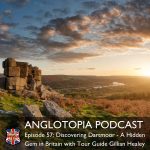
From the Anglotopia Podcast: Episode 57
Ask most American visitors to sketch out their dream trip to Britain and the itinerary tends to write itself: London first, then the honey-colored villages of the Cotswolds, and perhaps a brave push north to Yorkshire if they are feeling adventurous. Dartmoor, the 368-square-mile expanse of wild granite and open moorland in Devon, almost never makes the list. And that, according to expert walking guide Gillian Healey, is one of the great missed opportunities of British travel.
Healey came to Devon twenty years ago, after spending time hiking around the Andes, the Himalayas, and Patagonia. Today, as a qualified Hill and Moorland Leader, she spends her days exploring every corner of Dartmoor’s varied landscape, sharing its rich history, myths, legends, and natural beauty with visitors from all over the world. On this episode of the Anglotopia Podcast, host Jonathan Thomas sat down with her to talk about how she became a Dartmoor guide, her favorite routes across the moor, the surprising American connections buried in its history, and why this ancient, layered landscape deserves a place on every Anglophile’s bucket list.
What emerges is a portrait of a place that is far more than a national park. It is, as Healey describes it, a living, layered landscape where you can walk among Bronze Age villages, medieval farmsteads, and Victorian quarries in the space of a single afternoon, all of it wide open to the sky and, remarkably, open to your own two feet.
A Guide Born From Getting Lost
Healey’s path to becoming a professional guide, by her own admission, was “a little bit by accident, but a little bit by fate as well.” A lifelong lover of hiking and the outdoors, she had spent years walking the Southwest Coast Path and, more recently, planning weekend walks to take her friends up onto Dartmoor. She would study the routes, check the weather, and lead the way. It worked beautifully, until the day it didn’t.
“The notorious Dartmoor mist came down,” she recalled, “and we kind of got a bit lost, I have to say.” Her friends turned to her and asked which way to go. “I turned around and said, I have no idea.” It was a humbling moment, and a clarifying one. If people were going to look to her to get them safely in and out of Dartmoor, she needed real skills, real navigational training, and real qualifications. That realization led her to pursue her Hill and Moorland Leader qualification.
What began as a personal quest to feel confident and safe leading friends soon snowballed into something more. People started asking whether she would take paying visitors out onto the moor. “My gosh,” she remembered thinking, “this is a win-win situation.” She discovered a genuine passion for sharing Dartmoor with others, and the business grew from strength to strength from there.
From the Andes to the Moor
Before Devon, there were the mountains. Healey spent two years in Latin America, drawn to the huge skies and open wilderness she found there. She spent a good deal of time in Ecuador near Cotopaxi National Park, high in the Andes, and while she was staying there she was asked to guide groups and help them acclimatize to the thin air at high altitude. The challenge was to lead them gradually, allowing their bodies to adjust while she looked after them and made sure they were okay.
That experience, she says, was where it all really began. “I really enjoy getting people outdoors, making sure they’re safe, and just to have fun as well.” When she returned to England, she settled in Totnes, a town she affectionately describes as “a cooler version of Glastonbury” set between the sea and the moor. Dartmoor drew her in with that same pull she had felt in South America: the sense of being high up and out in the wilderness. The mountains of the Andes and the wild expanse of Dartmoor may look nothing alike, but for Healey the feeling of guiding people through them “is one and the same.”
Her credentials go beyond navigation. Alongside her Hill and Moorland Leader qualification, Healey is a trained outdoor first aider and a mental health first aider. The first two are self-explanatory on a landscape where the weather can turn in an instant and help can be a long way off. The Hill and Moorland qualification certifies that she is trained and assessed to lead groups safely in upland terrain, able to navigate in poor visibility and respond to emergencies. Outdoor first aid means she can provide emergency medical care in remote locations until professional help arrives.
The mental health first aid qualification is one that Healey feels is “coming into its own.” Being outdoors, she notes, can bring up a lot emotionally, and the training allows her to spot the signs of distress, listen, and guide someone toward further help if they need it. As Jonathan put it, she sounds like exactly the right person to get lost in the moors with.
What, Exactly, Is a Moor?
For American listeners, the word “moorland” doesn’t have an obvious equivalent, so Healey offered a working definition. Moorland is open space that was once populated by trees, until humans came along and cleared them for their own purposes. What remains are wide open expanses of grass and bracken, often used for grazing, so you tend to see sheep and cows, and on Dartmoor, the famous ponies. Britain has moorland all over, from the Peak District to Exmoor, but each has its own distinct character.
Dartmoor itself is extraordinarily varied, changing dramatically depending on where you go and what season you visit. Healey paints the picture: sweeping moorland views, dramatic granite tors for which Dartmoor is famous, natural swimming pools surrounded by beautiful ancient oaks, and the wild ponies wandering the hills. But what sets it apart, she insists, is that it is not just about nature and views. It is a living, layered landscape where you can walk among Bronze Age villages, medieval farmsteads, and Victorian quarries, and come across standing stones older than Stonehenge and ancient clapper bridges still in use today.
The magic, she explains, is that none of it is fenced off, locked in a museum, or hidden behind barriers. “You can walk into Bronze Age roundhouses and really get that connection with the history and the solitude.” For Healey, Dartmoor offers something increasingly rare: a genuine chance to slow down and experience the feeling of getting away from it all.
The Sales Pitch for American Travelers
Jonathan asked Healey to make her case directly: why should Americans, who typically stick to London and the Cotswolds, make the journey to Devon? She had clearly given it thought. “Imagine hiking through vast open moorland where you’ve got wild ponies roaming free,” she began, “and you can climb up ancient granite tors for huge panoramic views while stumbling across Bronze Age stone circles which are older than the pyramids.”
And crucially, she added, “there are no crowds there. It’s just space, stories, and sky.” This is a place, she said, where the landscape hasn’t just been seen but lived in for over 4,000 years. It is raw, untouched, and carries a deep sense of history that you feel with every step. By the end of the pitch, Jonathan conceded she had sold him completely.
Part of what makes Dartmoor so compelling for American visitors is how different it is from the national parks they know. Yosemite and Yellowstone are magnificent, but they are principally about scenery and wilderness. Dartmoor, Healey argues, “isn’t just a national park, it’s a walk through time.” Unlike Stonehenge, where you step back and observe from a distance, here you can touch the stones, feel them, and even ask permission to sit inside a roundhouse or a stone circle and watch the sunset. That intimacy with deep history, she says, is something you simply won’t experience anywhere else.
A Landscape Tailored to You
Healey’s tours are deliberately personalized, and she is a firm believer in the bespoke itinerary over any one-size-fits-all route. To truly get the most out of your time on Dartmoor, she says, the walk should be built around your interests and fitness level. She offered a memorable example from this year: a couple from Colorado, returning for their second visit, whose husband had ancestral roots in the area. His forebears had been Dartmoor tinners, so together they set out to explore areas still etched with the scars of post-medieval tin mining, weaving in ancient stone rows and Bronze Age settlements along the way.
“It was a journey through their own personal history and human history laid onto the moor itself,” she said, and it is precisely those walks that she finds most rewarding, watching visitors connect with the story of their own families. When Jonathan admitted he had always thought of tin mining as a Cornish specialty, Healey confirmed that its scars are found all over Dartmoor too.
She has two personal favorite routes. The first loops around Hound Tor and Hay Tor, packing an astonishing amount of Dartmoor into a small area: Bronze Age remains, granite mining, flora and fauna, stunning views, a medieval village, and the ponies who like to gather there. It is what she calls a “honeypot,” attracting plenty of visitors, but for good reason. The second lies toward the west of the moor, just beyond Princetown, and covers one of the finest Bronze Age sites on Dartmoor, with three stone rows, a stone circle, standing stones, and a number of cairns and kists, the Bronze Age burial chambers. That route also takes in some of the largest quarries on the moor, opening a window onto Dartmoor’s history of industrialization.
The American Prisoners of Dartmoor
It was that western route, and the town of Princetown, that unearthed one of the episode’s most surprising threads. The quarries there were used to build Dartmoor Prison in 1806, a forbidding place widely known for housing UK criminals and prisoners of war. Among those prisoners, Healey explained, were Americans held during the War of 1812. To this day, Americans travel to Princetown specifically to trace ancestors who were imprisoned there, or who died in a dark event that has come to be known as the Dartmoor Massacre.
Jonathan, who prides himself on his knowledge of British history, admitted he had never heard the story, and pressed her for the details. The tragedy came after the war had officially ended. Due to delays in communication, the British authorities were slow to release the American prisoners, and tensions rose. On April 6, 1815, a protest inside the prison turned deadly when the British guards opened fire, killing several American prisoners and injuring over thirty others.
Memorials to those men can be found inside the church across the road from the prison, a building that was itself partly built by American prisoners and partly by French prisoners captured during the wars with Napoleon. There is even an American graveyard which, with permission from the prison, visitors can go and see. For an American traveler, it is a startling reminder of just how deeply the histories of the two nations are intertwined, and in places you would never think to look.
The Ponies, the Wildlife, and the Living Moor
No conversation about Dartmoor would be complete without the ponies. They look wild, roaming freely across the hills, but as Healey clarified, they are more accurately “domesticated wild.” Many are owned and carefully looked after by the Dartmoor Pony Trust, which steps in to help any pony in trouble and manages the overall numbers so that the moor stays in balance. Each year there are two or three roundups where the ponies are counted, and some are taken off the moor and sold at market, occasionally for as little as around fifty pounds, meaning anyone with a spare bit of land and paddock could, in theory, take one home.
There are different types, too. Some have thick, shaggy coats that make them look like they are wearing little teddy bear jackets, while others have been bred with more traditional horses. Fans of Steven Spielberg’s War Horse, which Healey recommends, will be interested to know it was filmed on Dartmoor and touches on the history of using the ponies during wartime and in industry. There is evidence the ponies have been on the moors for a very long time, quite possibly thousands of years. Deer roam Dartmoor as well, though visitors are far less likely to spot them.
Keeping her tours rich with this kind of knowledge takes serious preparation. Before any walk, Healey does a “recce,” a reconnaissance of the route to confirm it is still safe, accessible, and appropriate for the group, checking path conditions and assessing river crossings that heavy rain can render impassable, and planning alternative routes in case Dartmoor’s famous weather turns. Only once she is confident in the route does she turn to the content of the walk. Much of Dartmoor’s history is well established, but she continually updates her knowledge with the latest archaeological digs, including a Bronze Age kist discovered the previous year and currently being excavated, which is yielding new information about a people we still know very little about.
Who Owns Dartmoor? The Fight for Access
This is where Healey’s passion runs deepest. On her tours she likes to ask American clients who owns their national parks. “It’s the state, of course,” they answer. Then she explains that in Britain, almost everything is privately owned, even a national park, which tends to leave visitors baffled. To explain how this came to be, she reaches back to 1066, when William the Conqueror divided up the land into private estates, setting in motion the enclosure movements whose legacy endures today. The result is that the public has legal access to only about eight percent of England’s land, a statistic she rightly calls shocking.
The biggest landowner on Dartmoor is the Duchy of Cornwall, historically associated with the heir to the throne, alongside a patchwork of other private owners. Healey noted that with King Charles having stepped back, Prince William has taken up the mantle, and there is real excitement about the ideas emerging for restoration on Duchy land. Both, as Jonathan observed, care deeply about the landscape.
Even so, access remains under threat, and Healey is part of a campaign called The Stars Are For Everyone, fighting to keep Dartmoor open. Britain has a fantastic network of public footpaths, she says, but they were hard won, born of struggles like the Kinder Scout trespass, and they still have to be defended. On Dartmoor she is seeing “micro enclosures” creep in, a little farm here, a small fence there, until, before you know it, big swathes of open-access land begin to close up. The stakes, she argues, could not be higher. “If COVID taught us anything,” she said, “it is we need access to outdoor space for everything, just to survive.”
Jonathan, who lives surrounded by farmland he is legally barred from setting foot on, offered a distinctly American counterpoint. Even eight percent, he pointed out, is far more open land than most Americans can freely walk. Dartmoor holds one more distinction that makes the fight so urgent: it is the last place in England and Wales where you can legally wild camp, a right currently being challenged in the courts by one particular landowner. It is a battle Healey and her fellow ramblers intend to keep fighting.
Legends, Literature, and the Landscape’s Memory
For many Anglophiles, Dartmoor first entered the imagination through literature, above all Sir Arthur Conan Doyle’s The Hound of the Baskervilles. Doyle loved Dartmoor, and was inspired to write the novel after hearing its myths and legends; its brooding atmosphere is central to the story. Healey delights in pointing out the real places behind the fiction. The Great Grimpen Mire is based on Foxtor Mires, a vast, treacherous bog where a single misstep could leave you, like the villain of the tale, sinking up to your neck. Doyle himself used to stay at the Duchy Hotel in Princetown.
Dartmoor’s otherworldly quality has made it a favorite film location too, from Doctor Who to a recent Netflix production Healey saw being filmed. On a glorious sunny day, she admits, it can be hard for visitors to picture the misty, eerie, desolate moorland of legend, so she works to spark the imagination and conjure those myths as she walks. Part of her craft is helping people not just look at the ancient sites but pause and imagine the people who built them, the lives they led and the hardships they endured. She brings stories, maps, and even short readings, talking about how the landscape holds memory, a phrase Jonathan singled out as one he loved.
Why You Should Leave the Car Behind
For her final word, Healey made the case for walking itself, for experiencing Dartmoor on foot rather than through a car window. On foot, she says, you feel the contours of the land and the soft peat beneath your feet, peat formed from thousands of years of degraded trees and plants. You hear the silence between the wind and the birdsong of the skylarks, and you notice the details that are simply invisible from the road. She often carries little microscopes and magnifying glasses so visitors can examine the moss and the bright yellow lichen clinging to ancient stones, or study the shape of a Bronze Age hut circle and the shifting light moving across the moor.
“For me it is about connecting not just with the place,” she said, “but with the time and the culture and the nature as well.” Her parting advice was simple and heartfelt: “Get out of your car, get your walking boots on, go for it.” It landed. Jonathan confessed that he had twice driven straight through Dartmoor without stopping, and now felt genuinely guilty about it, resolving to come back and explore it properly, boots and all.
That, in the end, is the quiet power of Gillian Healey’s Dartmoor: a place where 4,000 years of human history lie open to the sky and to anyone willing to walk into it, where the stones can be touched, the ponies roam free, and the mist still rolls in to remind you that this ancient landscape has never stopped being lived in. If you find yourself heading to the West Country, look her up. As Jonathan put it, you won’t regret it.
—
Want to hear the full conversation? Listen to Episode 57 of the Anglotopia Podcast, with Gillian Healey.


Never miss an episode
Free newsletter
New episodes, full transcripts and long-read articles on British history, travel and culture, straight to your inbox. Join 36,000+ fellow Anglophiles.
Unsubscribe anytime. We never share your email.
Featured image: Photo: Jonathan Thomas / Anglotopia, LLC


