
From the Anglotopia Podcast: Episode 68
There is a particular kind of Britishness that cannot be fully explained without dogs. It lives in the muddy boot rooms of country houses, in the ankles of a queen, in the pages of a weekly magazine that has been quietly cataloguing the nation’s obsessions for well over a century. When Jonathan Thomas sat down for this episode of the Anglotopia Podcast, he did something he rarely does: he changed locations, gathered up the family Cavaliers, and invited a couple of very special co-hosts onto the show. As he put it, “today we’re going to the dogs, but in the best possible way.”
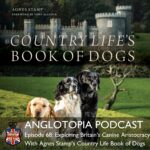
His guest was Agnes Stamp, author of Country Life’s Book of Dogs, a lavish new coffee table volume from Rizzoli that celebrates Britain’s most beloved aristocratic canine companions. Jonathan had an advance copy in hand throughout the conversation, and he was not shy about his verdict. “It is gorgeous,” he said, adding with a laugh that he was “going to say that a lot in this podcast.” From foxhounds and stately kennels to dachshunds perched on velvet cushions, the book is a love letter to the dogs that have trotted through the pages of Country Life for over a century.
What follows is a conversation that ranges from royal corgis to long-forgotten breeds, from the digitized depths of a magazine archive to the very personal grief of loving an animal that simply does not live long enough. It is, above all, a portrait of a nation of animal lovers told through the creatures that have sat, quite literally, at the center of its history.
Meet the Co-Hosts: A Studio Full of Spaniels
Before the conversation could properly begin, Jonathan had introductions to make. “I gotta introduce my other two guests on the podcast today,” he said, coaxing a King Charles Cavalier Spaniel named Cooper into the frame. A second, camera-shy Cavalier lurked somewhere off-screen and refused to make an appearance, so the show pressed on without her. Cooper, by contrast, proved a natural, lounging so calmly that Agnes remarked on how relaxed he was on camera.
Jonathan was quick to clarify the family hierarchy. The Cavaliers, he confessed, are his wife’s preferred breed rather than his own. “My favorite breed is the Irish Setter,” he admitted, revealing his hope to get one of his own within the year. Still, his affection for the Cavaliers was unmistakable. “They are the calmest, loveliest, friendliest dogs,” he said. “They’re idiots and they’re so lovable.” Agnes, for her part, described Cooper as “so regal.”
When Jonathan turned the question back on her, Agnes admitted that picking a favorite is nearly impossible in her line of work. “I love all dogs, of course,” she said. “I think it’s a prerequisite for working at Country Life. You need to be obsessed with dogs and horses.” In her adult life she has kept a Staffordshire Bull Terrier and French Bulldogs — breeds Jonathan approvingly called “very English.”
A Century of Dogs in the Pages of Country Life
The book, Agnes explained, grew directly out of the magazine that has employed her, on and off, for more than a decade. When the editor in chief asked whether she’d like to take on the project, she “put my hat in the ring because I couldn’t think of a nicer subject to write about.” And the raw material was already there in abundance. Country Life was founded in 1897, and as Agnes noted, “from day dot, we’ve run dog editorial.” There was a regular column called Notes from a Kennel, which later became Kennel Notes, and in more recent years the magazine has run substantial features on specific breeds. “Dogs have really been part of the editorial makeup since the beginning of the magazine.”
For listeners unfamiliar with the publication, Jonathan offered a warm endorsement, describing Country Life as “a little weekly encyclopedia of Britishness,” filled with articles about stately homes, historical properties, architecture, art, and history. Agnes finished his sentence for him: “and dogs.”
Agnes came to the subject by an unexpected route. She studied fashion history at university, but even then she was doing work experience placements at magazines — including Country Life. Her earliest published credit, which she recently rediscovered, is dated June 3, 2004. Professionally, she has worked for the magazine in various guises since 2013, both on staff and on freelance projects, and she knows the brand and its archive intimately. Country Life’s Book of Dogs is her first book, a milestone Jonathan enthusiastically congratulated her on, calling it “quite an achievement” and “a beautiful first go.” He noted that it shares a form factor with last year’s Country Life 150 book by John Goodall, so it will “sit nicely in the stack of fancy country books on your coffee table.”
Because the book was researched almost entirely in the Country Life archives, it reflects the magazine’s own way of covering the subject. “You could almost say that the book is an abridged version of all our dog content since 1897,” Agnes said, adding that she deliberately kept the tone of the magazine in the book so that readers would know exactly what to expect when they opened it.
Titan, Betsy, and the Dogs Who Shaped a Writer
Agnes’s love of dogs runs deep, even if her childhood didn’t include the puppy she desperately wanted. Instead, her family kept what she cheerfully called “a menagerie of rabbits and guinea pigs and hamsters and cats,” a combination she now admits “probably wasn’t the wisest.” It was in adulthood that dogs finally arrived — and several of them found their way into the book itself.
There was Titan, her Staffordshire Bull Terrier, who appears in the Staffordshire chapter around page 169. There was Betsy, an elderly rescued French Bulldog she took on to provide palliative care, “very special to me,” who appears on page 296. Even her sister’s dog, little Leo, makes an appearance on page 299, photographed among the daisies. Writing up breeds she had known personally gave Agnes particular pleasure, because she recognized the “confirmation and the personality traits” that Country Life had described so lyrically over the decades. French Bulldogs, the magazine noted, are “full of courage yet with clown-like qualities” — a description Agnes found spot-on for the Frenchies in her own life, “both ridiculous, but also really know their own mind.”
Her favorite anecdote in this vein concerns the Staffie’s tail, which the magazine once said should resemble “an old-fashioned pump handle.” Titan’s did exactly that. And in a letter to the editor from around 1962, a reader described a Staffordshire Bull Terrier named Fireman who loved to dig stones out of a loch in Scotland. It made Agnes laugh, because Titan did precisely the same thing. “Any opportunity to carry rocks, he took it,” she recalled, “and I was frequently telling him off because I was worried about him damaging his teeth.” Jonathan could relate: his own dog has an inexplicable habit of picking up old corn cobs from the yard. “Maybe it’s because he lives in Indiana,” he joked.
How to Organize a Nation’s Dogs
One of the quieter challenges of the book was deciding how to arrange it. Agnes mulled the question for some time, initially wondering about thematic chapters — dogs in art, dogs in literature, dogs in country houses. But she ultimately concluded that readers would simply “want to look up their favourite breed and see how country life has covered them.” So she adopted the Royal Kennel Club’s grouping system — hounds, terriers, gundogs, and so on — which she felt was “the perfect way to organise the material.” Within each breed, she still weaves in art, literature, and historical anecdote; the structure just makes it easy to browse. Jonathan confirmed the logic instantly: the first thing he did when the book arrived was look up the setters.
The book is not, Agnes stressed, an encyclopedia of every breed. Her selection criteria were straightforward: she included only breeds that Country Life had actually featured, dogs that were already popular with the readership or that an editor at some point had judged would appeal to it. In all, the book “romps through 70 breeds,” a number that made writing it, in her words, “a marathon.”
That approach let her balance the famous with the obscure. Country Life has long been a champion of vulnerable native breeds — those the Royal Kennel Club deems at risk, with fewer than 300 annual registrations — so there was ample editorial to draw on for rarities like otterhounds. The harder part was finding pictures. For breeds so rare they hadn’t been photographed recently, Agnes turned to the Royal Kennel Club and the wonderful Mary Evans Picture Library. At the other extreme sat the Labrador, of which the archive holds “many, many, many” photographs. A friend of hers likens Labradors to vintage MG cars: “a little bit boring but very popular for a reason.” They’re also, Jonathan noted, very easy to photograph — which is perhaps why they landed on the cover.
Dogs as Status Symbols: Kennels, Mastiffs, and Aristocratic Identity
Asked what role dogs have played in shaping British aristocratic identity, Agnes reached back into history. Dogs once served real purposes: hounds and terriers for hunting, mastiffs for guarding, Dalmatians as carriage dogs. Those jobs have largely vanished, but their legacy remains carved into the landscape. She pointed to the great kennels at the Goodwood estate, built to house the Duke of Richmond’s prize foxhounds — kennels so grand, she noted with delight, that they “had heating before the main house did.” Today that building is a private members’ club, its architectural legacy living on.
Mastiffs fascinate her especially. They are ancient breeds, and they appear in Shakespeare’s Henry V, described as having “unmatchable courage.” During the reign of Henry III, she explained, a law allowed substantial freeholders to keep such dogs for the protection of their houses, cementing the mastiff’s centuries-long association with the country house. At Chatsworth, the last mastiff is remembered by his surviving collar, made in 1832. But big dogs suffered terribly during the war years — “they really do eat as much as a horse,” Agnes noted — and after the Second World War she believes only about eight mastiffs were left in the entire country. They had all but disappeared from the great estates.
Then there is royalty. Queen Elizabeth II was “always surrounded by corgis” — so much so that Princess Diana once called them “a moving carpet of corgis.” The current Queen Consort loves Jack Russells; two of hers even appeared on the magazine’s frontispiece page, wearing her pearls, a couple of years ago. As Jonathan explained for the uninitiated, Country Life’s frontispiece traditionally features “a beautiful young aristocratic woman who is up and coming in high society” — so putting the dogs there instead was, in his words, “hilarious and awesome.”
Savage, Smut, and Fortune: The Delight of the Archive
Ask Agnes for surprising facts and the anecdotes tumble out. Everybody knows Lord Byron had a beloved Newfoundland named Boatswain, whose death from rabies left the poet inconsolable. Less well known is that Byron also kept two bulldogs during his time at Cambridge — dogs he named, marvelously, Savage and Smut. Then there is Josephine Bonaparte’s pug, Fortune. On her wedding night, when Napoleon climbed into bed with Josephine, Fortune “popped out and savaged Napoleon.” Agnes, who clearly relishes the mental image, suspects “Napoleon probably thought he met his match that evening.” Anyone who has met a pug, she added, knows they are “bombastic little creatures.”
The archive itself has changed over the years. Once, all the bound volumes lived in the office — “a treasure trove,” Agnes recalled, where you could sit and leaf through old editions. Now the volumes are specially housed in a warehouse and the archive has been digitized, searchable online, though roughly the most recent twenty years still require manual digging. Jonathan mused about the possibilities of turning modern AI loose on it: “give me all the dogs that look like this, give me all those homes that do this, give me eccentric aristocratic stories.”
The single greatest pleasure of the whole project, though, wasn’t in the estates she visited over her career but in the Royal Kennel Club’s Library in Mayfair, near Green Park. Agnes described it as “a dog lover’s heaven” — a space housing “every possible book you can imagine on dogs,” with an art gallery and walls filled with incredible dog paintings and illustrations. Remarkably, she wrote the entire book in six months, on top of her day job, a feat Jonathan warmly applauded.
Royal Spaniels, Loyal Companions, and a Heartbreaking Mastiff
As the owner of two Cavaliers, Jonathan couldn’t resist asking for an anecdote about King Charles Spaniels — and Agnes delivered. King Charles II was famously devoted to the breed, taking his dogs everywhere, even to Privy Council meetings, when he “probably should be thinking about more serious things.” She quoted Samuel Pepys, writing in the 1660s, who observed “the silliness of the king playing with his dogs all the while and not minding the business.” Jonathan, watching Cooper lick his own foot mid-interview, could only agree: “I can understand why he wasn’t getting anything done.”
The book’s royal thread runs deep. Queen Victoria kept diaries listing hundreds of her dogs, but Agnes reckons Queen Elizabeth II “probably comes a close second” in devotion. The late Queen even had a “dorgi” — a Dachshund crossed with a corgi — alongside her famous corgis and her beloved horses. Agnes recounted an Instagram video of the Queen watching old family films with the then Prince of Wales: when a young prince appeared on screen she hesitated (“could be William, could be George”), but the moment a corgi appeared she instantly named him — “that’s Susan,” the corgi given to her on her eighteenth birthday. Dogs first, as Jonathan laughed.
Not every story ends happily. The one that moved Agnes most concerns Rory Stewart, popular on both sides of the Atlantic, who appears in the Mastiff chapter photographed with his own mastiff, Morag. In his poetic account of walking across Afghanistan in 2002, Stewart describes forming a bond with a retired fighting mastiff he named Babur, whom he intended to bring home to Scotland to live out his days in comfort. But Babur died before the journey could be completed. “When I read this chapter, I was inconsolable,” Agnes admitted, fully empathizing with the grief of losing a pet. Jonathan shared his own: a shelter mutt named Winston, after Churchill, lost to canine cancer at just six years old. “The problem with dogs,” he reflected, “is they don’t live long enough.”
From Turnspits to Comforters: How a Dog’s Job Disappeared
The changing role of dogs, Agnes argued, is really “a reflection of progress.” The turnspit dog, once used to turn a wheel that rotated meat in the kitchen, vanished when more convenient cooking methods arrived. Carriage dogs like the Dalmatian faded as carriages gave way to cars. Cleaner cities meant fewer terriers were needed to manage vermin. “Over time, we’ve kind of taken away the dog’s jobs,” she said. Some breeds we keep simply because we like them; others have gone extinct entirely — the English White Terrier, a forerunner to the bull terrier, and the Tweed Water Spaniel, a forerunner to the golden retriever, both lost to interbreeding and the development of more desirable breeds.
Yet working dogs haven’t disappeared. Sheepdogs are still used, and Agnes believes they “truly are happiest working because their brains are wired that way.” Police dogs and medical detection dogs continue their vital work, and there are even dogs trained to sniff out Japanese knotweed, an invasive plant that can wreck buildings. Historically, lap dogs were known as “comforters,” valued both for emotional companionship and for the practical warmth they brought to a bed. “Today,” Agnes reflected, “I think probably all dogs are comforters in a way for us.”
Jonathan found the idea of stolen jobs poignant, because instinct has a way of outlasting employment. Even his placid Cavaliers, he noted, will detect a loose mouse in the house and hunt for it — not knowing quite what to do, but knowing they must look. “There’s generations of breeding that has gone into these breeds,” Agnes agreed, “and they have an instinct that you can’t ever remove.”
Photography, Preservation, and the Future of British Breeds
Photography, Agnes explained, transformed how the public saw dogs — and its rise coincided almost perfectly with the standardization of breeds. The Kennel Club formed in the Victorian era, and 24 years later Country Life arrived, just as it became fashionable to have your pet photographed. Suddenly images of dogs were appearing in magazines, promoting breeds previously unseen by the general public and opening up “a new facet of understanding.” You can read the finest description of a dog, she noted, but if you’ve never seen it, you don’t really know what it looks like. A leading dog photographer of the era, Thomas Fall, photographed the Princess of Wales and her borzoi — a Russian breed — for the magazine’s very first issue on January 8, 1897, and went on to shoot the dogs at Sandringham. Many of his photographs appear in the book.
On preserving Britain’s canine heritage, Agnes is a passionate advocate for rescue, praising shelters like Battersea and the Dogs Trust for their work rehoming animals. But her deeper message is about research. “It’s really easy to just opt for a familiar breed,” she said, “but actually you might discover that one of the vulnerable native breeds would really suit your lifestyle and your family.” She isn’t promising you’ll find rare breeds in shelters, only urging people to keep an open mind. Jonathan echoed the sentiment: rescue where you can, and if you buy from a breeder, do your research, make sure the dogs are registered, and avoid “battery farm puppies” that lead to problems later. It took his family a long process to find the right breeder for their Cavaliers, though he admits the dogs remain “practically impossible” to house-train.
Even the misunderstood breeds get their due. The Dachshund, favored by Prince Albert, and the German Shepherd both suffered persecution in Britain during the war years simply for being German — a fact Agnes found genuinely shocking “because this is a nation of animal lovers.” She tells the full story in what she affectionately calls “the sausage dog chapter.” And among the hardest breeds to research was the Manchester Terrier, which she describes as looking like a “mini, mini Doberman”; Agatha Christie was a fan, as was Eliza Soane, wife of the architect John Soane, who kept a Manchester Terrier named Fanny as a lap dog.
One Dog to Bring Home
Pressed to choose a single breed from the book to bring home, Agnes didn’t hesitate for long. She adores big dogs, but “unless you have a palatial setup, it doesn’t really work.” Her heart belongs to the bull terrier — a favorite of the Princess Royal, Princess Anne — and specifically the miniature version, which sits on the vulnerable native breeds list. She admires the photographer Alice Van Kempen for capturing the breed’s personality so well, and she has it “on good authority that they make excellent pets.” As Country Life itself noted in the late 1970s, the bull terrier is “a splendid example of a purpose-built breed, yet visually and temperamentally a good companion.” If she ever did get that palatial spread, though, she’d want a mastiff or two — or perhaps the magnificent Great Dane belonging to a friend, so handsome he opens the Great Dane chapter. “Is it a dog? Is it a horse? Does it matter?” Jonathan laughed.
Agnes saved one last favorite anecdote for the end: the tale of Lascelles, a Dandie Dinmont Terrier — another vulnerable native breed — who reportedly terrorized Boris Johnson during his time editing The Spectator. “Dogs know,” Jonathan concluded, insisting he wasn’t getting political. “This is just about dogs,” Agnes agreed, “and how they think of people.”
What emerges from the conversation is a book that is far more than a gallery of pretty portraits. It is a social history of Britain told through its dogs — the working animals whose jobs progress quietly retired, the aristocratic companions who warmed both beds and hearts, the vulnerable breeds worth saving, and the ordinary beloved pets who, as Agnes reminds us, have all become comforters in the end. If you love dogs or love Britain, Country Life’s Book of Dogs belongs on your coffee table. And if you’re not a dog person yet? As Agnes put it, with no judgment whatsoever, “you should be.”
—
Want to hear the full conversation? Listen to Episode 68 of the Anglotopia Podcast, with Agnes Stamp.


Never miss an episode
Free newsletter
New episodes, full transcripts and long-read articles on British history, travel and culture, straight to your inbox. Join 36,000+ fellow Anglophiles.
Unsubscribe anytime. We never share your email.

