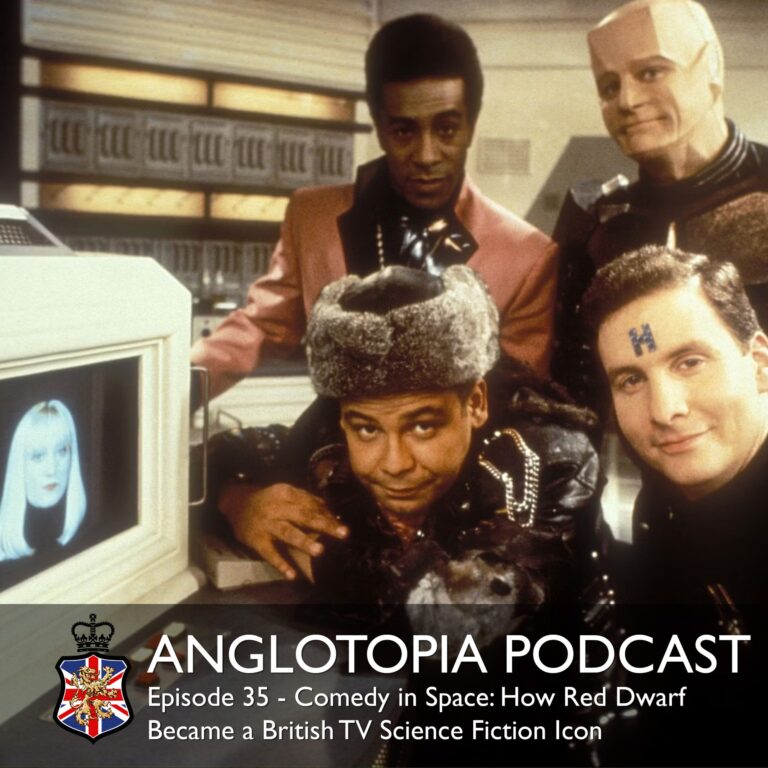
In 1988, the BBC premiered an unlikely science fiction sitcom about the last human alive, his holographic bunkmate, a senile computer, and a creature evolved from a cat. Against all odds, Red Dwarf became one of the most beloved British shows of its era—and it’s still being made over 35 years later.
In this episode of the Anglotopia Podcast, host Jonathan Thomas speaks with author Tom Salinsky, who has written a comprehensive new guide to this cult classic. Their conversation explores how Red Dwarf almost never got made, why it resonated so deeply with audiences, and what makes it endure.
The BBC’s Suspicion of Sci-Fi
The story of Red Dwarf‘s creation reveals as much about the BBC as about the show itself. The Corporation, Tom explains, harbored a deep suspicion of science fiction, viewing it as expensive, niche, and fundamentally uncommercial.
Writers Rob Grant and Doug Naylor had been pitching their sci-fi sitcom concept for years, facing rejection after rejection. They’d built successful careers on sketch shows like Spitting Image, but their dream project kept hitting walls.
The breakthrough came through a quirk of BBC accounting. Another show had been cancelled, but budget allocation for a follow-up series remained in the system. A sympathetic producer redirected those funds to Red Dwarf, essentially sneaking the show past the Corporation’s sci-fi skepticism.
This accidental origin story sets the tone for a show that never quite fit the mould—too science fiction for comedy commissioners, too comedic for sci-fi fans, and yet somehow perfect for both audiences.
Truckers in Space
Red Dwarf‘s premise drew inspiration from an unexpected source: the 1974 film Dark Star, a deliberately low-budget sci-fi comedy about working-class astronauts. That film’s “truckers in space” aesthetic influenced both Red Dwarf and, through writer Dan O’Bannon, Alien.
Grant and Naylor wanted characters at the bottom of the totem pole—not captains or commanders, but the guy who refills the vending machines. Dave Lister is explicitly the lowest-ranked crew member on Red Dwarf, a man whose highest ambition is to own a farm on Fiji and do nothing.
His forced companion, Arnold Rimmer, represents a different kind of failure: a petty bureaucrat obsessed with rank and regulation, whose death in the accident that killed the rest of the crew was entirely his own fault. Making him a hologram—visible but intangible—added metaphorical weight to his impotence.
The cat, evolved from Lister’s pet over three million years, and Holly, the ship’s computer driven somewhat mad by millennia alone, completed a foursome of misfits whose interpersonal dynamics could generate infinite comedy.
The Two-Men-Who-Hate-Each-Other Formula
Tom places Red Dwarf within a specifically British sitcom tradition: two men trapped together, unable to escape each other, generating comedy from their friction. Steptoe and Son, Porridge, Rising Damp—all follow this pattern.
The science fiction setting simply extended the trap. Rimmer and Lister can’t walk away from each other. They’re three million years from Earth, the only sapient beings in their corner of the universe. Their mutual antagonism must somehow become coexistence.
This character-driven approach distinguished Red Dwarf from American sci-fi comedy. The show wasn’t Star Trek with jokes; it was a sitcom that happened to be set on a spaceship. The best episodes, Tom argues, are those that dig deepest into character rather than relying on sci-fi spectacle.
Alternative Comedy’s Influence
Red Dwarf emerged during British comedy’s alternative comedy revolution. Performers like Rik Mayall, Adrian Edmondson, French and Saunders, and Ben Elton were creating a new wave that rejected the cozy, establishment comedy of previous generations.
The show shared DNA with this movement—slightly anarchic, occasionally dark, willing to undercut sentiment with absurdity. Yet it also drew from older traditions, creating a hybrid that appealed across comedy tribes.
Tom notes that Red Dwarf created its own subculture precisely because it occupied this unusual territory. Science fiction fans starved of British content adopted it. Comedy fans appreciated its wit. And the combination of both elements created something neither group could get elsewhere.
The Remarkable Longevity
Perhaps Red Dwarf‘s most remarkable achievement is its survival. The same core cast—Craig Charles, Chris Barrie, Danny John-Jules, and Robert Llewellyn (who joined in Series 3)—continues to make the show over three decades later.
After the BBC era ended, the digital channel Dave revived the series, producing new episodes that achieved remarkable ratings for a niche channel. The cast’s chemistry, Tom suggests, remains the secret sauce. These actors grew into their characters, and the characters evolved with them.
The show’s consistency contrasts with other long-running sitcoms. My Family produced hundreds of essentially identical episodes. Last of the Summer Wine cycled through casts as actors aged and died. Red Dwarf has maintained both continuity and development, an unusual combination in British television.
Behind the Scenes
Tom’s research uncovered details no previous book has documented. Original ratings data from the BBC archives. Draft scripts showing how episodes evolved. The real reasons for various production decisions.
One revelation: the first episode was substantially reshot after initial recording proved unsatisfactory. The version we know was the product of significant revision—a pattern that would continue throughout the show’s history.
The DVD releases, with their multiple commentary tracks and alternative versions, have made Red Dwarf unusually well-documented. Tom watched episodes in multiple versions, comparing broadcast, remastered, and original recordings. For at least one episode, he estimates he watched six distinct versions.
The Failed American Remake
Like many British hits, Red Dwarf attracted American remake interest. A pilot was produced with almost entirely different cast—only Robert Llewellyn reprised his role as Kryten.
The results, Tom reports, were not successful. The producers didn’t understand what made the Lister-Rimmer dynamic work. The American version softened their antagonism, removing the friction that generated the comedy.
This failure illustrates a broader pattern in British-to-American adaptations. Success comes when American productions take the premise and make it genuinely their own, as The Office did. Failure comes when they try to copy the surface while missing the underlying mechanics.
British Comedy’s Global Appeal
Why does British comedy travel so well? Tom suggests the answer lies in understatement and ambiguity. American comedy, generalized broadly, tends to explain its jokes. British comedy often leaves the punchline implicit, expecting audiences to work slightly for it.
For American Anglophiles, this style offers something unavailable in domestic productions. The wit feels sharper, the humor more sophisticated—even when, objectively, it’s about a man evolved from a cat chasing shiny things.
Red Dwarf benefits additionally from its Britishness being exotic. Where American audiences take American culture for granted, British culture provides novelty. The accents, the attitudes, the references all add a layer of interest that domestic sci-fi can’t match.
The Future of Red Dwarf
With the creative partnership between Grant and Naylor legally resolved after years of litigation, the future looks brighter than it has in years. New episodes are planned, and the cast has expressed willingness to continue.
Tom hopes any new material maintains the character focus that defines the show’s best work. Fan service and nostalgia have their place, but Red Dwarf endures because we care about these four idiots stuck together in the vastness of space.
—
Want to learn more about this beloved British sci-fi comedy? Listen to the full episode of the Anglotopia Podcast wherever you get your podcasts.

The Anglotopia Podcast is your deep dive into the rich and diverse world of British culture, hosted by Jonathan and Jacqueline Thomas, publishers of Anglotopia.net and Londontopia.net. Each episode takes you on a journey through iconic British television, captivating historical events, and essential travel tips, ensuring you experience the very best of the British Isles. Our engaging discussions feature important British guests and authors, covering everything from the latest trends and timeless traditions to hidden gems and popular landmarks. Whether you’re a passionate Anglophile or simply curious about the UK, our podcast offers a delightful mix of insights and entertainment. Join us as we celebrate the charm, heritage, and unique allure of Britain, making every episode a must-listen for anyone who loves all things British.
This week on the Anglotopia Podcast, we interview author and podcaster Tom Salinsky and explore his new book Red Dwarf: Discovering the TV Series, a deep dive into the beloved British sci-fi sitcom Red Dwarf. Tom discusses his inspiration for the book, covering every episode, and how the BBC’s skepticism of sci-fi made Red Dwarf an underdog that grew into a cult classic. The interview touches on the show’s humor, its influence on British TV, and the challenges of chronicling decades of content, from broadcast to remastered versions. Join us for a fun discussion about British TV comedy and science fiction.
Links
- Red Dwarf: Discovering the TV Series: Volume I: 1988-1993
- Red Dwarf on BritBox
- Tom Salinsky
- The Best Pick Movie Podcast
Takeaways
- Origins of Red Dwarf: The BBC was hesitant about a sci-fi sitcom, but Red Dwarf emerged due to a quirk in budget allocation, allowing it to become a cult hit despite early obstacles.
- Unique Format: The series capitalized on the British sitcom format, combining science fiction with the traditional “two men who hate each other but can’t leave” dynamic, popular in shows like Porridge.
- Character Chemistry: The show’s enduring appeal lies in the chemistry between the characters, especially Lister and Rimmer, whose opposing personalities anchor the narrative.
- Cultural Legacy: Red Dwarf influenced later sci-fi comedies, despite the BBC’s general disdain for the genre. Its longevity and ability to adapt over decades have cemented its place in British television history.
- Behind-the-Scenes Insights: Tom’s research uncovered original ratings, unbroadcast scenes, and unused scripts that reveal new aspects of the show’s creation.
Sound Bites
- On Red Dwarf’s Origins: “Red Dwarf almost didn’t happen—it snuck past the BBC’s deep suspicion of science fiction, thanks to a bizarre quirk in their accounting.”
- On the Show’s Characters: “You’ve got two losers—one content with his lot, one frustrated and hating himself—and that dynamic has kept the show fresh through 70 episodes.”
- On Revisiting Every Episode: “For the first episode, I watched the broadcast version, remastered version, DVD extras, and multiple commentaries… I think I know that episode pretty well by now.”
- On the Show’s Longevity: “The consistency of the cast is one of the things that’s kept Red Dwarf going. It’s amazing to see how stable the chemistry has been after all these years.”
- On British vs. American Comedy: “In America, sitcoms tend to start with a problem and end with a resolution. In Britain, sitcoms often begin with an aspiration and end with dashed hopes.”
Chapters
00:00 Introduction to Red Dwarf and Its Cultural Impact 02:45 The Journey of Writing the Book 05:48 The Backstory of Red Dwarf’s Creation 08:48 The Evolution of Red Dwarf’s Popularity 11:32 Behind the Scenes: Fun Facts and Mishaps 14:27 Challenges in Analyzing Red Dwarf 17:29 The Cult Following of Red Dwarf 20:36 Red Dwarf’s Longevity and Comparison to Other Sitcoms 23:32 Character Dynamics: Rimmer and Lister 26:17 Humor and Storytelling in Red Dwarf vs. Star Trek 29:14 Expectations for Future Red Dwarf Episodes 32:16 Tom Salinsky’s Future Projects 35:03 The International Appeal of British TV 38:06 The American Remake of Red Dwarf 41:04 Recommendations for Other British Comedies
Video Version

Free Podcast Newsletter
Subscribe to our special podcast newsletter below and never miss the latest episode of the Anglotopia Podcast.